Results by title
4 books match the query 'Guha, Ranajit'

A Rule of Property for Bengal
An Essay on the Idea of Permanent SettlementRanajit Guha
Duke University Press, 1996
By proclaiming the Permanent Settlement in 1793, the British hoped to promote a prosperous capitalist agriculture of the kind that had developed in England. The act renounced for all time the state’s right to raise the assessment already made upon landowners and thus sought to establish a system of property that was, in the British view, necessary for the creation of a stable government. Guha traces the origins of the Permanent Settlement to the anti-feudal ideas of Phillip Francis and the critique of feudalism provided by physiocratic thought, the precursor of political economy. The central question the book asks is how the Permanent Settlement, founded in anti-feudalism and grafted onto India by the most advanced capitalist power of the day became instrumental in the development of a neo-feudal organization of landed property and in the absorption and reproduction of precapitalist elements in a colonial regime.
Guha’s examination of the British attempt to mold Bengal to the contours of its own society without an understanding of the traditions and obligations upon which the Indian agrarian system was based is a truly pioneering work. The implications of A Rule of Property for Bengal remain rich for the current discussions from the postcolonialist perspective on the meaning of modernity and enlightenment.
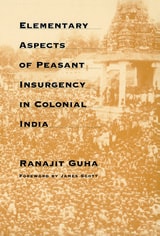
Elementary Aspects of Peasant Insurgency in Colonial India
Ranajit Guha
Duke University Press, 1999
This classic work in subaltern studies explores the common elements present in rebel consciousness during the Indian colonial period. Ranajit Guha—intellectual founder of the groundbreaking and influential Subaltern Studies Group—describes from the peasants’ viewpoint the relations of dominance and subordination in rural India from 1783 to 1900.
Challenging the idea that peasants were powerless agents who rebelled blindly against British imperialist oppression and local landlord exploitation, Guha emphasizes their awareness and will to effect political change. He suggests that the rebellions represented the birth of a theoretical consciousness and asserts that India’s long subaltern tradition lent power to the landmark insurgence led by Mahatma Gandhi. Yet as long as landlord authority remains dominant in a ruling culture, Guha claims, all mass struggles will tend to model themselves after the unfinished projects documented in this book.
Students and scholars will welcome this paperback edition of Guha’s 1983 original, which was distributed on a limited scale in the United States. It will influence new generations studying colonialism, postcolonialism, subaltern studies, historiography, anthropology, and Indian, Asian, and Latin American history.
Subaltern Studies Reader, 1986-1995
Ranajit Guha
University of Minnesota Press, 1997

The Latin American Subaltern Studies Reader
Ileana Rodríguez, ed.
Duke University Press, 2001
In addition to an overview by Ranajit Guha, essay topics include nineteenth-century hygiene in Latin American countries, Rigoberta Menchú after the Nobel, commentaries on Haitian and Argentinian issues, the relationship between gender and race in Bolivia, and ungovernability and tragedy in Peru. Providing a radical critique of elite culture and of liberal, bourgeois, and modern epistemologies and projects, the essays included here prove that Latin American Subaltern Studies is much more than the mere translation of subaltern studies from South Asia to Latin America.
Contributors. Marcelo Bergman, John Beverley, Robert Carr, Sara Castro-Klarén, Michael Clark, Beatriz González Stephan, Ranajit Guha, María Milagros López , Walter Mignolo, Alberto Moreiras, Abdul-Karim Mustapha, José Rabasa, Ileana Rodríguez, Josefina Saldaña-Portillo, Javier Sanjinés, C. Patricia Seed, Doris Sommer, Marcia Stephenson, Mónica Szurmuk, Gareth Williams, Marc Zimmerman