Results by title

5 books match the query 'Gulag'
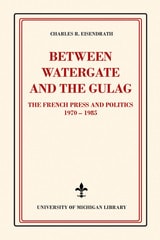
cover of Between Watergate and the Gulag: The French Press and Politics, 1970–1985

Between Watergate and the Gulag

The French Press and Politics, 1970–1985

Charles R. Eisendrath

Michigan Publishing Services, 2022

This book analyzes the relationship of the French press to political power. The bedrock concept of “innocent until proven guilty” is reversed for French journalists in libel cases; they enter courtrooms presumed guilty. Royal holdovers live on: Louis XIV’S system of indirect control through revocable favors persists in the form of state financial aid to the press.  The weekly Le Canard Enchaîné is a journalistic court jester that plays the same role as the fops at Versailles, telling truth to power in joke form on topics that “serious” journals avoid.

Also introduced: “surplus freedom” a novel approach for gauging self-censorship by comparing the degree of free expression a legal system permits to what publications actually exercise.
[more]
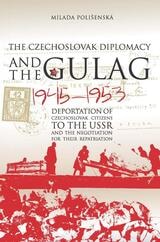
cover of Czechoslovak Diplomacy and the Gulag: Deportation of Czechoslovak Citizens to the USSR and the Negotiation for their Repatriation, 1945-1953

Czechoslovak Diplomacy and the Gulag

Deportation of Czechoslovak Citizens to the USSR and the Negotiation for their Repatriation, 1945-1953

Milada Polisenská

Central European University Press, 2016
After the entry of the Red Army into Czechoslovak territory in 1945, Red Army authorities began to arrest and deport Czechoslovak citizens to labor camps in the Soviet Union. The regions most affected were Eastern and South Slovakia and Prague. The Czechoslovak authorities repeatedly requested a halt to the deportations and that the deported Czechoslovaks be returned immediately. It took a long time before these protests generated any response. Czechoslovak Diplomacy and the Gulag focuses on the diplomatic and political aspects of the deportations. The author explains the steps taken by the Czechoslovak Government in the repatriation agenda from 1945 to 1953 and reconstructs the negotiations with the Soviets. The research tries to answer the question of why and how the Russians deported the civilian population from Czechoslovakia which was their allied country already during the war. Key words: 1. World War, 1939–1945—Deportations from Czechoslovakia. 2. Forced labor—Soviet Union—History. 3. Labor camps—Soviet Union—History. 4. Czechs—Soviet Union—History. 5. Slovaks—Soviet Union—History. 6. Czechoslovakia—Foreign relations—Soviet Union. 7. Soviet Union—Foreign relations—Czechoslovakia. 8. Czechoslovakia—Foreign relations—1945–1992. 9. Repatriation—Czechoslovakia—History.
[more]
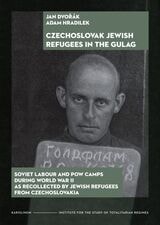
cover of Czechoslovak Jewish Refugees in the Gulag: Soviet Labour and POW Camps during World War II as Recollected by Jewish Refugees from Czechoslovakia

Czechoslovak Jewish Refugees in the Gulag

Soviet Labour and POW Camps during World War II as Recollected by Jewish Refugees from Czechoslovakia

Jan Dvorák and Adam Hradilek

Karolinum Press, 2025

Containing meticulous research of a long under-represented part of the Holocaust, this book provides a rich pictorial documentation of the Gulag environment as told by Jewish refugees.

While millions of Soviet slaves awaited liberation from the Nazi troops, millions of German concentration camp victims put their last bit of hope in the Red Army.

An in-depth look into the Soviet persecution of Jewish refugees, this book offers twenty-one different interviews with Czechoslovak Jewish refugees who found themselves in Soviet labor and prison camps between 1939 and 1941. They represent around two thousand Czechoslovak Jews who escaped persecution from German and Hungarian occupational forces and Slovak fascists by fleeing to the East. The Soviets sentenced most of them to long stints of forced labor in the Gulags for illegal immigration, espionage, and other arbitrary accusations. A specific group was formed by the Jews from the Hungarian labor service who either defected to or were captured by the Soviets.

Dvořák and Hradilek chronicle four waves of escape—those from the Protectorate of Bohemia and Moravia, the Nisko concentration camp, Carpathian Ruthenia, and the aforementioned labor service. Thorough and clear, every interview coincides with supplementary documents and photographs found in the NKVD archives, sourced from Ukraine.
[more]
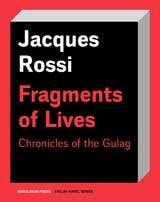
cover of Fragments of Lives: Chronicles of the Gulag

Fragments of Lives

Chronicles of the Gulag

Jacques Rossi

Karolinum Press, 2018

In Fragments of Lives, Gulag survivor Jacques Rossi opens a window onto everyday life inside the notorious Soviet prison camp through a series of portraits of inmates and camp personnel across all walks of life—from workers to peasants, soldiers, civil servants, and party apparatchiks. Featuring Rossi’s original illustrations and written in a tone as sharp and dry as that of Russian writer Varlam Shalamov, Rossi’s vignettes are also filled with surprising humor. A former agent in the Spanish Civil War and a lifelong Communist, Rossi never considered himself a victim. Instead, in the manner of Primo Levi, Solzhenitsyn, and Margaret Buber-Neumann, he sought to share and transmute his experience within the living hell of the Gulag. In so doing, he gives voice to the inmates whose lives were shattered by one of the most corrupt and repressive regimes of the twentieth century.

An impassioned reminder to always question one’s beliefs, to have the courage to give up one’s illusions at the risk of one’s life, Fragments of Lives lays bare, with acute observations and biting wit, the falsity of the Soviet utopia that transformed Rossi’s home into a “huge Potemkin village, a farcical sham dissimulating oceans of mud and blood.”
[more]
cover of Voices from the Gulag

Voices from the Gulag

Aleksandr Solzhenitsyn

Northwestern University Press, 2010

After the publication in 1962 of One Day in the Life of Ivan Denisovich, Aleksandr Solzhenitsyn began receiving, and would continue to receive throughout his life, testimonies from fellow survivors of the gulag. Originally selected by Solzhenitsyn, the memoirs in this volume are an important addition to the literature of the Soviet gulag. Written by men from a wide variety of occupations and social classes, the writing in Voices from the Gulag lends a voice to the many ordinary people—including a circus performer, a teenage boy, and a Red Army soldier—whom a brutal system attempted to erase from memory.

[more]