Results by title
5 books match the query 'Gunn, Joshua'
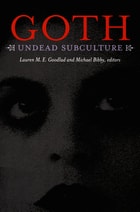
Goth
Undead SubcultureLauren M. E. Goodlad and Michael Bibby, eds.
Duke University Press, 2007
The volume’s editors provide a rich history of goth, describing its play of resistance and consumerism; its impact on class, race, and gender; and its distinctive features as an “undead” subculture in light of post-subculture studies and other critical approaches. The essays include an interview with the distinguished fashion historian Valerie Steele; analyses of novels by Anne Rice, Poppy Z. Brite, and Nick Cave; discussions of goths on the Internet; and readings of iconic goth texts from Bram Stoker’s Dracula to James O’Barr’s graphic novel The Crow. Other essays focus on gothic music, including seminal precursors such as Joy Division and David Bowie, and goth-influenced performers such as the Cure, Nine Inch Nails, and Marilyn Manson. Gothic sexuality is explored in multiple ways, the subjects ranging from the San Francisco queercore scene of the 1980s to the increasing influence of fetishism and fetish play. Together these essays demonstrate that while its participants are often middle-class suburbanites, goth blurs normalizing boundaries even as it appears as an everlasting shadow of late capitalism.
Contributors: Heather Arnet, Michael Bibby, Jessica Burstein, Angel M. Butts, Michael du Plessis, Jason Friedman, Nancy Gagnier, Ken Gelder, Lauren M. E. Goodlad, Joshua Gunn, Trevor Holmes, Paul Hodkinson, David Lenson, Robert Markley, Mark Nowak, Anna Powell, Kristen Schilt, Rebecca Schraffenberger, David Shumway, Carol Siegel, Catherine Spooner, Lauren Stasiak, Jeffrey Andrew Weinstock

Modern Occult Rhetoric
Mass Media and the Drama of Secrecy in the Twentieth CenturyJoshua Gunn
University of Alabama Press, 2005
Uncovering how secrecy, symbolism, and hidden meanings shape modern culture and communication.
The occult has traditionally been understood as the study of secrets of the practice of mysticism or magic. This book broadens our understanding of the occult by treating it as a rhetorical phenomenon tied to language and symbols and more central to American culture than is commonly assumed.
Joshua Gunn approaches the occult as an idiom, examining the ways in which acts of textual criticism and interpretation are occultic in nature, as evident in practices as diverse as academic scholarship, Freemasonry, and television production. Gunn probes, for instance, the ways in which jargon employed by various social and professional groups creates barriers and fosters secrecy. From the theory wars of cultural studies to the Satanic Panic that swept the national mass media in the late 1980s and early 1990s, Gunn shows how the paradox of a hidden, buried, or secret meaning that cannot be expressed in language appears time and time again in Western culture.
These recurrent patterns, Gunn argues, arise from a generalized, popular anxiety about language and its limitations. Ultimately, Modern Occult Rhetoric demonstrates the indissoluble relationship between language, secrecy, and publicity, and the centrality of suspicion in our daily lives.
Pleasure and Pain in US Public Culture
edited by Christopher J. Gilbert and John Louis Lucaites
University of Alabama Press, 2025
A critical examination of how pleasure and pain are constructed, represented, and contested within American public culture.
Mainstream news and social media often highlight presentations of pain that invite a voyeuristic, pleasurable experience, whether the result of war, disasters, crime, accidents, or other catastrophes. This collection of essays explores pleasurable pains and painful pleasures, showing how they pervade contemporary western public culture.
Deploying methodologies drawn from psychoanalysis, rhetoric and communication, political theory, and visual culture, Pleasure and Pain in US Public Culture offers insightful criticisms and theories about how pleasure and pain function in public discourse, media, and everyday communication practices.
The contributors provide a sample of fascinating range of news reportage, television, film and cinema, stage drama, comic performances, street art, and other forms of popular culture. The media cited and analyzed include Spike Lee’s films, Afrofuturism, autoethnography, and the #MeToo movement.
The collection takes up engrossing topics such as the cathartic allure of pain, ethical dilemmas surrounding public displays of suffering, and the transformative power of narratives that confront trauma. The essays also draw connections between theory and real-world outcomes, explore the implications of enjoying traumatic comedy, and link the natural world to otherwise mundane instances of interspecies violence. Brett Kavanaugh's Supreme Court nomination hearings and what they suggest about witnessing trauma is also discussed.
Pleasure and Pain in US Public Culture will change how a reader sees the world. It imparts a startling vision of western culture permeated by pain and pleasure.
Political Perversion
Rhetorical Aberration in the Time of TrumpeteeringJoshua Gunn
University of Chicago Press, 2020
Drawing on insights from critical theory, media ecology, and psychoanalysis, Gunn argues that perverse rhetorics dominate not only the political sphere but also our daily interactions with others, in person and online. From sexting to campaign rhetoric, Gunn advances a new way to interpret our contemporary political context that explains why so many of us have difficulty deciphering the appeal of aberrant public figures. In this book, Trump is only the tip of a sinister, rapidly growing iceberg, one to which we ourselves unwittingly contribute on a daily basis.
Public Modalities
Edited by Daniel C. Brouwer and Robert Asen
University of Alabama Press, 2010
A bold rethinking of public discourse, Public Modalities explores how people shape civic life through protest, media, and identity in an ever-evolving public sphere.
This book explores the ways that scholars, journalists, politicians, and citizens conceive of “the public” or “public life,” and how those entities are defined and invented. For decades, scholars have used the metaphors of spheres, systems, webs, or networks to talk about, describe, and map various practices. This volume proposes a new metaphor—modalities—to suggest that publics are forever in flux, and much more fluid and dynamic than the static models of systems or spheres would indicate—especially in the digital age, where various publics rapidly evolve and dissipate.
Contributors to the volume—employing approaches from the fields of communication studies, English, sociology, psychology, and history—explore a broad range of texts and artifacts that give rise to publics, and discuss what they reveal about conceptualizations of social space. By focusing on process in public engagement, these scholars highlight questions of how people advance their interests and identities, and how they adapt to situational constraints.
Bringing together scholars in rhetorical, cultural, and media studies, this collection of new case studies illustrates a modalities approach to the study of publics. These case studies explore the implications of different ways of forming publics, including alternative means of expression (protests, culture jamming); the intersection of politics and consumerism (how people express their identities and interests through their consumer behavior); and online engagement (blogs as increasingly important public fora). In doing so, they raise important questions of access, community, and political efficacy