Results by title
4 books match the query 'Gunn, Thom'
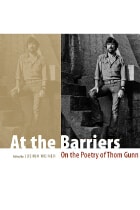
At the Barriers
On the Poetry of Thom GunnEdited by Joshua Weiner
University of Chicago Press, 2009
Maverick gay poetic icon Thom Gunn (1929–2004) and his body of work have long dared the British and American poetry establishments either to claim or disavow him. To critics in the UK and US alike, Gunn demonstrated that formal poetry could successfully include new speech rhythms and open forms and that experimental styles could still maintain technical and intellectual rigor. Along the way, Gunn’s verse captured the social upheavals of the 1960s, the existential possibilities of the late twentieth century, and the tumult of post-Stonewall gay culture.
The first book-length study of this major poet, At the Barriers surveys Gunn’s career from his youth in 1930s Britain to his final years in California, from his earliest publications to his later unpublished notebooks, bringing together some of the most important poet-critics from both sides of the Atlantic to assess his oeuvre. This landmark volume traces how Gunn, in both his life and his writings, pushed at boundaries of different kinds, be they geographic, sexual, or poetic. At the Barriers will solidify Gunn’s rightful place in the pantheon of Anglo-American letters.
Shelf Life
Essays, Memoirs, and an InterviewThom Gunn
University of Michigan Press, 1993
Gunn’s criticism communicates his own enthusiasm for poetry. He tries to show his readers how to get a first foothold into the work of some of his favorite poets, whether Wyatt or Whitman, Mina Loy or Robert Creeley.
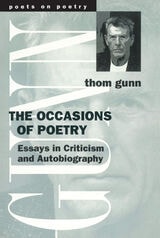
The Occasions of Poetry
Essays in Criticism and AutobiographyThom Gunn
University of Michigan Press, 1999
Thom Gunn is well-known as a poet, and increasingly as a literary critic. The Occasions of Poetry includes insightful critical pieces on writers ranging from William Carlos Williams and Gary Snyder to Thomas Hardy and Robert Duncan. "The occasion in all cases," writes Gunn, "is the starting point, only, of a poem, but it should be a starting point to which the poet must in some sense stay true." The first loyalty of a writer who is "true to his occasions," he writes, must be to the facts of experience.
The book includes five autobiographical essays, which combine to form an engaging account of the author's development as a poet and to chronicle some of the most significant literary currents of recent decades, both in England and America.
Thom Gunn, born in England in 1929, has lived in America since 1954. His books include Shelf Life: Essays, Memoirs, and an Interview; The Man with Night Sweats; Collected Poems; and The Passages of Joy. The Occasions of Poetry was originally published by Faber and Faber.
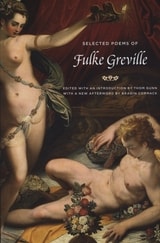
The Selected Poems of Fulke Greville
Fulke Greville
University of Chicago Press, 2009
Along with his childhood friend Sir Philip Sidney, Fulke Greville (1554–1628) was an important member of the court of Queen Elizabeth I. Although his poems, long out of print, are today less well known than those of Sidney, Spenser, or Shakespeare, Greville left an indelible mark on the world of Renaissance poetry, both in his love poems, which ably work within the English Petrarchan tradition, and in his religious meditations, which, along with the work of Donne and Herbert, stand as a highpoint of early Protestant poetics.
Back in print for a new generation of scholars and readers, Thom Gunn’s selection of Greville’s short poems includes the whole of Greville’s lyric sequence, Caelica, along with choruses from some of Greville’s verse dramas. Gunn’s introduction places Greville’s thought in historical context and in relation to the existential anxieties that came to preoccupy writers in the twentieth century. It is as revealing about Gunn himself, and the reading of earlier English verse in the 1960s, as it is about Greville’s own poetic achievement. This reissue of Selected Poems of Fulke Greville is an event of the first order both for students of early British literature and for readers of Thom Gunn and English poetry generally.