Results by title
6 books match the query 'Gurus'
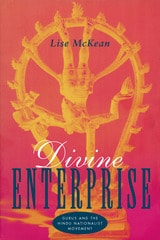
Divine Enterprise
Gurus and the Hindu Nationalist MovementLise McKean
University of Chicago Press, 1996
In this close look at the business of religion, McKean traces the ideological and organizational antecedents to the Hindu nationalist movement. The Indian state's increasing patronage of Hindu institutions makes competition for its support greater than ever. Using materials from guru's publications, the press, and extensive field research, McKean examines how participation by upper-caste ruling class groups in the Divine Life Society and other Hindu organizations further legitimates their own authority.
With a remarkable selection of photographs and advertisements showing icons of spirituality used to sell commodities from textiles to cement to comic books, McKean illustrates the pervasive presence of Hindu imagery in India's burgeoning market economy. She shows how gurus popularize Hindu nationalism through imagery such as the goddess, Mother India, and her martyred sons and daughters.

Gurus and Media
Sound, Image, Machine, Text and the DigitalEdited by Jacob Copeman, Arkotong Longkumer, and Koonal Duggal
University College London, 2023
Illuminating the mediatization of guruship and the guruization of media, this book bridges the gap between scholarship on gurus and the disciplines of media and visual culture studies. It investigates guru iconographies in and across various time periods and also the distinctive ways in which diverse gurus engage with and inhabit different forms of media: statuary, games, print publications, photographs, portraiture, films, machines, social media, bodies, words, graffiti, dolls, sound, verse, tombs, and more.
The book’s interdisciplinary chapters advance, both conceptually and ethnographically, our understanding of the function of media in the dramatic production of guruship and reflect on the corporate branding of gurus and on mediated guruship as a series of aesthetic traps for the captivation of devotees and others. They show how different media can further enliven the complex plurality of guruship, for instance in instantiating notions of “absent-present” guruship and demonstrating the mutual mediation of gurus, caste, and Hindutva.
Gurus and Media foregrounds contested visions of the guru in the development of devotional publics and pluriform guruship across time and space. Thinking through the guru’s many media entanglements in a single place, this book contributes new insights to the study of South Asian religions and to the study of mediation more broadly.

Gurus, Hucksters, Entertainers
How Influencers Reshaped Social MediaAngèle Christin
University of Chicago Press, 2026
An illuminating investigation of the complex work of social media content creators—their lives, conflicts, and controversies.
In this eye-opening book, digital studies scholar Angèle Christin demystifies the content creator economy, explaining its long history and the pitfalls of its professionalization. Drawing on in-depth fieldwork with digital creators as varied as vegan YouTubers, dads of Instagram, and self-described drama commentators, Christin shows how individuals enter social media creation, how they make money, and how their online environments shape their content.
Aspiring creators often dream of a better life in social media careers. Yet these dreams soon turn into exhaustion as influencers try to meet the contradictory demands of platforms, brands, and audiences. Over time, Christin shows, creators cluster into three types: hucksters, who work on behalf of brands; entertainers, who chase virality and platform payments; and gurus, who monetize the loyalty of their fans. Platform dynamics push entertainers and gurus to create extreme and incendiary content to maintain audience engagement, while brands and marketers nudge hucksters toward repetitive, staid commercial performances. Concerns about algorithmic manipulation and conflicts between creators further lead to reputation-damaging, harassment-laden scandals. Christin reveals how platform labor repeatedly—and structurally—fosters precarity and inequality, destructive drama, and inflammatory content online.
Osho Rajneesh
Studies in Contemporary ReligionJudith M. Fox
Signature Books, 2002
Highly unorthodox, he courted controversy and was condemned for being a “sex guru.” His Oregon headquarters, Rajneeshpuram, proved to be a short-lived utopia that provoked antagonism and only added to his notoriety. But his ashram in Poona, India, continues to thrive, as do Osho centers in Europe and elsewhere. His adherents number in the thousands. His books have become bestsellers around the globe.
Prophets, Gurus, and Pundits
Rhetorical Styles and Public EngagementAnna M. Young
Southern Illinois University Press, 2014
In Prophets, Gurus, and Pundits, author Anna M. Young proposes that the difficulty of bridging the gap between intellectuals and the public is not a failure of ideas; rather, it is an issue of rhetorical strategy. By laying a rhetorical foundation and presenting analytical case studies of contemporary “public intellectuals,” Young creates a training manual for intellectuals who seek to connect with a public audience and effect change writ large.
Young begins by defining key aspects of rhetorical style before moving on to discuss the specific ways in which intellectuals may present ideas to a general audience in order to tackle large-scale social problems. Next, she defines the ways in which five crucial turning points in our nation—the rise of religious fundamentalism, a growing lack of trust in our institutions, the continued destruction of the environment, the ubiquity of media and information in our daily lives, and the decline of evidence-based reasoning—have set the stage for opportunities in the current public-intellectual dialogue.
Via case studies of such well-known personalities as Deepak Chopra and Professor Cornel West, Young goes on to reveal the six types of public intellectuals who achieve success in presenting scholarly ideas to audiences at large:
The Prophet presents the public’s sins for contemplation, then offers a path to redemption.
The Guru shepherds his or her flock to enlightenment and a higher power.
The Sustainer draws upon our natural and human resources to proffer solutions for social, political, and ecological systems.
The Pundit utilizes wit and brevity to bring crucial issues to the attention of the public.
The Narrator combines a variety of perspectives to create a story the average person can connect with and understand.
The Scientist taps into the dreams of the public to offer ideas from above and beyond the typical scope of public discourse.
At once a rallying cry and roadmap, The Politics of Thinking Out Loud draws upon rhetorical expertise and analysis of contemporary public intellectuals to offer a model for scholars to effectively engage the public—and in doing so, perhaps forever change the world in which we live.
The Analyst and the Mystic
Psychoanalytic Reflections on Religion and MysticismSudhir Kakar
University of Chicago Press, 1992