Results by title
2 books match the query 'Hájková, Dagmar'

National Holidays in Czechoslovakia Between the World Wars
Celebrate the RepublicDagmar Hájková
Central European University Press, 2027
National holidays were among the most ambitious tools the new Czechoslovak state employed in its attempt to forge loyalty among a diverse population after 1918. This volume offers the first comprehensive examination of how ordinary citizens, officials, and political elites alike constructed, contested, and lived the interwar republic's political calendar whose celebrations ranged from Independence Day through the Feast of Saints Cyril and Methodius and Saint Wenceslas, to May Day. Drawing on numerous primary sources, the contributors demonstrate how state-sponsored commemorations sought to translate the political narrative of a unified Czechoslovak nation into everyday ritual, even as they excluded or provoked many of the non-national peoples. The book also analyzes alternative and resistance celebrations that flourished outside, and often against, the official calendar, revealing the limits of Czechoslovak state-building alongside its successes.
[more]
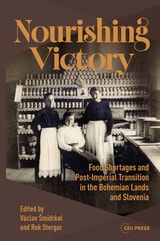
Nourishing Victory
Food Shortages and Post-Imperial Transition in the Bohemian Lands and SloveniaRok Stergar
Central European University Press, 2026
The aggravating food shortage was the central internal crisis in Habsburg Austria during the First World War and posed a major challenge to the consolidation of the successor states. Nourishing Victory offers a fresh comparative perspective on food and the collapse and rebuilding of political legitimacy from the regional vantage point of the Bohemian Lands and Slovenia before and after 1918. Zooming in on multiple levels of society, the book explores how politicians, local officials, and grassroots protagonists navigated collapsing supply systems, relied on black markets, and sought to make sense of the chaos around them. Since this was a crisis of international proportions, the book also examines foreign food aid and the contradictions it entailed. At the same time, to emphasize the local dynamics of food supply and political legitimacy, it explores how food became a political weapon in struggles over contested borderlands such as Teschen Silesia and Prekmurje.
[more]