Results by title
3 books match the query 'Hütter, Reinhard'
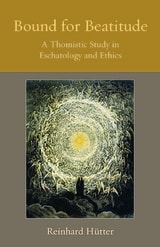
Bound for Beatitude A Thomistic Study in Eschatology and Ethics
Reinhard Hütter
Catholic University of America Press, 2019
Bound for Beatitude is about St. Thomas Aquinas’s theology of beatitude and the journey thereto. Consequently, the work’s topic is the meaning and purpose of human life embedded in that of the whole cosmos. This study is not an antiquarian exercise in the thought of some sundry medieval thinker, but an exercise of ressourcement in the philosophical and theological wisdom of one of the most profound theologians of the Catholic Church, one whom the Church has canonized, granted the title “Doctor of the Church,” and for a long time regarded as the common doctor. This exercise of ressourcement takes its methodological cues from the common doctor; hence, it is an integrated exercise of philosophical, dogmatic, and moral theology. Its specific theological topic, the ultimate human end, perfect happiness, beatitude, and the journey thereto—stands at the very heart of St. Thomas’s theology. Far from being passé, his theology of beatitude is of urgent pertinence as the crisis of humanity and of creation and the exile of God seems to approach its apogee.
By way of a presentation, interpretation, and defense of Thomas Aquinas’s doctrine of beatitude and the journey thereto, Bound for Beatitude advances an argument based on four theses: (1) The loss of a theology of beatitude has greatly impoverished contemporary theology. In order to succeed and flourish, theology must recover a sound teleological orientation. (2) In order to recover a sound teleological orientation, theology must recover metaphysics as its privileged instrument. (3) Thomas Aquinas provides a still pertinent model for how theology might achieve these goals in a metaphysically profound theology of beatitude and the beatific vision. Finally, (4) Aquinas’s rich and sophisticated account of the virtues charts the journey to beatitude in a way that still has analytic force and striking relevance in the early twenty-first century.
[more]
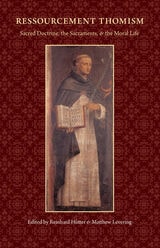
Ressourcement Thomism
Sacred Doctrine, the Sacraments, and the Moral LifeReinhard Hütter
Catholic University of America Press, 2010
The essays in this volume explore three areas in which St. Thomas Aquinas's voice has never fallen silent: sacred doctrine, the relationship of sacraments and metaphysics, and the central role of virtue in moral theology.
[more]

Tradition in Act
Development and Its Counterfeits After NewmanReinhard Hütter
Catholic University of America Press, 2027
Tradition in Act addresses the present crisis over a proper understanding of the development of doctrine in contemporary Catholic theology and thus is a critical as well as constructive theological intervention in arguably the most central controversy in contemporary Catholic theology. The concept of “tradition in act” provides an approach that enables a recovered understanding of the development of doctrine for the theologian, and one that avoids the Scylla of antiquarianism and the Charybdis of presentism. The concept of “tradition in act” (drawing on the distinction between act and potency) is understood as the active undergoing of the continuously unfolding of the History of Salvation in the Church by way of the living paradosis of the doctrina evangelii in the Eucharistic liturgy, the life, and teaching of the Church. If doctrine is to develop at all, it must do so as the unfolding of a revelation once delivered to the apostles and entrusted to the Church as a sacred deposit. Hence it is required that subsequent formulations, however diverse in expression or circumstance, remain one with their antecedents—homogeneous with them, cognate to them in meaning and intention. This necessary continuity is identity. Without such identity, development degenerates into alteration and hence corruption; the line of transmission is broken, and the Church no longer hands on what she has herself received. The unfolding argument utilizes both the work and the approach of John Henry Newman to propose the criteria of identity of doctrine understood in terms of St Vincent of Lerins’ second rule, as presented by Newman, as constitutive of authentic development. The notion of authentic development of doctrine understood in terms of “tradition in act” offers a novel approach that avoids entirely the inherent risks in the historical consciousness of how doctrine has developed, in short, it is meant to offer an antidote to the historicism at large. Tradition in Act assays a contemporary Catholic theological articulation of the development of doctrine in the spirit of Gustav Mahler’s famous statement that “Tradition is not the worship of ashes, but the preservation of fire.”
[more]