Results by title

6 books match the query 'Habermas, Jürgen'
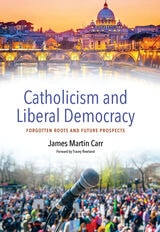
cover of Catholicism and Liberal Democracy: Forgotten Roots and Future Prospects

Catholicism and Liberal Democracy

Forgotten Roots and Future Prospects

James Martin Carr

Catholic University of America Press, 2022

Catholicism and Liberal Democracy seeks to clarify if there is a place for Catholicism in the public discourse of modern liberal democracy, bringing secular liberalism, as articulated by Jürgen Habermas, into conversation with the Catholic tradition. James Martin Carr explores three aspects of the Catholic tradition relevant to this debate: the Church’s response to democracy from the nineteenth century up until the eve of the Second Vatican Council; the Council’s engagement with modernity, in particular through Gaudium et spes and Dignitatis humanae; and Joseph Ratzinger’s theology of politics as a particularly incisive (and influential) articulation of the Catholic tradition in this area. Jürgen Habermas’s theorization of the place of religion in modern democracy, both in his earlier secularist phase and after his ‘post-secular’ turn, is evaluated. The adequacy of Habermas’s recent attempts to accommodate religious citizens are critically examined and it is argued that developments in his later thought logically require a more thoroughgoing revision of his earlier theory. These developments, it is argued, create tantalizing openings for fruitful dialogue between Habermas and the Catholic tradition. Using analytical tools drawn from communications theory, the debates on same-sex marriage at Westminster and in the Irish referendum campaign are analyzed, assessing whether Catholic contributions to these debates comply with Habermasian rules of civic discourse. In light of this analysis, the prospects of, and impediments to, Catholic participation in public discourse are appraised. Carr concludes by proposing a Ratzingerian critique of contemporary attempts to redefine marriage within a broader, more fundamental critique of the modern democratic state as currently configured. A political system founded upon secularist monism cannot but regard Christian Gelasianism, and its Catholic variant in particular, as an existential threat. Thus, Catholics, however Habermasian their political behavior, can never be more than uneasy bedfellows with modern liberal democracy.
[more]
cover of Jurgen Habermas: Democracy and the Public Sphere

Jurgen Habermas

Democracy and the Public Sphere

Luke Goode

Pluto Press, 2005

Habermas is a hugely influential thinker, yet his writing can be dense and inaccessible. This critical introduction offers undergraduates a clear way into Habermas’s concept of the ‘public sphere’ and its relevance to contemporary society. Luke Goode’s lively account also sheds new light on the ‘public sphere’ debate that will interest readers already familiar with Habermas’s work.

For Habermas, the 'public sphere' was a social forum that allowed people to debate -- whether it was the town hall or the coffee house, maintaining a space for public debate was an essential part of democracy. Habermas’s controversial work examines the erosion of these spaces within consumer society and calls for new thinking about democracy today.

Drawing on Habermas’s early and more recent writings, this book examines the ‘public sphere’ in its full complexity, outlining its relevance to today’s media and culture. It will be of interest to students and scholars in a range of disciplines across the social sciences and humanities.

[more]
cover of Kenneth Burke and Contemporary European Thought: Rhetoric in Transition

Kenneth Burke and Contemporary European Thought

Rhetoric in Transition

Bernard L. Brock

University of Alabama Press, 1995

Insights into the problem of our relation to language

Kenneth Burke and Contemporary European Thought: A Rhetoric in Transition reflects the present transitional nature of rhetoric and society. Its purpose is to relate the rhetorical theory of Burke to the theories of four major European philosophers—Jürgen Habermas, Ernesto Grassi, Foucault, and Jacques Derrida—as they discuss the nature of language and its central role in society.
 
This book describes a rhetorical world in transition but not a world in chaos. It points to the centrality of symbolism in theories of language and rhetoric and illustrates Burke’s influence as a pivotal things and theorist in the communication arts and sciences, suggesting that the observations regarding shifting paradigms and perspectives made by other scholars are indeed emergent in the realm of rhetoric. It also regards the powerful impact of language and symbolic action in both the critique and construction of human knowledge and augurs a central role for rhetoric in the intellectual and social transformations of this and the next century.
 
[more]
cover of Philosophy in a Time of Terror: Dialogues with Jurgen Habermas and Jacques Derrida

Philosophy in a Time of Terror

Dialogues with Jurgen Habermas and Jacques Derrida

Giovanna Borradori

University of Chicago Press, 2003
The idea for Philosophy in a Time of Terror was born hours after the attacks on 9/11 and was realized just weeks later when Giovanna Borradori sat down with Jürgen Habermas and Jacques Derrida in New York City, in separate interviews, to evaluate the significance of the most destructive terrorist act ever perpetrated. This book marks an unprecedented encounter between two of the most influential thinkers of our age as here, for the first time, Habermas and Derrida overcome their mutual antagonism and agree to appear side by side. As the two philosophers disassemble and reassemble what we think we know about terrorism, they break from the familiar social and political rhetoric increasingly polarized between good and evil. In this process, we watch two of the greatest intellects of the century at work.
[more]
cover of Sociability and Its Enemies: German Political Theory After 1945

Sociability and Its Enemies

German Political Theory After 1945

Jakob Norberg

Northwestern University Press, 2014

Sociability and Its Enemies contributes both to contemporary studies of political theory and to discourse on postwar Germany by reconstructing the arguments concerning the nature and value of sociability as a form of interaction and interconnection particular to modern bourgeois society. Jakob Norberg argues that the writings of Hannah Arendt, Jürgen Habermas, Carl Schmitt, and the historian Reinhart Koselleck present conflicting responses to a hitherto neglected question or point of contention: whether bourgeois sociability should serve as a therapeutic practice and politically relevant ideal for postwar Germany. The book sheds light on previously neglected historical and conceptual connections among political theorists, and it enriches established narratives of postwar intellectual history.
[more]
cover of The Derrida-Habermas Reader

The Derrida-Habermas Reader

Edited by Lasse Thomassen

University of Chicago Press, 2006

Jacques Derrida and Jürgen Habermas have long represented opposite camps in contemporary thought. Derrida, who pioneered the intellectual style of inquiry known as deconstruction, ushered in the postmodern age with his dramatic critique of reason; Habermas, on the other hand, has consistently argued in defense of reason, modernity, and the legacy of the Enlightenment. Their many differences led to a long-standing, if scattered, dialogue, evidence of which has been available in only bits and pieces. But now, for the first time, TheDerrida-Habermas Reader brings these pieces together, along with a collection of essays documenting the intellectual relationship between two of the twentieth century’s preeminent thinkers. 

Taken together, Derrida and Habermas’s writings—combined here with contributions by other prominent philosophers and social theorists—tell the story of the two thinkers’ provocative engagement with each other’s ideas. Beyond exploring the conflict between Derrida’s deconstruction and Habermas’s communicative rationality, they show how the Derrida-Habermas encounter changed over the years, becoming more theoretically productive without ever collapsing into mutual rejection or simple compromise.

Lasse Thomassen has divided the essays—including works on philosophy and literature, ethics, politics, and international law—into four parts that cover the full range of thought in which Derrida and Habermas engaged. The last of these sections fittingly includes the thinkers’ jointly signed work on European solidarity and the Iraq War, highlighting the hopes they held in common despite their differences. The wide breadth of this book, along with Thomassen’s lucid introductions to each section, makes The Derrida-Habermas Reader an ideal starting point for anyone interested in one of the most dynamic intellectual debates of our time.

[more]