Results by title
4 books match the query 'Habitat (Ecology)'
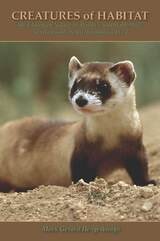
Creatures Of Habitat
The Changing Nature of Wildlife and Wild Places in Utah and the Intermountain WestMark Gerard Hengesbaugh
Utah State University Press, 2001
From flying squirrels on high wooded plateaus to hanging gardens in redrock canyons, the Intermountain West is home to some of the world's rarest and most fascinating animals and plants. Creatures of Habitat details many unique but little-known talents of this region's strange and wonderful wild inhabitants and descibes their connections with native environments. For example, readers will learn about the pronghorn antelope's supercharged cardiovascular system, a brine shrimp-powered shorebird that each year flies nonstop from the Great Salt Lake to Central Argentina, and a rare mustard plant recently discovered on Mount Ogden. Emphasizing how increasing loss and degradation of habitat hinders native species' survival, Mark Gerard Hengesbaugh discusses what is happening to wildlife and wild places and what is being done about it.
Well illustrated, this book has habitat maps, pen-and-ink illustrations, and fifty photos of wildlife and wild places selected by photo editor Dan Miller. Also included are guides to wildlife viewing and lists of Utah species, including those considered sensitive, threatened, or endangered.
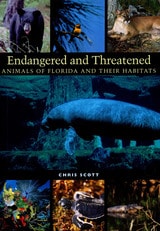
Endangered and Threatened Animals of Florida and Their Habitats
By Chris Scott
University of Texas Press, 2004
A biological crossroads where temperate gives way to tropical and east blends into west, Florida has over twenty-five primary habitat types, several of which are unique to the state. Within these richly varied natural communities lives an astonishing abundance of animals and plants, making Florida one of the United States' most biologically diverse regions. At the same time, sadly, Florida is also one of the country's most ecologically imperiled regions, second only to California in the number of its animals and plants that have been federally designated as endangered or threatened.
This fully illustrated book is a comprehensive, yet convenient and easy-to-understand guide to Florida's endangered and threatened animals and the habitats that support them. Chris Scott covers all 71 species, subspecies, or populations of mammals, birds, reptiles, fish, crustaceans, insects, corals, and mollusks. His species accounts describe each animal's listed status, identifying characteristics, historical and current distribution, biology, current threats, and conservation efforts. To make the crucial link between animals and their habitats, Scott also includes extensive discussions of Florida's natural regions; human impacts on the environment, including habitat destruction, pollution, and the introduction of invasive, nonnative species; and ongoing efforts to conserve and restore native plant and animal communities. With this wealth of information available in no other single volume, everyone who cares about the natural environment can help preserve one of America's biological treasurehouses.
Nevada's Changing Wildlife Habitat
An Ecological HistoryGeorge E. Gruell
University of Nevada Press, 2013
For millennia the ecology of the Great Basin has evolved because of climate change and the impacts of human presence. Nevada’s Changing Wildlife Habitat is the first book to explain the transformations in the plants and animals of this region over time and how they came about. Using data gleaned from archaeological and anthropological studies, numerous historical documents, repeat photography, and several natural sciences, the authors examine changes in vegetation and their impact on wildlife species and the general health of the environment. They also outline the choices that current users and managers of rangelands face in being good stewards of this harsh but fragile environment and its wildlife.
Reimagining a Place for the Wild
Leslie Miller, Louise Excell, and Christopher Smart
University of Utah Press, 2018
Reimagining a Place for the Wild contains a diverse collection of personal stories that describe encounters with the remaining wild creatures of the American West and critical essays that reveal wildlife’s essential place in western landscapes. Gleaned from historians, journalists, biologists, ranchers, artists, philosophers, teachers, and conservationists, these narratives expose the complex challenges faced by wild animals and those devoted to understanding them. Whether discussing keystone species like grizzly bears and gray wolves or microfauna swimming the thermal depths of geysers, these accounts reflect the authors’ expertise as well as their wonder and respect for wild nature. The writers do more than inform our sensibilities; their narratives examine both humanity’s conduct and its capacity for empathy toward other life. A selection of photos and paintings punctuates the volume.
This collection sprang from the Reimagine Western Landscapes Symposium held at the University of Utah’s Taft-Nicholson Environmental Humanities Education Center in Centennial Valley, Montana. These testaments join a chorus of voices seeking improved relations with the western wild in the twenty-first century.