Results by title
3 books match the query 'Hage, Ghassan'

Decay
Ghassan Hage, editor
Duke University Press, 2021
In eleven sharp essays, the contributors to Decay attend to the processes and experiences of symbolic and material decay in a variety of sociopolitical contexts across the globe. They examine decay in its myriad manifestations—biological, physical, organizational, moral, political, personal, and social and in numerous contexts, including colonialism and imperialism, governments and the state, racism, the environment, and infrastructure. The volume's topics are wide in scope, ranging from the discourse of social decay in contemporary Australian settler colonialism and the ways infrastructures both create and experience decay to cultural decay in the aftermath of the Sri Lankan civil war and the relations among individual, institutional, and societal decay in an American high-security prison. By using decay as a problematic and expounding its mechanisms, conditions, and temporalities, the contributors provide nuanced and rigorous means to more fully grapple with the exigencies of the current sociopolitical moment.
Contributors. Cameo Dalley, Peter D. Dwyer, Akhil Gupta, Ghassan Hage, Michael Herzfeld, Elise Klein, Bart Klem, Tamara Kohn, Michael Main, Fabio Mattioli, Debra McDougall, Monica Minnegal, Violeta Schubert
Contributors. Cameo Dalley, Peter D. Dwyer, Akhil Gupta, Ghassan Hage, Michael Herzfeld, Elise Klein, Bart Klem, Tamara Kohn, Michael Main, Fabio Mattioli, Debra McDougall, Monica Minnegal, Violeta Schubert
[more]
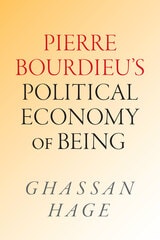
Pierre Bourdieu's Political Economy of Being
Ghassan Hage
Duke University Press, 2025
In Pierre Bourdieu’s Political Economy of Being, Ghassan Hage explores the great French social theorist’s work and revitalizes conventional and undertheorized aspects of his thinking. Hage focuses on Bourdieu’s concern with social being and what constitutes a worthwhile and fulfilling life. Such a life is not something that one either has or does not have; rather, society distributes and assigns values to ways of living. These values are structured by relations of power and domination and are subject to the outcome of political conflicts. Hage elucidates this political economy of being by reworking Bourdieu’s key concepts of habitus, illusio, symbolic capital, and field. In this political economy, people enjoy a worthwhile life to the degree that they are able to orient and deploy themselves practically in the world that surrounds them, have a sense of purpose, and achieve a level of social recognition. For Hage, the project of theorizing and understanding how people struggle to define, legitimize, and live a viable life in the face of symbolic domination permeates all of Bourdieu’s work.
[more]
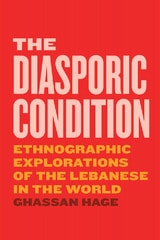
The Diasporic Condition
Ethnographic Explorations of the Lebanese in the WorldGhassan Hage
University of Chicago Press, 2021
Bridging the gap between migration studies and the anthropological tradition, Ghassan Hage illustrates that transnationality and its attendant cultural consequences are not necessarily at odds with classic theory.
In The Diasporic Condition, Ghassan Hage engages with the diasporic Lebanese community as a shared lifeworld, defining a common cultural milieu that transcends spatial and temporal distance—a collective mode of being here termed the “diasporic condition.” Encompassing a complicated transnational terrain, Hage’s long-term ethnography takes us from Mehj and Jalleh in Lebanon to Europe, Australia, South America, and North America, analyzing how Lebanese migrants and their families have established themselves in their new homes while remaining socially, economically, and politically related to Lebanon and to each other.
At the heart of The Diasporic Condition lies a critical anthropological question: How does the study of a particular sociocultural phenomenon expand our knowledge of modes of existing in the world? As Hage establishes what he terms the “lenticular condition,” he breaks down the boundaries between “us” and “them,” “here” and “there,” showing that this convergent mode of existence increasingly defines everyone’s everyday life.
[more]