Results by title
7 books match the query 'Hall, Donald'
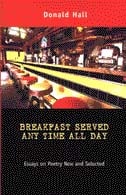
Breakfast Served Any Time All Day
Essays on Poetry New and SelectedDonald Hall
University of Michigan Press, 2004
Praise for Breakfast Served:
". . . the essays in this book are engaging, passionate, strange, and unified. Hall has been around a long time, and you can trace the concerns of a generation through the mind of this one man: questions about the diminished scope of poetry, the diminished ambitions of poets, how a poem 'means,' etc. . . . . Criticism . . . is an exercise in sanity, of which these essays are a splendid and useful example."
-Poetry
"A luminous and essential volume about the sensuality of language, its pleasures and sounds."
-Ploughshares
"It is in this merger of a poet's biography and a poem's body that Hall does his best work. . . . [Breakfast Served Any Time All Day] has an undeniably infectious quality to it. Finishing it, you cannot help but want to return to your bookshelf, and read-again or for the first time-the great forgotten poems of our past."
-Nathan Greenwood Thompson, Rain Taxi
Claims for Poetry
Donald Hall, Editor
University of Michigan Press, 1982
Death to the Death of Poetry
Essays, Reviews, Notes, InterviewsDonald Hall
University of Michigan Press, 1994
Donald Hall believes that American poetry, at the present moment, thrives both in quality and in leadership. In his latest collection of essays, reviews, and interviews, Hall counters the increasingly publicized view that poetry has an ever-diminishing importance in contemporary American culture. He resents the endlessly repeated cliché that finds poetry unpopular and losing popularity. Thus: Death to the Death of Poetry.
Throughout the pages of this latest offering in the Poets on Poetry series, Hall returns again and again to the theme of poetry's health, and offers essays praising contemporary poets, who serve as examples of poetry's thriving condition. In addition, Death to the Death of Poetry collects interviews in which Hall discusses the work of poetry--revisions, standards, the psychology and sociology of the poet's life.
The collection will be warmly received by Donald Hall's large readership, enhanced in 1993 by publication of two exemplary volumes: The Museum of Clear Ideas, his eleventh book of poetry; and his essay Life Work, which brought him both new and returning readers.
Goatfoot Milktongue Twinbird
Interviews, Essays, and Notes on Poetry, 1970-76Donald Hall
University of Michigan Press, 1978
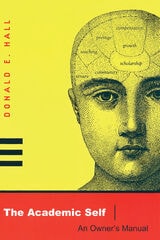
The Academic Self
An Owner’s ManualDonald E. Hall
The Ohio State University Press, 2002
Donald E. Hall offers a self-help book designed for academics, from graduate students to tenured faculty. He helps readers engage in an active process of career management, goal setting, prioritization, and reflection on the norms that constitute what he calls “academic selfhood.” Drawing broadly on the insights of Anthony Giddens’ notions of reflexivity and self-identity, Hall encourages new and seasoned scholars to “own up to” the behaviors, attitudes, and complicities that compromise their professional identities. This book couples all its exhortations with clear, concrete, and practical strategies for responding productively to the many uncertainties of academic life.
Separate chapters of the book examine the textuality of the academic self, profession, academic processes and collegiality. Among the topics candidly discussed are careerism, burnout, procrastination, and insecurity. Throughout the book readers will find anecdotes, real-life examples, and concrete tips for constructing and maintaining a successful career defined on their own terms.
The Academic Self: An Owner’s Manual opens up a new and frank discussion on academic life and academics’ basic responsibility for their own actions and attitudes.
The Weather for Poetry
Essays, Reviews, and Notes on Poetry, 1977-81Donald Hall
University of Michigan Press, 1982
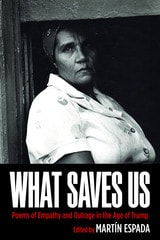
What Saves Us
Poems of Empathy and Outrage in the Age of TrumpEdited by Martín Espada
Northwestern University Press, 2019
This is an anthology of poems in the Age of Trump—and much more than Trump. These are poems that either embody or express a sense of empathy or outrage, both prior to and following his election, since it is empathy the president lacks and outrage he provokes.
There is an extraordinary diversity of voices here. The ninety-three poets featured include Elizabeth Alexander, Julia Alvarez, Richard Blanco, Carolyn Forché, Aracelis Girmay, Donald Hall, Juan Felipe Herrera, Yusef Komunyakaa, Naomi Shihab Nye, Marge Piercy, Robert Pinsky, Danez Smith, Patricia Smith, Brian Turner, Ocean Vuong, Bruce Weigl, and Eleanor Wilner. They speak of persecuted and scapegoated immigrants. They bear witness to violence: police brutality against African Americans, mass shootings in a school or synagogue, the rage inflicted on women everywhere. They testify to poverty: the waitress surviving on leftovers at the restaurant, the battles of a teacher in a shelter for homeless mothers, the emergency-room doctor listening to the heartbeats of his patients. There are voices of labor, in the factory and the fields. There are prophetic voices, imploring us to imagine the world we will leave behind in ruins lest we speak and act.
However, this is not merely a collection of grievances. The poets build bridges. One poet steps up to translate in Arabic at the airport; another walks through the city and sees her immigrant past in the immigrant present; another declaims a musical manifesto after the hurricane that devastated his island; another evokes a demonstration in the street, shouting in an ecstasy of defiance. The poets take back the language, resisting the demagogic corruption of words themselves. They assert our common humanity in the face of dehumanization.