Results by title

5 books match the query 'Hamburg'
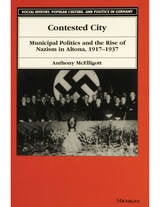
cover of Contested City: Municipal Politics and the Rise of Nazism in Altona, 1917-1937

Contested City

Municipal Politics and the Rise of Nazism in Altona, 1917-1937

Anthony McElligott

University of Michigan Press, 1998

In the wake of the First World War, many Germans saw the future of their nation as contingent on a vision of municipal progress. In this well-researched study, Anthony McElligott uses an analysis of local politics to decipher the fate of the Weimar Republic. Focusing on the industrial city of Altona, McElligott locates his discussion of the contradictions of the Weimar "local state" along two axes--first, persistent financial, policy, and political conflict between the central and the local state and, second, the conflicts within the Weimar local state between the displaced and resentful middle/lower-middle class and the newly enfranchised working class. Social Democrats used their considerable political influence at the level of local government to pursue progressive social policies, local experiments in "practical socialism." Socialist programs, however, alienated middle and lower middle-class voters without guaranteeing the support of all workers, since the dwindling financial resources of local governments made it impossible to extend the benefits of the new social programs to many of the unskilled and poorer sections of the working class. Ultimately, the translation of the democratic republican vision into active policy provoked the conservative push for a reassertion of central authority in the state. McElligott probes beneath the level of formal, local party conflicts to reconstruct the "politics of everyday life" at the street level. This study will be of wide interest to historians and political scientists. Anthony McElligott is Lecturer in Modern History, University of St. Andrews, Scotland.
[more]
cover of Dreamland of Humanists: Warburg, Cassirer, Panofsky, and the Hamburg School

Dreamland of Humanists

Warburg, Cassirer, Panofsky, and the Hamburg School

Emily J. Levine

University of Chicago Press, 2013

Deemed by Heinrich Heine a city of merchants where poets go to die, Hamburg was an improbable setting for a major intellectual movement. Yet it was there, at the end of World War I, at a new university in this commercial center, that a trio of twentieth-century pioneers in the humanities emerged. Working side by side, Aby Warburg, Ernst Cassirer, and Erwin Panofsky developed new avenues in art history, cultural history, and philosophy, changing the course of cultural and intellectual history in Weimar Germany and throughout the world.

In Dreamland of Humanists, Emily J. Levine considers not just these men, but the historical significance of the time and place where their ideas took form. Shedding light on the origins of their work on the Renaissance and the Enlightenment, Levine clarifies the social, political, and economic pressures faced by German-Jewish scholars on the periphery of Germany’s intellectual world. By examining the role that context plays in our analysis of ideas, Levine confirms that great ideas—like great intellectuals—must come from somewhere.
 
[more]
cover of Invisible Walls and To Remember is to Heal: A German Family under the Nuremberg Laws

Invisible Walls and To Remember is to Heal

A German Family under the Nuremberg Laws

Ingeborg Hecht

Northwestern University Press, 1999

Ingeborg Hecht's father, a prosperous Jewish attorney, was divorced from his titled German wife in 1933—two years before the promulgation of the Nuremberg Laws—and so was deprived of what these laws termed "privileged mixed matrimony." He died in Auschwitz. His two children, called "half-Jews," were stripped of their rights, prevented from earning a living, and forbidden to marry.

In Invisible Walls, Hecht writes of what it was like to live under these circumstances, sharing heartbreaking details of her personal life, including the loss of her daughter's father on the Russian front; the death of her own father after his deportation in 1944; and her fears of perishing coupled with the shame of faring better than most of her family and friends. This new volume adds the first translation of part of Hecht's second book, To Remember is to Heal, a collection of vignettes of encounters and experiences that resulted from the publication of the first.

[more]
cover of The Beatles in Hamburg

The Beatles in Hamburg

Ian Inglis

Reaktion Books, 2012

John Lennon, Paul McCartney, George Harrison, and Ringo Starr are four of the most famous names in the history of music. In the 1960s, the Beatles became the bestselling pop band in the world, inspiring legions of fans and developing into popular music icons. Fifty years later, their recordings are still in demand. But none of this happened overnight. As Ian Inglis reveals in this tale of the band’s early years, before they took the world by storm, the Beatles were little more than an inexperienced, semi-professional group of talented musicians in dire need of practice.

Inglis tells the story of the Beatles in Hamburg, Germany, where their agent, Allan Williams, first sent them in August of 1960. In addition to showing how Hamburg itself played a role in the Beatles’ remarkable story, Inglis details the difficulties they faced— unusual performance venues, age restrictions, and deportations—and the experiences and personalities that shaped them as performers and composers. Ultimately, Inglis explains, the Beatles not only became proficient musicians in Hamburg, but while there they began to build the reputation that would eventually make them the most popular band in the world.
 
An illuminating look at the group’s formative years, The Beatles in Hamburg is the perfect book for any one in thrall of Beatlemania or fan of popular music history.
[more]
cover of The End: Hamburg 1943

The End

Hamburg 1943

Hans Erich Nossack

University of Chicago Press, 2004

One didn't dare to inhale for fear of breathing it in. It was the sound of eighteen hundred airplanes approaching Hamburg from the south at an unimaginable height. We had already experienced two hundred or even more air raids, among them some very heavy ones, but this was something completely new. And yet there was an immediate recognition: this was what everyone had been waiting for, what had hung for months like a shadow over everything we did, making us weary. It was the end.

Novelist Hans Erich Nossack was forty-two when the Allied bombardments of German cities began, and he watched the destruction of Hamburg—the city where he was born and where he would later die—from across its Elbe River. He heard the whistle of the bombs and the singing of shrapnel; he watched his neighbors flee; he wondered if his home—and his manuscripts—would survive the devastation. The End is his terse, remarkable memoir of the annihilation of the city, written only three months after the bombing. A searing firsthand account of one of the most notorious events of World War II, The End is also a meditation on war and hope, history and its devastation. And it is the rare book, as W. G. Sebald noted, that describes the Allied bombing campaign from the German perspective.

In the first English-language edition of The End, Nossack's text has been crisply translated by Joel Agee and is accompanied by the photographs of Erich Andres. Poetic, evocative, and yet highly descriptive, The End will prove to be, as Sebald claimed, one of the most important German books on the firebombing of that country.

"A small but critical book, something to read in those quiet moments when we wonder what will happen next."—Susan Salter Reynolds, Los Angeles Times

[more]