Results by title
6 books match the query 'Hammer'
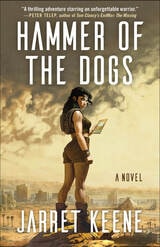
Hammer of the Dogs
A NovelJarret Keene
University of Nevada Press, 2023
A postapocalyptic adventure in Las Vegas for readers of all ages.
Set in the wasteland of post-apocalyptic Las Vegas, Hammer of the Dogs is a literary dystopian adventure filled with high-octane fun starring twenty-one-year-old Lash. With her high-tech skill set and warrior mentality, Lash is a master of her own fate as she helps to shield the Las Vegas valley’s survivors and protect her younger classmates at a paramilitary school holed up in Luxor on the Las Vegas Strip. After graduation, she’ll be alone in fending off the deadly intentions and desires of the school’s most powerful opponents.
When she’s captured by the enemy warlord, she’s surprised by two revelations: He’s not the monster her headmaster wants her to believe and the one thing she can’t safeguard is her own heart. Hammer of the Dogs celebrates the courageousness of a younger generation in the face of authority while exploring the difficult choices a conscionable young woman must make with her back against a blood-spattered wall. It’s a story of transformation and maturity, as Lash grapples with her own identity and redefines the glittering Las Vegas that Nevada is known for.
[more]
Hammer of the Dogs
A NovelJarret Keene
University of Nevada Press, 2023
A postapocalyptic adventure in Las Vegas for readers of all ages.
Set in the wasteland of post-apocalyptic Las Vegas, Hammer of the Dogs is a literary dystopian adventure filled with high-octane fun starring twenty-one-year-old Lash. With her high-tech skill set and warrior mentality, Lash is a master of her own fate as she helps to shield the Las Vegas valley’s survivors and protect her younger classmates at a paramilitary school holed up in Luxor on the Las Vegas Strip. After graduation, she’ll be alone in fending off the deadly intentions and desires of the school’s most powerful opponents.
When she’s captured by the enemy warlord, she’s surprised by two revelations: He’s not the monster her headmaster wants her to believe and the one thing she can’t safeguard is her own heart. Hammer of the Dogs celebrates the courageousness of a younger generation in the face of authority while exploring the difficult choices a conscionable young woman must make with her back against a blood-spattered wall. It’s a story of transformation and maturity, as Lash grapples with her own identity and redefines the glittering Las Vegas that Nevada is known for.
Set in the wasteland of post-apocalyptic Las Vegas, Hammer of the Dogs is a literary dystopian adventure filled with high-octane fun starring twenty-one-year-old Lash. With her high-tech skill set and warrior mentality, Lash is a master of her own fate as she helps to shield the Las Vegas valley’s survivors and protect her younger classmates at a paramilitary school holed up in Luxor on the Las Vegas Strip. After graduation, she’ll be alone in fending off the deadly intentions and desires of the school’s most powerful opponents.
When she’s captured by the enemy warlord, she’s surprised by two revelations: He’s not the monster her headmaster wants her to believe and the one thing she can’t safeguard is her own heart. Hammer of the Dogs celebrates the courageousness of a younger generation in the face of authority while exploring the difficult choices a conscionable young woman must make with her back against a blood-spattered wall. It’s a story of transformation and maturity, as Lash grapples with her own identity and redefines the glittering Las Vegas that Nevada is known for.
[more]
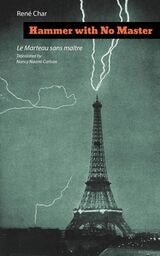
Hammer with No Master
Poems of René Char (French and English Edition)René Char
Tupelo Press, 2016
In his foreword to Stone Lyre, Nancy Naomi Carlson’s previous collection of René Char translations, Ilya Kaminsky praised “the intensity, the dream-like language, the gravity of tone, and the constant impression that one is reading not words in the language, but sparks of flames.”
Stone Lyre was a selection of poems from Char’s numerous volumes of poems; Carlson’s new Hammer with No Master is a discrete and continuous work, the first English translation of Char’s Le marteau sans maître, first published in 1934 — a time of rumbling menace that our time resembles.
Stone Lyre was a selection of poems from Char’s numerous volumes of poems; Carlson’s new Hammer with No Master is a discrete and continuous work, the first English translation of Char’s Le marteau sans maître, first published in 1934 — a time of rumbling menace that our time resembles.
[more]
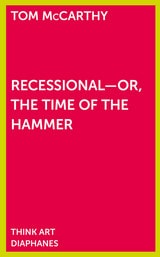
Recessional - Or, the Time of the Hammer
Tom McCarthy
Diaphanes, 2016
Modernist and contemporary literature are marked by a preoccupation with time, specifically with the passage of time characterized by starts and stops and suspended states of waiting. Acclaimed novelist Tom McCarthy brings out a temporal pattern, a subliminal convention of a certain fringe of modernism that works both in and against the canon of modernist literature in works by Thomas Pynchon, J. G. Ballard, Maurice Blanchot, Thomas Mann, Joseph Conrad, James Joyce, and William Faulkner, as well as in McCarthy’s own fiction.
The latest edition in Diaphanes’s THINK ART series, which explores the cultural and theoretical impact of artistic processes, Recessional—Or, the Time of the Hammer opens with an essay by McCarthy on recessional time as an aesthetic element and literary device. This essay is followed by an interview with McCarthy, in which he further discusses his own writing process, taking his most recent novel, Satin Island, as the starting point and casting new light on both avant-garde and realist literature.
Praise for Remainder
“An avant-garde challenge. . . . [McCarthy is] one of the great English novelists of the past ten years.”—Zadie Smith
[more]
Song of the Hammer and Drill
The Colorado San Juans, 1860-1914Duane A. Smith
University Press of Colorado, 2000
As one of the great mining regions of Colorado and the United States, the San Juan Mountains provide insight into the development of both the industry and the state. First published in 1982, Song of the Hammer and Drill, with the help of more than 100 historical photographs, traces the mining and urban history of the San Juans from 1860-1914 through the lives of the people who opened, settled, and developed the beautiful but rugged mineral-rich peaks of southwestern Colorado.
[more]

The Plow, the Hammer, and the Knout
An Economic History of Eighteenth-Century RussiaArcadius Kahan
University of Chicago Press, 1985
In this extraordinary rich and subtle work, Arcadius Kahan analyzes a massive collection of documents which revise traditional interpretations of eighteenth-century Russian economic history. Kahan stresses economic rationality in the context of social constraints, offering the fullest and most convincing explanation yet of the economic foundations of Russia's power. He shows that what have been taken as major failings in the Russian economy were in fact resourceful and even ingenious methods of circumventing deeply rooted structural obstacles to change. Kahan also escapes two extremes that have bedeviled Russian historians since the nineteenth century: he avoids depicting the state as an autonomous structure that acted with impunity upon a passive society, and he refutes the notion of the state as a mere instrument for advancing selfish class interests.
[more]