Results by title
9 books match the query 'Hand'
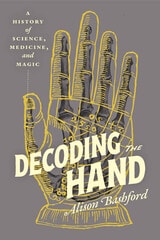
Decoding the Hand
A History of Science, Medicine, and MagicAlison Bashford
University of Chicago Press, 2025
“Delightful.”—Times Literary Supplement • “Intriguing.”—The Sydney Morning Herald • “Fascinating, well-illustrated.”—Nature • “Altogether surprising and hard to categorise.”—London Review of Books • “There are many stories to be told here, and Bashford tells them well.”—Literary Review
The astonishing history of palmistry and biometrics—from occult physicians to the very foundations of modern science and medicine.
Why did Isaac Newton read books on chiromancy, the occult science of hand reading that revealed the secrets of the soul? Why did Charles Darwin claim that the hand gave humans dominion over all other species? Why did psychoanalyst Charlotte Wolff climb into the primate cages of the London Zoo, taking hundreds of delicate palm prints? Why did Francis Galton, the father of fingerprinting, take palm prints too? And why did world-leading geneticists study the geometry of palm lines in their search for the secrets of chromosomal syndromes?
Decoding the Hand is an astounding history of magic, medicine, and science, of an enduring search for how our bodily surfaces might reveal an inner self—a soul, a character, an identity. From sixteenth-century occult physicians influenced by the Kabbalah to twentieth-century geneticists, and from criminologists to eugenicists, award-winning historian Alison Bashford takes us on a remarkable journey into the strange world of hand readers, revealing how signs on the hand—its shape, lines, marks, and patterns—have been elaborately decoded over the centuries. Sometimes learned, sometimes outrageously deceptive, sometimes earnest, and, more often than we ever expected, medically and scientifically trained, these palm readers of the past prove to be essential links in the human quest to peer into bodies, souls, minds, and selves. Not only for fortune-telling palmists were the future and the past, health, and character laid bare in the hand, but for other experts in bodies and minds as well: anatomists, psychiatrists, embryologists, primatologists, evolutionary biologists, geneticists, and more.
Drawing telling parallels between the divination promised by palmistry and the appeal to self-knowledge offered by modern genetic testing, Decoding the Hand also makes clear that palm-reading is far from a relic or simple charlatanism. Bashford’s sagacious history of human hands touching and connecting opens wide the essential human pursuit of what lies within and beyond.
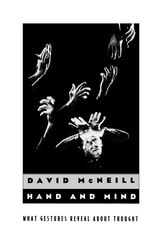
Hand and Mind
What Gestures Reveal about ThoughtDavid McNeill
University of Chicago Press, 1992
Head, Heart, and Hand
John Brown University and Modern Evangelical Higher EducationRick Ostrander
University of Arkansas Press, 2018
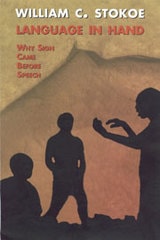
Language in Hand
Why Sign Came Before SpeechWilliam C. Stokoe
Gallaudet University Press, 2001
In Language in Hand: Why Sign Came Before Speech, William C. Stokoe begins his exploration of the origin of human language with a 2400-year-old quote by Democritus: “Everything existing in the universe is the fruit of chance and necessity.” Stokoe capitalizes upon this simple credo in this far-ranging examination of the scholarly topography to support his formula for the development of language in humans: gesture-to-language-to-speech. Intrinsic to this is the proposition that speech is sufficient for language, but not necessary. Chance brought human ancestors down from the trees to the ground, freeing their hands for gesture, and then sign language, a progression that came from the necessity to communicate.
Stokoe recounts in Language in Hand how inspiration grew out of his original discovery in the 1950s and ’60s that deaf people who signed were using a true language with constructions that did not derive from spoken English. This erudite, highly engaging investigation calls upon decades of personal experience and published research to refute the recently entrenched principles that humans have a special, innate learning faculty for language and that speech equates with language. Integrating current findings in linguistics, semiotics, and anthropology, Stokoe fashions a closely-reasoned argument that suggests how our human ancestors’ powers of observation and natural hand movements could have evolved into signed morphemes.
Stokoe also proposes how the primarily gestural expression of language with vocal support shifted to primarily vocal language with gestural accompaniment. When describing this transition, however, he never loses sight of the significance of humans in the natural world and the role of environmental stimuli in the development of language. Stokoe illustrates this contention with fascinating observations of small, contemporary ethnic groups such as the Assiniboin Nakotas, a Native American group from Montana that intermingle their spoken and signed languages depending upon cultural imperatives.
Language in Hand also presents innovative thoughts on classifiers in American Sign Language and their similarity to certain spoken languages, convincing evidence that speech originally copied sign language forms before developing unrelated conventions through usage. Stokoe concludes with a hypothesis on how the acceptance of sign language as the first language of humans could revolutionize the education of infants, both deaf and hearing, who, like early humans, have the full capacity for language without speech.
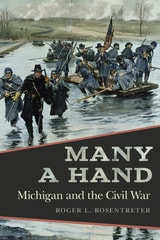
Many a Hand
Michigan and the Civil WarRoger L. Rosentreter
Michigan State University Press, 2026
When war came to the nation in 1861, Michiganians rallied around the Stars and Stripes and readily agreed with a veteran politician who declared, “He who is not for his country is against her.” Even as the conflict grew bloody and costly, they remained committed to suppressing the rebellion. By war’s end, an astonishing 50 percent of its military-age males had enlisted in the army. This Michigan Civil War chronicle is more than a story about soldiers’ heroism on distant battlefields. It also includes the often-overlooked role of women—some of whom refused to stay home and went to war. Also buried in the historical record are accounts of white soldiers whose views on slavery and African Americans, especially those in uniform, were transformed. There is also a much-needed exploration of Michigan’s response to the shocking assassination of a beloved president. Many a Hand captures these stories in a single volume.
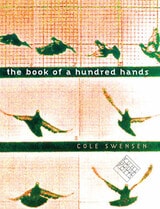
The Book of a Hundred Hands
Cole Swensen
University of Iowa Press, 2005
These short poems reveal the hand from a hundred different perspectives. Incorporating sign language, drawing manuals, paintings from the 14th to the 20th century, shadow puppets, imagined histories, positions (the “hand as a boatless sail”), and professions (“the hand as window in which the panes infinitesimal”), Cole Swensen’s fine hand is “that which augments” our understanding and appreciation of “this freak wing,” this “wheel that comforts none” yet remains “a fruit the size and shape of the heart.”
The Hand Book
Surviving in a Germ-Filled WorldMiryam Z. Wahrman
Brandeis University Press, 2016
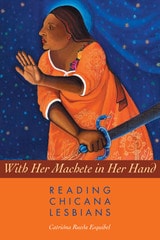
With Her Machete in Her Hand
Reading Chicana LesbiansBy Catrióna Rueda Esquibel
University of Texas Press, 2006
With the 1981 publication of the groundbreaking anthology This Bridge Called My Back: Writings by Radical Women of Color, Cherríe Moraga and Gloria Anzaldúa ushered in an era of Chicana lesbian writing. But while these two writers have achieved iconic status, observers of the Chicana/o experience have been slow to perceive the existence of a whole community—lesbian and straight, male as well as female—who write about the Chicana lesbian experience. To create a first full map of that community, this book explores a wide range of plays, novels, and short stories by Chicana/o authors that depict lesbian characters or lesbian desire.
Catrióna Rueda Esquibel starts from the premise that Chicana/o communities, theories, and feminisms cannot be fully understood without taking account of the perspectives and experiences of Chicana lesbians. To open up these perspectives, she engages in close readings of works centered around the following themes: La Llorona, the Aztec Princess, Sor Juana Inés de la Cruz, girlhood friendships, rural communities and history, and Chicana activism. Her investigation broadens the community of Chicana lesbian writers well beyond Moraga and Anzaldúa, while it also demonstrates that the histories of Chicana lesbians have had to be written in works of fiction because these women have been marginalized and excluded in canonical writings on Chicano life and experience.
With His Pistol in His Hand
A Border Ballad and Its HeroBy Américo Paredes
University of Texas Press, 1958
Gregorio Cortez Lira, a ranchhand of Mexican parentage, was virtually unknown until one summer day in 1901 when he and a Texas sheriff, pistols in hand, blazed away at each other after a misunderstanding. The sheriff was killed and Gregorio fled immediately, realizing that in practice there was one law for Anglo-Texans, another for Texas-Mexicans. The chase, capture, and imprisonment of Cortez are high drama that cannot easily be forgotten. Even today, in the cantinas along both sides of the Rio Grande, Mexicans sing the praises of the great "sheriff-killer" in the ballad which they call "El Corrido de Gregorio Cortez."
Américo Paredes tells the story of Cortez, the man and the legend, in vivid, fascinating detail in "With His Pistol in His Hand," which also presents a unique study of a ballad in the making. Deftly woven into the story are interpretations of the Border country, its history, its people, and their folkways.