Results by title

2 books match the query 'Hanging'
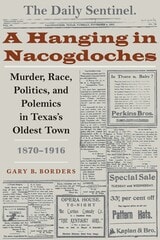
cover of A Hanging in Nacogdoches: Murder, Race, Politics, and Polemics in Texas's Oldest Town, 1870-1916

A Hanging in Nacogdoches

Murder, Race, Politics, and Polemics in Texas's Oldest Town, 1870-1916

By Gary B. Borders

University of Texas Press, 2006

On October 17, 1902, in Nacogdoches, Texas, a black man named James Buchanan was tried without representation, condemned, and executed for the murder of a white family—all in the course of three hours. Two white men played pivotal roles in these events: Bill Haltom, a leading local Democrat and the editor of the Nacogdoches Sentinel, who condemned lynching but defended lynch mobs, and A. J. Spradley, a Populist sheriff who, with the aid of hundreds of state militiamen, barely managed to keep the mob from burning Buchanan alive, only to escort him to the gallows following his abbreviated trial. Each man's story serves to illuminate a part of the path that led to the terrible parody of justice which lies at the heart of A Hanging in Nacogdoches.

The turn of the twentieth century was a time of dramatic change for the people of East Texas. Frightened by the Populist Party's attempts to unite poor blacks and whites in a struggle for economic justice, white Democrats defended their power base by exploiting racial tensions in a battle that ultimately resulted in the complete disenfranchisement of the black population of East Texas. In telling the story of a single lynching, Gary Borders dramatically illustrates the way politics and race combined to bring horrific violence to small southern towns like Nacogdoches.
[more]
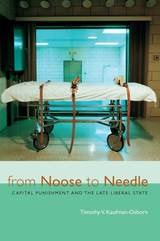
cover of From Noose to Needle: Capital Punishment and the Late Liberal State

From Noose to Needle

Capital Punishment and the Late Liberal State

Timothy V. Kaufman-Osborn

University of Michigan Press, 2002

From Noose to Needle contributes a new perspective on the controversial topic of capital punishment by asking how the conduct of state killing reveals broader contradictions in the contemporary liberal state, especially, but not exclusively, in the United States. Moving beyond more familiar legal and sociological approaches to this matter, Timothy V. Kaufman-Osborn asks several questions. Why do executions no longer take the form of public spectacles? Why are certain methods of execution considered barbaric? Why must the liberal state strictly segregate the imposition of a death sentence, whether by judge or jury, from its actual infliction, whether by a state official or an ordinary citizen? Why are women so infrequently sentenced to death and executed? How does the state seek to hide the suffering inflicted by capital punishment through its endorsement of a bio-medical conception of pain? How does the nearly-universal shift to lethal injection pose problems for the late liberal state by confusing its punitive and welfare responsibilities?
Drawing on a wide range of theoretical sources, including John Locke, Max Weber, Nicos Poulantzas, Friedrich Nietzsche, J. L. Austin, Michel Foucault, Judith Butler, Pierre Bourdieu, Elaine Scarry, and others, Kaufman-Osborn grounds his appropriation of these authors in analyses of specific recent executions, including that of Wesley Allan Dodd and Charles Campbell in Washington, Karla Faye Tucker in Texas, and Allen Lee Davis in Florida.
From Noose to Needle will be of interest to students of law, political theory, and sociology as well as more general readers interested in the troublesome issue of capital punishment.
Timothy V. Kaufman-Osborn is Baker Ferguson Professor of Politics and Leadership, Whitman College.
[more]