Results by title
5 books match the query 'Harbors'
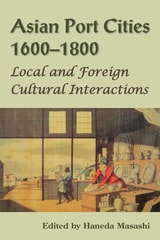
Asian Port Cities, 1600-1800
Local and Foreign Cultural InteractionsHaneda Masashi
National University of Singapore Press, 2009
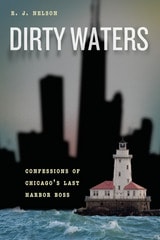
Dirty Waters
Confessions of Chicago's Last Harbor BossR. J. Nelson
University of Chicago Press, 2016
In 1987, the city of Chicago hired a former radical college chaplain to clean up rampant corruption on the waterfront. R. J. Nelson thought he was used to the darker side of the law—he had been followed by federal agents and wiretapped due to his antiwar stances in the sixties—but nothing could prepare him for the wretched bog that constituted the world of a Harbor Boss. Dirty Waters is the wry, no-holds-barred memoir of Nelson’s time controlling some of the city’s most beautiful spots while facing some of its ugliest traditions. Nelson takes us through Chicago's beloved “blue spaces” and deep into the city’s political morass, revealing the different moralities underlining three mayoral administrations and navigating the gritty mechanisms of the city’s political machine. Ultimately, Dirty Waters is a tale of morality, of what it takes to be a force for good in the world and what struggles come from trying to stay ethically afloat in a sea of corruption.
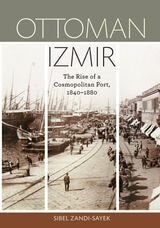
Ottoman Izmir
The Rise of a Cosmopolitan Port, 1840-1880Sibel Zandi-Sayek
University of Minnesota Press, 2011
Between 1840 and 1880, the Eastern Mediterranean port of Izmir (Smyrna) underwent unprecedented change. A modern harbor that welcomed international steamships and new railway lines that transported a cornucopia of products transformed the physical city. Migrants, seasonal workers, and transient sailors thronged into an already diverse metropolis, helping to double the population to 200,000. Simultaneously, Ottoman officials and enterprising citizens vied to control and reform the city’s administrative and legal institutions.
Ottoman Izmir examines how urban space, institutional structures, and everyday practices shaped one another in the thriving seaport of Izmir during a volatile period of growth. Sibel Zandi-Sayek investigates a variety of urban actors—Muslims and non-Muslims, Ottomans and Europeans, newcomers and native residents, merchants, investors, civil servants, and press reporters—who were actively engaged in restructuring the city. Concentrating on the workings of urban committees and on laws and policies that were written, rewritten, but never fully implemented, Zandi-Sayek exposes how modern interventions sought to impose clear-cut concepts of public and private, safety and danger, and hygiene on a city that previously had a wide range of customary regulations.
Ottoman Izmir shows how Izmir’s various stakeholders contested its built environment. In so doing, it offers a new view of the dynamics of urban modernization.
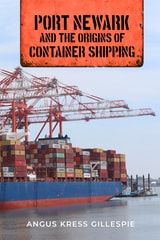
Port Newark and the Origins of Container Shipping
Angus Kress Gillespie
Rutgers University Press, 2023
This fascinating study traces the birth of containerization to Port Newark, New Jersey, in 1956 when trucker Malcom McLean thought of a brilliant new way to transport cargo. It tells the story of how Port Newark grew rapidly as McLean’s idea was backed by both New York banks and the US military, who used containerization to ship supplies to troops in Vietnam. Angus Gillespie takes us behind the scenes of today’s active container shipping operations in Port Newark, talking to the pilots who guide the ships into port, the Coast Guard personnel who help manage the massive shipping traffic, the crews who unload the containers, and even the chaplains who counsel and support the mariners. Port Newark shines a spotlight on the unsung men and women who help this complex global shipping operation run smoothly.
Since McLean's innovation, Port Newark has expanded with the addition of the nearby Elizabeth Marine Terminal. This New Jersey complex now makes up the busiest seaport on the East Coast of the United States. Some have even called it “America’s Front Door.” The book tells the story of the rapid growth of worldwide containerization, and how Port Newark has adapted to bigger ships with deeper channels and a raised bridge. In the end, there is speculation of the future of this port with ever-increasing automation, artificial intelligence, and automation.
The Underharbor
Submerged Histories of SydneyAnn Elias
University of Chicago Press, 2026
An underwater look at Sydney that surfaces new and unfamiliar histories of people, objects, spaces, and environmental and social change.
The Underharbor places the ocean at the center of a cultural history of Sydney, Australia, a place built on and around seawater, where the community is linked historically, emotionally, and psychologically to the water. Drawing on a series of vignettes that focus on Sydney’s underwater dimensions—including the harbor’s relationship to technological modernity, Indigenous ideas and practices, artistic experimentation, and scientific inquiry—Ann Elias creates a unique portrait of a city and its past. By shifting the terrestrial perspective to the subaquatic, Elias uncovers an area filled with political meaning, poetic significance, and ideological struggles.
Few harbors are as researched as Sydney’s, where fishing, exploration, colonialism, warfare, science, and industry all shaped cultural ideas about underwater space. Between 1850 to 1950, only a few groups of people had access to the remote underharbor: Indigenous divers and First Nations peoples, who were dispossessed by colonizers; divers working primarily to further the maritime industrialization of the growing city and to salvage objects from the harbor floor; researchers in the emerging field of marine science who dove for first-hand observation; and beachcombers, naturalists, and dredgers who got to know the underharbor by bringing it to the surface. Through press stories, models, illustrations, maps, and photographic and cinematic representations, The Underharbor reveals how these watery visions of Sydney shifted over the course of a century.