Results by title
6 books match the query 'Harding, Sandra'
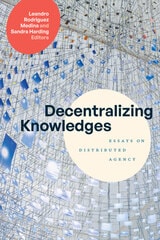
Decentralizing Knowledges
Essays on Distributed AgencyLeandro Rodriguez Medina and Sandra Harding, editor
Duke University Press, 2025
Contributors: Linda Martín Alcoff, Elías Barticevic, Johan Henrik Buljo, Ronald Cancino, Cristina Flores, Kim Fortun, Sandra Harding, Line Aimee Kalak, Duygu Kasdogan, Wiebke Keim, Aalok Khandekar, Daniel Lee Kleinman, Wen-Hua Kuo, John Law, Les Levidow, Leandro Rodriguez Medina, Angela Okune, Liv Østmo, Ari Sitas, Maka Suarez, Sharon Traweek, Hebe Vessuri

Objectivity and Diversity
Another Logic of Scientific ResearchSandra Harding
University of Chicago Press, 2015
Sandra Harding is not ready to throw out objectivity quite yet. For all of its problems, she contends that objectivity is too powerful a concept simply to abandon. In Objectivity and Diversity, Harding calls for a science that is both more epistemically adequate and socially just, a science that would ask: How are the lives of the most economically and politically vulnerable groups affected by a particular piece of research? Do they have a say in whether and how the research is done? Should empirically reliable systems of indigenous knowledge count as "real science"? Ultimately, Harding argues for a shift from the ideal of a neutral, disinterested science to one that prizes fairness and responsibility.
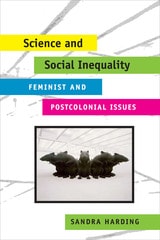
Science and Social Inequality
Feminist and Postcolonial IssuesSandra Harding
University of Illinois Press, 2006
In Science and Social Inequality, Sandra Harding makes the provocative argument that the philosophy and practices of today's Western science, contrary to its Enlightenment mission, work to insure that more science will only worsen existing gaps between the best and worst off around the world. She defends this claim by exposing the ways that hierarchical social formations in modern Western sciences encode antidemocratic principles and practices, particularly in terms of their services to militarism, the impoverishment and alienation of labor, Western expansion, and environmental destruction. The essays in this collection--drawing on feminist, multicultural, and postcolonial studies--propose ways to reconceptualize the sciences in the global social order.
At issue here are not only social justice and environmental issues but also the accuracy and comprehensiveness of our understandings of natural and social worlds. The inadvertent complicity of the sciences with antidemocratic projects obscures natural and social realities and thus blocks the growth of scientific knowledge. Scientists, policy makers, social justice movements and the consumers of scientific products (that is, the rest of us) can work together and separately to improve this situation.

Sciences from Below
Feminisms, Postcolonialities, and ModernitiesSandra Harding
Duke University Press, 2008
Describing the work of the post-Kuhnian science studies scholars Bruno Latour, Ulrich Beck, and the team of Michael Gibbons, Helga Nowtony, and Peter Scott, Harding reveals how, from different perspectives, they provide useful resources for rethinking the modernity versus tradition binary and its effects on the production of scientific knowledge. Yet, for the most part, they do not take feminist or postcolonial critiques into account. As Harding demonstrates, feminist science studies and postcolonial science studies have vital contributions to make; they bring to light not only the male supremacist investments in the Western conception of modernity and the historical and epistemological bases of Western science but also the empirical knowledge traditions of the global South. Sciences from Below is a clear and compelling argument that modernity studies and post-Kuhnian, feminist, and postcolonial sciences studies each have something important, and necessary, to offer to those formulating socially progressive scientific research and policy.
Sex and Scientific Inquiry
Edited by Sandra Harding and Jean F. O'Barr
University of Chicago Press, 1987
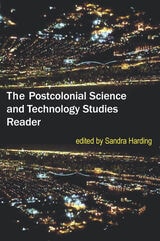
The Postcolonial Science and Technology Studies Reader
Sandra Harding, ed.
Duke University Press, 2011
Contributors
Helen Appleton
Karen Bäckstrand
Lucille H. Brockway
Stephen B. Brush
Judith Carney
Committee on Women, Population, and the Environment
Arturo Escobar
Maria E. Fernandez
Ward H. Goodenough
Susantha Goonatilake
Sandra Harding
Steven J. Harris
Betsy Hartmann
Cori Hayden
Catherine L. M. Hill
John M. Hobson
Peter Mühlhäusler
Catherine A. Odora Hoppers
Consuelo Quiroz
Jenny Reardon
Ella Reitsma
Ziauddin Sardar
Daniel Sarewitz
Londa Schiebinger
Catherine V. Scott
Colin Scott
Mary Terrall
D. Michael Warren