Results by title
11 books match the query 'Harm'

Carry Me Gently
On Maternal Life, Care, and HarmLalaie Ameeriar
Duke University Press, 2027
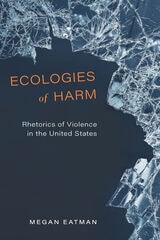
Ecologies of Harm
Rhetorics of Violence in the United StatesMegan Eatman
The Ohio State University Press, 2020
While Eatman looks to examples of violent spectacles to make her case (lynching, capital punishment, and torture in the War on Terror), it is in her analysis of more mundane responses to these forms of violence (congressional debates, court documents, visual art, and memorial performance) where the key to her argument lies—as she shows how circulating violence in these ways produces violent rhetorical ecologies that facilitate some modes of being while foreclosing others. Through this ecological approach, Ecologies of Harm offers a new understanding of the debates surrounding legacies of violence, examines how rhetoric and violence function together, and explores implications of their entanglement for antiviolence work.
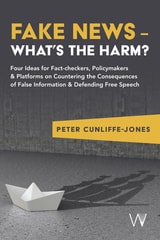
Fake News – What’s the harm?
Four ideas for fact-checkers, policymakers & platforms on countering the consequences of false information & defending free speechPeter Cunliffe-Jones
University of Westminster Press, 2025
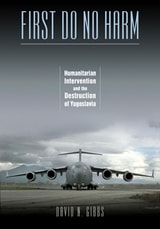
First Do No Harm
Humanitarian Intervention and the Destruction of YugoslaviaDavid N. Gibbs
Vanderbilt University Press, 2009
The book focuses on the 1991-99 breakup of Yugoslavia, which helped forge the idea that the United States and its allies could stage humanitarian interventions that would end ethnic strife. It is widely believed that NATO bombing campaigns in Bosnia and Kosovo played a vital role in stopping Serb-directed aggression, and thus resolving the conflict.
Gibbs challenges this view, offering an extended critique of Samantha Power's Pulitzer Prize-winning book, A Problem from Hell: America in the Age of Genocide. He shows that intervention contributed to the initial breakup of Yugoslavia, and then helped spread the violence and destruction. Gibbs also explains how the motives for U.S. intervention were rooted in its struggle for continued hegemony in Europe.
First Do No Harm argues for a new, noninterventionist model for U.S. foreign policy, one that deploys nonmilitary methods for addressing ethnic violence.
First, Do No Harm
Power, Oppression, and Violence in HealthcareEdited by Nancy L. Diekelmann
University of Wisconsin Press, 2002
First, Do No Harm shows how health care professionals, with the best intentions of providing excellent, holistic health care, can nonetheless perpetuate violence against vulnerable patients. The essays investigate the need to rethink contemporary healthcare practices in ways that can bring the art and science of medicine back into sorely needed balance.
These ground-breaking studies by noted scholars question commonly held assumptions in contemporary healthcare that underlie oppressive power dynamics and even violence for patients and their families. The contributors discuss such topics as women and violence, life-support technologies, and healthcare professionals’ own experiences as patients. First, Do No Harm opens the discourse for reaching new understandings, from reassessing the meaning of "quality of life" to questioning the appropriateness of the very language used by healthcare professionals. It will be welcomed by healthcare workers and by scholars in nursing, medicine, and the allied health sciences.
Harm
Hillary Gravendyk
Omnidawn, 2012
Intersections of Harm
Narratives of Latina Deviance and DefianceHalperin, Laura
Rutgers University Press, 0
More than "First, Do No Harm"
Academic Global HealthTimothy R. B. Johnson
Michigan Publishing Services, 2023
Using personal experience and narrative, as well as the voices of students, trainees, and academic colleagues, this book illustrates how an initiative beginning over thirty years ago to train obstetrician-gynecologists in Ghana can serve as a model for global engagement by universities and learners at many levels. In addition to detailing a proven sustainable model for global health programs, this book highlights the ethical and moral imperatives participants should expect and demand of truly engaged academic global health.
Reckoning with Harm
The Toxic Relations of Oil in AmazoniaAmelia Fiske
University of Texas Press, 2023
2025 Margaret Mead Award, Society for Applied Anthropology (SfAA) and the American Anthropological Association (AAA)
An ethnography of the Ecuadorian Amazon that demonstrates the need for a relational, place-based, contingent understanding of harm and toxicity.
Reckoning with Harm is a striking ethnographic analysis of the harm resulting from oil extraction. Covering fifty years of settler colonization and industrial transformation of the Ecuadorian Amazon, Amelia Fiske interrogates the relations of harm. She moves between forest-courtrooms and oily waste pits, farms and toxic tours, to explore both the ways in which harm from oil is entangled with daily life and the tensions surrounding efforts to verify and redress it in practice. Attempts to address harm from the oil industry in Ecuador have been consistently confounded by narrow, technocratic understandings of evidence, toxicity, and responsibility. Building on collaborators’ work to contest state and oil company insistence that harm is controlled and principally chemical in nature, Fiske shows that it is necessary to refigure harm as relational in order to reckon with unremediated contamination of the past while pushing for broad forms of accountability in the present. She theorizes that harm is both a relationship and an animating feature of relationships in this place, a contingent understanding that is needed to contemplate what comes next when living in a toxic world.
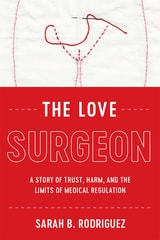
The Love Surgeon
A Story of Trust, Harm, and the Limits of Medical RegulationSarah B. Rodriguez
Rutgers University Press, 2020
It would be easy to dismiss Dr. Burt as a monstrous aberration, a modern-day Dr. Frankenstein. Yet as medical historian Sarah Rodriguez reveals, that’s not the whole story. The Love Surgeon asks tough questions about Burt’s heinous acts and what they reveal about the failures of the medical establishment: How was he able to perform an untested surgical procedure? Why wasn’t he obliged to get informed consent from his patients? And why did it take his peers so long to take action?
The Love Surgeon is both a medical horror story and a cautionary tale about the limits of professional self-regulation.
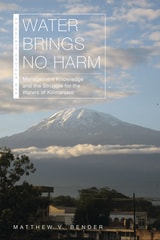
Water Brings No Harm
Management Knowledge and the Struggle for the Waters of KilimanjaroMatthew V. Bender
Ohio University Press, 2019
In Water Brings No Harm, Matthew V. Bender explores the history of community water management on Mount Kilimanjaro in Tanzania. Kilimanjaro’s Chagga-speaking peoples have long managed water by employing diverse knowledge: hydrological, technological, social, cultural, and political. Since the 1850s, they have encountered groups from beyond the mountain—colonial officials, missionaries, settlers, the independent Tanzanian state, development agencies, and climate scientists—who have understood water differently. Drawing on the concept of waterscapes—a term that describes how people “see” water, and how physical water resources intersect with their own beliefs, needs, and expectations—Bender argues that water conflicts should be understood as struggles between competing forms of knowledge.
Water Brings No Harm encourages readers to think about the origins and interpretation of knowledge and development in Africa and the global south. It also speaks to the current global water crisis, proposing a new model for approaching sustainable water development worldwide.