Results by title
3 books match the query 'Harootunian, Harry D.'
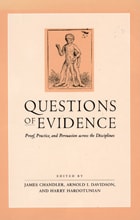
Questions of Evidence
Proof, Practice, and Persuasion across the DisciplinesEdited by James Chandler, Arnold I. Davidson, and Harry D. Harootunian
University of Chicago Press, 1994
Biologists, historians, lawyers, art historians, and literary critics all voice arguments in the critical dialogue about what constitutes evidence in research and scholarship. They examine not only the constitution and "blurring" of disciplinary boundaries, but also the configuration of the fact-evidence distinctions made in different disciplines and historical moments; the relative function of such concepts as "self-evidence," "experience," "test," "testimony," and "textuality" in varied academic discourses; and the way "rules of evidence" are themselves products of historical developments.
The essays and rejoinders are by Terry Castle, Lorraine Daston, Carlo Ginzburg, Ian Hacking, Mark Kelman, R. C. Lewontin, Pierre Vidal-Naquet, Mary Poovey, Donald Preziosi, Simon Schaffer, Joan W. Scott, Eve Kosofsky Sedgwick, and Barbara Herrnstein Smith.
The critical responses are by Lauren Berlant, James Chandler, Jean Comaroff, Arnold I. Davidson, Harry D. harootunian, Elizabeth Helsinger, Thomas C. Holt, Francoise Meltzer, Robert J. Richards, Lawrence Rothfield, Joel Snyder, Cass R. Sunstein, and William Wimsatt.
[more]

The Unspoken as Heritage
The Armenian Genocide and Its Unaccounted LivesHarry Harootunian
Duke University Press, 2019
In the 1910s historian Harry Harootunian's parents Ohannes and Vehanush escaped the mass slaughter of the Armenian genocide, making their way to France, where they first met, before settling in suburban Detroit. Although his parents rarely spoke of their families and the horrors they survived, the genocide and their parents' silence about it was a permanent backdrop to the Harootunian children's upbringing. In The Unspoken as Heritage Harootunian—for the first time in his distinguished career—turns to his personal life and family heritage to explore the genocide's multigenerational afterlives that remain at the heart of the Armenian diaspora. Drawing on novels, anecdotes, and reports, Harootunian presents a composite sketch of the everyday life of his parents, from their childhood in East Anatolia to the difficulty of making new lives in the United States. A meditation on loss, inheritance, and survival—in which Harootunian attempts to come to terms with a history that is just beyond his reach—The Unspoken as Heritage demonstrates how the genocidal past never leaves the present, even in its silence.
[more]
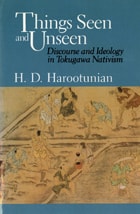
Things Seen and Unseen
Discourse and Ideology in Tokugawa NativismHarry D. Harootunian
University of Chicago Press, 1988
This long-awaited work explores the place of kokugaku (rendered here as "nativism") during Japan's Tokugawa period. Kokugaku, the sense of a distinct and sacred Japanese identity, appeared in the eighteenth century in reaction to the pervasive influence of Chinese culture on Japan. Against this influence, nativists sought a Japanese sense of difference grounded in folk tradition, agricultural values, and ancient Japanese religion. H. D. Harootunian treats nativism as a discourse and shows how it functioned ideologically in Tokugawa Japan.
[more]