Results by title
2 books match the query 'Harvard'
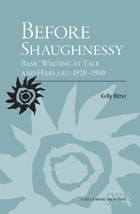
Before Shaughnessy
Basic Writing at Yale and Harvard, 1920-1960Kelly Ritter
Southern Illinois University Press, 2009
In Before Shaughnessy: Basic Writing at Yale and Harvard, 1920–1960, Kelly Ritter uses materials from the archives at Harvard and Yale and contemporary theories of writing instruction to reconsider the definition of basic writing and basic writers within a socio-historical context. Ritter challenges the association of basic writing with only poorly funded institutions and poorly prepared students.
Using Yale and Harvard as two sample case studies, Ritter shows that basic writing courses were alive and well, even in the Ivy League, in the early twentieth century. She argues not only that basic writers exist across institutional types and diverse student populations, but that the prevalence of these writers has existed far more historically than we generally acknowledge.
Uncovering this forgotten history of basic writing at elite institutions, Ritter contends that the politics and problems of the identification and the definition of basic writers and basic writing began long before the work of Mina Shaughnessy in Errors and Expectations and the rise of open admissions. Indeed, she illustrates how the problems and politics have been with us since the advent of English A at Harvard and the heightened consumer-based policies that resulted in the new admissions criteria of the early twentieth-century American university. In order to recognize this long-standing reality of basic writing, we must now reconsider whether the nearly standardized, nationalized definition of “basic” is any longer a beneficial one for the positive growth and democratic development of our first-year writing programs and students.
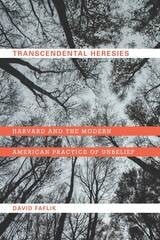
Transcendental Heresies
Harvard and the Modern American Practice of UnbeliefDavid Faflik
University of Massachusetts Press, 2020
At a moment when the requirements of belief and unbelief were being negotiated in unexpected ways, transcendentalism allowed for a more creative approach to spiritual questions. Interrogating the movement's alleged atheistic underpinnings, David Faflik contends that transcendentalism reconstituted the religious sensibilities of 1830s and 1840s New England, producing a dynamic and complex array of beliefs and behaviors that cannot be categorized as either religious or nonreligious. Rather than “the latest form of infidelity,” as one contemporary described it, adherents viewed their unconventional and distinct spiritual practices as a modern religion.
Transcendental Heresies draws on an expansive antebellum archive of period commentary and writings by transcendentalism's practitioners, including Ralph Waldo Emerson, Henry David Thoreau, Theodore Parker, Margaret Fuller, and the women of transcendentalism's second and third waves. From Boston to Concord to the heady environs of Harvard, the species of unbelief they practiced multiplied the religious possibilities of the era, expressing misgivings about traditional notions of divinity, flouting religion's customary forms, and ultimately encouraging spiritual questioning.