Results by title
3 books match the query 'Hasegawa, Guy R.'
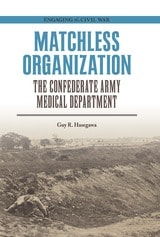
Matchless Organization
The Confederate Army Medical DepartmentGuy R. Hasegawa, Foreword by F. Terry Hambrecht
Southern Illinois University Press, 2021
Despite the many obstacles it had to overcome—including a naval blockade, lack of a strong industrial base, and personnel unaccustomed to military life—the Richmond-based Confederate Army Medical Department developed into a robust organization that nimbly adapted to changing circumstances. In the first book to address the topic, Guy R. Hasegawa describes the organization and management of the Confederate army’s medical department. At its head was Surgeon General Samuel Preston Moore, a talented multitasker with the organizational know-how to put in place qualified medical personnel to care for sick and wounded Confederate soldiers.
Hasegawa investigates how political considerations, personalities, and, as the war progressed, the diminishing availability of human and material resources influenced decision-making in the medical department. Amazingly, the surgeon general’s office managed not only to provide care but also to offer educational opportunities to its personnel and collect medical and surgical data for future use, regardless of constant and growing difficulties.
During and after the war, the medical department of the Confederate army was consistently praised as being admirably organized and efficient. Although the department was unable to match its Union counterpart in manpower and supplies, Moore’s intelligent management enabled it to help maintain the fighting strength of the Confederate army.
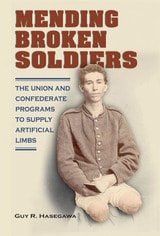
Mending Broken Soldiers
The Union and Confederate Programs to Supply Artificial LimbsGuy R. Hasegawa
Southern Illinois University Press, 2012
Guy R. Hasegawa presents the first volume to explore the wartime provisions made for amputees in need of artificial limbs—programs that were the forebears of modern governmental efforts to assist in the rehabilitation of wounded service members. Hasegawa offers a comprehensive look at the artificial-limb industry, including detailed descriptions of the ingenious designs employed by manufacturers; illustrations and photographs of period prosthetics; accounts of the rapid advancement of medical technology during the Civil War; and in-depth examinations of the companies that manufactured limbs for soldiers and bid for contracts, including at least one still in existence today. An intriguing account of innovation, determination, humanitarianism, and the devastating toll of battle, Mending Broken Soldiers provides a fascinating glimpse into groundbreaking military health programs during the most tumultuous years in American history.
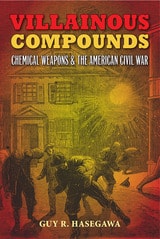
Villainous Compounds
Chemical Weapons and the American Civil WarGuy R. Hasegawa
Southern Illinois University Press, 2015
In chilling detail, Hasegawa describes the weapons proposed and prepared for use during the war and introduces the people behind the concepts. Although many of the ideas for chemical weapons had a historical precedent, most of the suggested agents were used in industry or medicine, and their toxicity was common knowledge. Proponents, including a surprisingly high number of civilian physicians, suggested a wide variety of potential chemical weapons—from liquid chlorine in artillery shells to cayenne pepper solution sprayed from fire engines. Some weapons advocates expressed ethical qualms, while others were silent on the matter or justified their suggestions as necessary under current circumstances.
As Hasegawa explains, bureaucrats in the war departments of both armies either delayed or rejected outright most of these unusual weapons, viewing them as unneeded or unworkable. Nevertheless, many of the proposed armaments presaged the widespread use of chemical weapons in the twentieth and twenty-first centuries. For example, while Civil War munitions technology was not advanced enough to deliver poison gas in artillery shells as some advocates suggested, the same idea saw extensive use during World War I. Similarly, forms of an ancient incendiary weapon, Greek fire, were used sparingly during the Civil War and appeared in later conflicts as napalm bombs and flamethrowers.
Especially timely with today’s increased chemical threats from terrorists and the alleged use of chemical agents in the Syrian Civil War, Villainous Compounds: Chemical Weapons and the American Civil War reveals the seldom-explored chemical side of Civil War armaments and illuminates an underappreciated stage in the origins of modern chemical warfare.