Results by title

11 books match the query 'Hasidism'
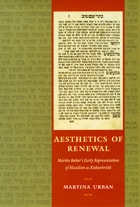
cover of Aesthetics of Renewal: Martin Buber's Early Representation of Hasidism as Kulturkritik

Aesthetics of Renewal

Martin Buber's Early Representation of Hasidism as Kulturkritik

Martina Urban

University of Chicago Press, 2008
Martin Buber’s embrace of Hasidism at the start of the twentieth century was instrumental to the revival of this popular form of Jewish mysticism. Hoping to instigate a Jewish cultural and spiritual renaissance, he published a series of anthologies of Hasidic teachings written in German to introduce the tradition to a wide audience. In Aesthetics of Renewal, Martina Urban closely analyzes Buber’s writings and sources to explore his interpretation of Hasidic spirituality as a form of cultural criticism.
 
For Buber, Hasidic legends and teachings were not a static, canonical body of knowledge, but were dynamic and open to continuous reinterpretation. Urban argues that this representation of Hasidism was essential to the Zionist effort to restore a sense of unity across the Jewish diaspora as purely religious traditions weakened—and that Buber’s anthologies in turn played a vital part in the broad movement to use cultural memory as a means to reconstruct a collective identity for Jews. As Urban unravels the rich layers of Buber’s vision of Hasidism in this insightful book, he emerges as one of the preeminent thinkers on the place of religion in modern culture.
[more]
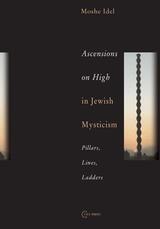
cover of Ascensions on High in Jewish Mysticism: Pillars, Lines, Ladders

Ascensions on High in Jewish Mysticism

Pillars, Lines, Ladders

Moshe Idel

Central European University Press, 2005
Ascensions on high took many forms in Jewish mysticism and they permeated most of its history from its inception until Hasidism. The book surveys the various categories, with an emphasis on the architectural images of the ascent, like the resort to images of pillars, lines, and ladders. After surveying the variety of scholarly approaches to religion, the author also offers what he proposes as an eclectic approach, and a perspectivist one. The latter recommends to examine religious phenomena from a variety of perspectives. The author investigates the specific issue of the pillar in Jewish mysticism by comparing it to the archaic resort to pillars recurring in rural societies. Given the fact that the ascent of the soul and pillars constituted the concerns of two main Romanian scholars of religion, Ioan P. Culianu and Mircea Eliade, Idel resorts to their views, and in the Concluding Remarks analyzes the emergence of Eliade's vision of Judaism on the basis of neglected sources.
[more]
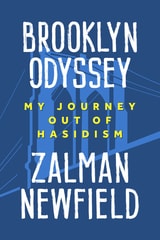
cover of Brooklyn Odyssey: My Journey out of Hasidism

Brooklyn Odyssey

My Journey out of Hasidism

Zalman Newfield

Temple University Press, 2026

Growing up in Crown Heights, Brooklyn as a member of the Chabad-Lubavitch Hasidic Orthodox Jewish community, Zalman Newfield was raised in an atmosphere of strict gender segregation, rigorous religious education, and nearly all-consuming ritual practices. Trained to be a Lubavitch emissary, he traveled around the world doing Jewish outreach to help usher in the messianic redemption. However, after exposure to the wider world, he abandoned the faith of his youth.

Brooklyn Odyssey is Newfield’s poignant and hopeful memoir about exiting Orthodoxy. He recounts asserting his individuality and taking the radical step of shaving his beard. Reflective about his upbringing, Newfield is open to and curious about a world beyond Brooklyn while also maintaining his profound bond with his family and Jewish tradition. He writes candidly about his emotional, intellectual, and social experiences in and out of the Lubavitch community.  

From pivotal moments of devastation, including the illness and death of his younger brother and of his revered spiritual leader Rabbi Menachem Mendel Schneerson, to moments of joyful resolve, including the decision to pursue a doctorate and marry a non-Orthodox Jew, Newfield takes readers on his moving and impactful journey.

[more]
cover of Communicating the Infinite: The Emergence of the Habad School

Communicating the Infinite

The Emergence of the Habad School

Naftali Loewenthal

University of Chicago Press, 1990

At the end of the eighteenth century the hasidic movement was facing an internal crisis: to what extent should the teachings of Baal Shem Tov and Maggid of Mezritch, with their implicit spiritual demands, be transmitted to the rank-and-file of the movement? Previously these teachings had been reserved for a small elite. It was at this point that the Habad school emerged with a communication ethos encouraging the transmission of esoteric to the broad reaches of the Jewish world. Communicating the Infinite explores the first two generations of the Habad school under R. Shneur Zalman of Liadi and his son R. Dov Ber and examines its early opponents.

Beginning with the different levels of communication in the teachings of the Baal Shem Tov and the Maggid and his disciples, Naftali Loewenthal traces the unfolding of the dialectic between the urge to transmit esoteric ideas and a powerful inner restraint. Gradually R. Shneur Zalman came to the fore as the prime exponent of the communication ethos. Loewenthal follows the development of his discourses up to the time of his death, when R. Dov Ber and R. Aaron Halevi Horowitz formed their respective "Lubavitch" and "Staroselye" schools. The author continues with a detailed examination of the teachings of R. Dov Ber, an inspired mystic. Central in his thought was the esoteric concept of self-abnegation, bitul, yet this combined with the quest to communicate hasidic teachings to every level of society, including women.

From the late eighteenth century onwards, the main problem for the Jewish world was posed by the fall of the walls of the social and political ghetto. Generally, the response was either to secularize, or abandon altogether, traditional Judaism or to retreat from the threatening modern world into enclave religiosity; by stressing communication, the Habad school opened the way for a middle range response that was neither a retreat into elitism nor an abandonment of tradition. Based on years of research from Hebrew and Yiddish primary source materials, Communicating the Infinite is a work of importance not only to specialists of Judaic studies but also to historians and sociologists.
[more]
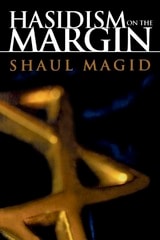
cover of Hasidism on the Margin: Reconciliation, Antinomianism, and Messianism

Hasidism on the Margin

Reconciliation, Antinomianism, and Messianism

Shaul Magid

University of Wisconsin Press, 2003

Hasidism on the Margin explores one of the most provocative and radical traditions of Hasidic thought, the school of Izbica and Radzin that Rabbi Gershon Henokh originated in nineteenth-century Poland. Shaul Magid traces the intellectual history of this strand of Judaism from medieval Jewish philosophy through centuries of Kabbalistic texts to the nineteenth century and into the present. He contextualizes the Hasidism of Izbica-Radzin in the larger philosophy and history of religions and provides a model for inquiry into other forms of Hasidism.
[more]
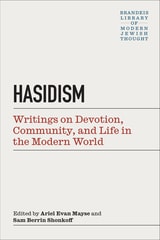
cover of Hasidism: Writings on Devotion, Community, and Life in the Modern World

Hasidism

Writings on Devotion, Community, and Life in the Modern World

Edited by Ariel Evan Mayse Editor and Sam Berrin Shonkoff

Brandeis University Press, 2020

Hasidism has attracted, repelled, and bewildered philosophers, historians, and theologians since its inception in the eighteenth century. In Hasidism: Writings on Devotion, Community, and Life in the Modern World, Ariel Evan Mayse and Sam Berrin Shonkoff present students and scholars with a vibrant and polyphonic set of Hasidic confrontations with the modern world. In this collection, they show that the modern Hasid marks not only another example of a Jewish pietist, but someone who is committed to an ethos of seeking wisdom, joy, and intimacy with the divine.

While this volume focuses on Hasidism, it wrestles with a core set of questions that permeate modern Jewish thought and religious thought more generally: What is the relationship between God and the world? What is the relationship between God and the human being? But Hasidic thought is cast with mystical, psychological, and even magical accents, and offers radically different answers to core issues of modern concern. The editors draw selections from an  array of genres including women’s supplications; sermons and homilies; personal diaries and memoirs; correspondence; stories; polemics; legal codes; and rabbinic response. These selections consciously move between everyday lived experience and the most ineffable mystical secrets, reflecting the multidimensional nature of this unusual religious and social movement. The editors include canonical texts from the first generation of Hasidic leaders up through present-day ultra-orthodox, as well as neo-Hasidic voices and, in so doing, demonstrate the unfolding of a rich and complex phenomenon that continues to evolve today.
[more]
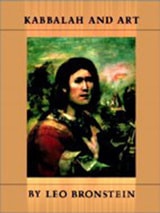
cover of Kabbalah and Art

Kabbalah and Art

Léo Bronstein

University Press of New England, 2002
Told as a series of reflections, this study traces links between cultures as diverse as pre-Vedic India and late 19th-century France. An array of unrelated artists are all in fact linked by the Kabbalah and the correlation between art and this mystic Jewish thought.
[more]
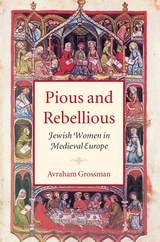
cover of Pious and Rebellious: Jewish Women in Medieval Europe

Pious and Rebellious

Jewish Women in Medieval Europe

Avraham Grossman

Brandeis University Press, 2004
This volume, an amazing act of historical recovery and reconstruction, offers a comprehensive examination of Jewish women in Europe during the High Middle Ages (1000–1300). Avraham Grossman covers multiple aspects of women’s lives in medieval Jewish society, including the image of woman, the structure of the family unit, age at marriage, position in family and society, her place in economic and religious life, her education, her role in family ceremonies, violence against women, and the position of the divorcée and the widow in society. Grossman shows that the High Middle Ages saw a distinct improvement in the status of Jewish women in Europe relative to their status during the Talmudic period and in Muslim countries. If, during the twelfth century, rabbis applauded women as "pious and pure" because of their major role in the martyrdom of the Crusades of 1096, then by the end of the thirteenth century, rabbis complained that women were becoming bold and rebellious. Two main factors fostered this change: first, the transformation of Jewish society from agrarian to "bourgeois," with women performing an increasingly important function in the family economy; and second, the openness toward women in Christian Europe, where women were not subjected to strict limitations based upon conceptions of modesty, as was the case in Muslim countries. The heart of Grossman’s book concerns the improvement of Jewish women’s lot, and the efforts of secular and religious authorities to impede their new-found status. Bringing together a variety of sources including halakhic literature, biblical and talmudic exegesis, ethical literature and philosophy, love songs, folklore and popular literature, gravestones, and drawings, Grossman’s book reconstructs the hitherto unrecorded lives of Jewish women during the Middle Ages.
[more]
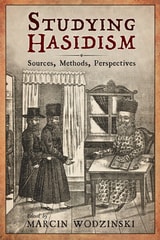
cover of Studying Hasidism: Sources, Methods, Perspectives

Studying Hasidism

Sources, Methods, Perspectives

Marcin Wodzinski

Rutgers University Press, 2019
Hasidism, a Jewish religious movement that originated in Poland in the eighteenth century, today counts over 700,000 adherents, primarily in the U.S., Israel, and the UK. Popular and scholarly interest in Hasidic Judaism and Hasidic Jews is growing, but there is no textbook dedicated to research methods in the field, nor sources for the history of Hasidism have been properly recognized. Studying Hasidism, edited by Marcin Wodziński, an internationally recognized historian of Hasidism, aims to remedy this gap. The work’s thirteen chapters each draws upon a set of different sources, many of them previously untapped, including folklore, music, big data, and material culture to demonstrate what is still to be achieved in the study of Hasidism. Ultimately, this textbook presents research methods that can decentralize the role community leaders play in the current literature and reclaim the everyday lives of Hasidic Jews.
[more]
cover of The Way of Humanity: According to Chasidic Teaching

The Way of Humanity

According to Chasidic Teaching

Martin Buber, translated by Rabbi Bernard H. Mehlman, DHL and GabrielE. Padawer, ScD

Central Conference of American Rabbis, 2023

Martin Buber (1878–1965) was one of the most influential Jewish thinkers of the twentieth century. A philosopher, seeker, and nurturer of dialogue, he responded to the complexities of his times by affirming the fullness of interpersonal encounter and the spiritual everyday. In 1947, Buber delivered lectures interpreting six traditional Chasidic stories to a German-speaking audience, published as The Way of Humanity. In the first new English translation in over half a century, Rabbi Bernard H. Mehlman, DHL, and Gabriel E. Padawer, ScD, z"l, bring the work to contemporary readers in a clear, accessible voice. The teachings within highlight the subversion and innovation of the early Chasidic masters of the eighteenth and nineteenth centuries, while providing meaningful spiritual guidance and insight for any seeker today. Scholarly forewords by Paul Mendes-Flohr, PhD, and Rabbi Joseph A. Skloot, PhD, as well as an introduction, epilogue, and notes from the translators, place Buber’s work in historical context. Timeless and enlightening, The Way of Humanity guides us to inner meaning and highlights our human wholeness.
[more]
cover of Untold Tales of the Hasidim: Crisis and Discontent in the History of Hasidism

Untold Tales of the Hasidim

Crisis and Discontent in the History of Hasidism

David Assaf

Brandeis University Press, 2011

This fascinating volume reveals some of the dark, dramatic episodes concealed in the folds of the hasidic cloak—shocking events and anomalous figures in the history of Hasidism. Using tools of detection, Assaf extracts historical truth from a variety of sources by examining how the same events are treated in different memory traditions, whether hasidic, maskilic, or modern historical, and tells the stories of individuals from the hasidic elites who found themselves unable to walk the trodden path. By placing these episodes and individuals under his historical lens, Assaf offers a more nuanced historical portrayal of Hasidism in the nineteenth-century context.
[more]