Results by title
2 books match the query 'Hau, Caroline S.'
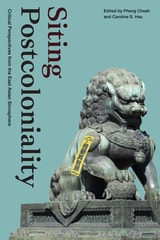
Siting Postcoloniality
Critical Perspectives from the East Asian SinospherePheng Cheah and Caroline Hau, editors
Duke University Press, 2023
The contributors to Siting Postcoloniality reevaluate the notion of the postcolonial by focusing on the Sinosphere—the region of East and Southeast Asia that has been significantly shaped by relations with China throughout history. Pointing out that the history of imperialism in China and Southeast Asia is longer and more complex than Euro-American imperialism, the contributors complicate the traditional postcolonial binaries of center-periphery, colonizer-colonized, and developed-developing. Among other topics, they examine socialist China’s attempts to break with Soviet cultural hegemony; the postcoloniality of Taiwan as it negotiates the legacy of Japanese colonial rule; Southeast Asian and South Asian diasporic experiences of colonialism; and Hong Kong’s complex colonial experiences under the British, the Japanese, and mainland China. The contributors show how postcolonial theory’s central concepts cannot adequately explain colonialism in the Sinosphere. Challenging fundamental axioms of postcolonial studies, this volume forcefully suggests that postcolonial theory needs to be rethought.
Contributors. Pheng Cheah, Dai Jinhua, Caroline S. Hau, Elaine Yee Lin Ho, Wendy Larson, Liao Ping-hui, Lin Pei-yin, Lo Kwai-Cheung, Lui Tai-lok, Pang Laikwan, Lisa Rofel, David Der-wei Wang, Erebus Wong, Robert J. C. Young
Contributors. Pheng Cheah, Dai Jinhua, Caroline S. Hau, Elaine Yee Lin Ho, Wendy Larson, Liao Ping-hui, Lin Pei-yin, Lo Kwai-Cheung, Lui Tai-lok, Pang Laikwan, Lisa Rofel, David Der-wei Wang, Erebus Wong, Robert J. C. Young
[more]
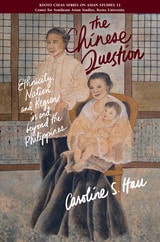
The Chinese Question
Ethnicity, Nation, and Region in and Beyond the PhilippinesCaroline S. Hau
National University of Singapore Press, 2014
The rising strength of mainland China has spurred a revival of “Chineseness” in the Philippines. Perceived during the Cold War era as economically dominant, politically disloyal, and culturally different, the “Chinese” presented themselves as an integral part of the Filipino imagined community. Today, as Filipinos seek associations with China, many of them see the local Chinese community as key players in East Asian regional economic development.
With the revaluing of Chineseness has come a repositioning of “Chinese” racial and cultural identity. Philippine mestizos (people of mixed ancestry) form an important sub-group of the Filipino elite, but their Chineseness was occluded as they disappeared into the emergent Filipino nation. In the twentieth century, mestizos defined themselves and based claims to privilege on “white” ancestry, but mestizos are now actively reclaiming their “Chinese” heritage. At the same time, so-called “pure Chinese” are parlaying their connections into cultural, social, symbolic, or economic capital, and leaders of mainland Chinese state companies have entered into politico-business alliances with the Filipino national elite. As the meanings of “Chinese” and “Filipino” evolve, intractable contradictions are appearing in the concepts of citizenship and national belonging.
Through an examination of cinematic and literary works, The Chinese Question shows how race, class, ideology, nationality, territory, sovereignty, and mobility are shaping the discourses of national integration, regional identification, and global cosmopolitanism.
[more]