Results by title
18 books match the query 'Havana'
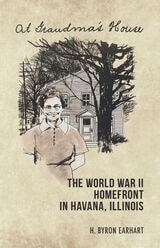
At Grandma's House
The World War II Homefront in Havana, IllinoisH. Byron Earhart with Illustrations by John Michael Downs
Southern Illinois University Press, 2020
When H. Byron Earhart’s father enlisted in the U.S. Navy in 1942, young Byron and his family moved into his grandparents' old-fashioned home with a coal-fired range and potbelly stove, and his mother took charge of the family business, a frozen food locker. Grandma was the undisputed head of the family. While his father served on the battleship USS Missouri, his grandparents and mother held the family and the business together. At Grandma’s House is a tribute to everyday Americans who provided the social glue for a country at war as they balanced fear and anxiety for loved ones with the challenges and pleasures of daily life. The experiences of the Earhart family and this Midwestern community, supplemented by contemporary documents, family photos, and professional illustrations, recount with vivid local color the drama that played out on the national and international stage.

At Grandma's House
The World War II Homefront in Havana, IllinoisH. Byron Earhart
Southern Illinois University Press, 2020
At Grandma's House
The World War II Homefront in Havana, IllinoisH. Byron Earhart
Southern Illinois University Press, 2020
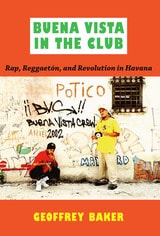
Buena Vista in the Club
Rap, Reggaetón, and Revolution in HavanaGeoffrey Baker
Duke University Press, 2011
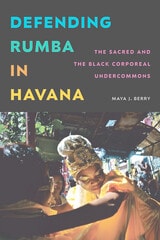
Defending Rumba in Havana
The Sacred and the Black Corporeal UndercommonsMaya J. Berry
Duke University Press, 2025
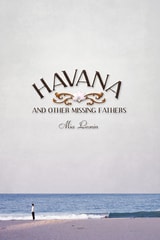
Havana and Other Missing Fathers
Mia Leonin
University of Arizona Press, 2009
Shortly after her sixteenth birthday, Leonin learned from her mother that her father, a Cuban exile, was very much alive and living in Florida. Her attempts to contact him, however, were thwarted until four years later, when she left home in search of her roots.
She meets her father, but trying to discover the truth behind him proves to be a more daunting task. Her journey takes her to Miami, Colombia, and Cuba, and her search for cultural identity leads her to create memories, friendships, and romances. She finds moments of connection and redemption, ending up in Havana not as a cultural tourist but as an illegitimate daughter of Cuba looking for validation. What she discovers is an island bereft of fathers and brimming with paternalism. As she becomes entangled with two different men, she descends further into the Havana of poverty, humiliation, and despair, as well as the ever-inventive city that is as passionate as it is contradictory.
Insightful, imaginative, and often poetic, Havana and Other Missing Fathers is Mia Leonin’s recollection of this journey and her longing to learn more about her origins. In the end, she must learn to accept the answers she discovers as well as the questions that remain.
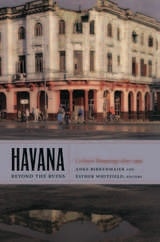
Havana beyond the Ruins
Cultural Mappings after 1989Anke Birkenmaier and Esther Whitfield, eds.
Duke University Press, 2011
Contributors
Emma Álvarez-Tabío Albo
Eric Felipe-Barkin
Anke Birkenmaier
Velia Cecilia Bobes
Mario Coyula-Cowley
Elisabeth Enenbach
Sujatha Fernandes
Jill Hamberg
Patricio del Real
Cecelia Lawless
Jacqueline Loss
Orlando Luis Pardo Lazo
Antonio José Ponte
Nicolás Quintana
Jose Quiroga
Laura Redruello
Rafael Rojas
Joseph L. Scarpaci
Esther Whitfield
Hollywood in Havana
US Cinema and Revolutionary Nationalism in Cuba before 1959Megan Feeney
University of Chicago Press, 2018
Megan Feeney argues that the freedom fighting extolled in American World War II dramas and the rebellious values and behaviors seen in postwar film noir helped condition Cuban audiences to expect and even demand purer forms of Cuban democracy and national sovereignty. At the same time, influential Cuban intellectuals worked to translate Hollywood ethics into revolutionary rhetoric—which, ironically, led to pointed critiques and subversions of the US presence in Cuba. Hollywood in Havana not only expands our notions of how American cinema was internalized around the world—it also broadens our view of the ongoing history of US-Cuban interactions, both cultural and political.
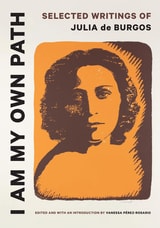
I Am My Own Path
Selected Writings of Julia de BurgosEdited and with an introduction by Vanessa Pérez-Rosario
University of Texas Press, 2023
2026 Silver Medal for the Victor Villaseñor Best Latino Focused Nonfiction Book Award – Spanish, Conference on Latin American History (CLAH)
A definitive, bilingual selection of poetry, essays, and letters by one of Puerto Rico’s most beloved poets.
Julia de Burgos (1914–1953) is best known for her poetry, but she is also an important cultural figure famous for her commitment to social justice, feminist ideas, and the independence of Puerto Rico. Admirers cultivated her legacy to bring to light the real Julia de Burgos, the woman behind the public figure, which this remarkable collection further illuminates by supplying a complex portrait using her own powerful and imaginative words.
Beginning with a critical introduction to Burgos's life and work, Vanessa Pérez-Rosario then presents a selection of poems, essays, and letters, that offer a glimpse into this formidable talent and intellect. Burgos left Puerto Rico, spending the 1940s in both New York City and Havana, where she cultivated a new kind of identity refracted through her pathbreaking work as a poet and journalist. Both poetry and prose are alive with politically charged insights into the struggle of national liberation, literary creation, and being a woman in a patriarchal society. I Am My Own Path is essential reading for anyone interested in Puerto Rican literature and culture as well as a foundational text of Latinx literature and culture in the United States.

Making Home in Havana
Pietropaolo, Vincenzo
Rutgers University Press, 2002
Havana is a city that rarely fails to captivate. But much of the unique beauty and culture of this historic city is rapidly disappearing. As Cuban society finds itself at a crossroads, Havana is more than ever a city on the edge, for although frozen in time as a consequence of Fidel Castro’s revolution, it has certainly not been well preserved. Time, climate, and neglect have eroded a rare architectural legacy, making the need to document this heritage even more pressing than ever before.
Making Home in Havana is an elegant book of photographs and testimonies, recording, questioning, and evoking the meaning of place — in particular, the meaning of home. The combination of fine photography and the words of residents of former palaces, humble apartments, and other dwellings offer us an irresistible portrait of Havana that might otherwise be lost forever.Vincenzo Pietropaolo and Cecelia Lawless have made numerous visits to Havana in order to fully understand and convey the essence of what home means to the inhabitants of the dwellings of the El Vedado and Centro Habana neighborhoods. Together, they—and we—explore how a building becomes a home through its human history as well as its architectural features. With some renovation already underway in colonial Havana, they concentrate on largely unexplored and unrecognized sections that continue to fall into ruin. The intimacy of their connection with the buildings and people offers us a rare combination of documentary realism and high art. Buildings and people speak their histories to us in classic humanistic style. Residents of Havana tell their stories of lifelong efforts to turn decay into beauty, while the photographer’s evocative pictures enable us to feel exactly what they are talking about — a creation of time and space called home.
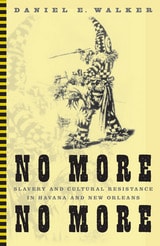
No More, No More
Slavery And Cultural Resistance In Havana And New OrleansDaniel E. Walker
University of Minnesota Press, 2004
An illuminating look at the festival performances of slaves in Havana and New Orleans
However urban slave societies might have differed from their rural counterparts, they still relied on a concerted assault on the psychological, social, and cultural identity of their African-descended inhabitants to maintain power and control. This ambitious book looks at how people of African descent in two such societies—Havana and New Orleans in the nineteenth century—created and maintained their own forms of cultural resistance to the slave regime’s assault and, in the process, put forth autonomous views of self and the social landscape.
In Havana’s annual Día de Reyes festival and in the weekly activities that took place at New Orleans’s Congo Square, author Daniel Walker identifies specific cultural beliefs and activities that Africans brought to the New World and modified in order to withstand and contest the dehumanizing effects of oppression. No More, No More crosses disciplinary boundaries as well, elucidating the economic, social, cultural, and demographic operations at work in two cities and the wide-scale efforts at cultural resistance embodied in public performances.
On Captivity
A Spanish Soldier's Experience in a Havana Prison, 1896-1898Manuel Ciges Aparicio
University of Alabama Press, 2012
A rare and unfiltered witness to Spain’s colonial collapse—Ciges Aparicio’s prison memoir exposes the political, human, and moral stakes of the Cuban War of Independence.
Ciges enlisted in the Spanish army in 1893 at the age of twenty. He served in Africa and then in Cuba, where he opposed Spanish General Valeriano Weyler’s policies in Cuba as well as the war itself. Ciges soon found himself imprisoned and facing execution for treason as punishment for an article critical of Weyler’s conducting of the war that was intercepted by Spanish authorities before it could be published in the pro-Cuban Parisian paper L’Intransigeant.
First published in book form in 1903, Ciges’s account includes detailed observations concerning prison organization, perceptions of political events and personalities of the time, as well as graphic descriptions of the daily life of the men confined in the infamous prison. Ciges is the only one of the so-called Generation of 1898—writers considered to have been deeply marked by el desastre (the loss of the colonies)—who was in Cuba during the war years. His witness to events there, colored by his stance as a freethinker and political skeptic, constitutes a significant historical document. Following his release from prison, Ciges returned to Spain where he resumed his career as an activist journalist and also earned acclaim as a translator and novelist. In time, his political allegiances shifted from socialism to liberal republicanism. He was acting as provincial governor of Avila when he was killed by unidentified assassins on August 4, 1936—eighteen days after the Falangist uprising against the Second Republic.
Return to Havana
The Decline of Cuban Society Under CastroMaurice Halperin
Vanderbilt University Press, 1994
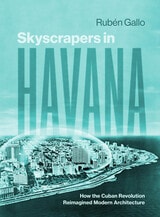
Skyscrapers in Havana
How the Cuban Revolution Reimagined Modern ArchitectureRubén Gallo
University of Chicago Press, 2027
Why Havana attracted the most important architects in the 1950s, and how the Cuban Revolution transformed the uses of these impressive skyscrapers.
During the 1950s, Havana’s Vedado district became an epicenter of modern architecture. Architects from around the world—including Mies van der Rohe, Richard Neutra, and Josep Lluis Sert—worked in Cuba and helped make Havana one of the most modern capitals in Latin America. After the Cuban Revolution, the buildings designed during Cuba’s American-influenced hyper-capitalist past had to be reimagined, about what use what use could luxury hotels, private condominiums, and golf clubs could have in a socialist society. Writers and artists from around the world including Simone de Beauvoir, Agnès Varda, Allen Ginsberg, Graham Greene, and Gabriel García Márquez flocked to Havana to witness the first socialist experiment in the Americas and marveled at the modern towers. French philosopher Jean-Paul Sartre wrote about “Skyscrapers in Havana” for his first journalistic piece about his trip. In contrast, modern architects abandoned Cuba after the Revolution: not even those designers who had built projects there set foot in the island again.
Considering Havana’s architecture as part of a larger Cuban modernity, Gallo places built projects in dialogue with film, literature, and other cultural texts, revealing how poets, novelists, filmmakers, and designers theorized the city’s urban fabric. Skyscrapers in Havana features six chapters, each devoted to an iconic modernist structure, as well as five shorter meditations on the architects, including Le Corbusier, who had the opportunity to go to Cuba after the Revolution but decided to stay away.
Sowing Change
The Making of Havana's Urban AgricultureAdriana Premat
Vanderbilt University Press, 2012
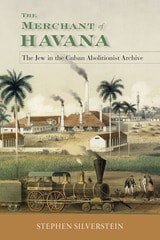
The Merchant of Havana
The Jew in the Cuban Abolitionist ArchiveStephen Silverstein
Vanderbilt University Press, 2016
As Cuba industrialized in the nineteenth century, an epochal realignment of the social order occurred. In this period of change, two seemingly disparate, yet nevertheless intertwined, ideological forces appeared: anti-Semitism and abolitionism. As the antislavery movement became organized in Cuba, the argument grew that Jews participated in the African slave trade and in New World slavery, and that this participation gave Jews extraordinary influence in the new Cuban economy and culture. What was remarkable about this anti-Semitism was the decidedly small Jewish population on the island in this era. This form of anti-Semitism, Silverstein reveals, sprang almost exclusively from mythological beliefs.
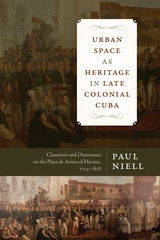
Urban Space as Heritage in Late Colonial Cuba
Classicism and Dissonance on the Plaza de Armas of Havana, 1754-1828By Paul Niell
University of Texas Press, 2015
According to national legend, Havana, Cuba, was founded under the shade of a ceiba tree whose branches sheltered the island’s first Catholic mass and meeting of the town council (cabildo) in 1519. The founding site was first memorialized in 1754 by the erection of a baroque monument in Havana’s central Plaza de Armas, which was reconfigured in 1828 by the addition of a neoclassical work, El Templete. Viewing the transformation of the Plaza de Armas from the new perspective of heritage studies, this book investigates how late colonial Cuban society narrated Havana’s founding to valorize Spanish imperial power and used the monuments to underpin a local sense of place and cultural authenticity, civic achievement, and social order.
Paul Niell analyzes how Cubans produced heritage at the site of the symbolic ceiba tree by endowing the collective urban space of the plaza with a cultural authority that used the past to validate various place identities in the present. Niell’s close examination of the extant forms of the 1754 and 1828 civic monuments, which include academic history paintings, neoclassical architecture, and idealized sculpture in tandem with period documents and printed texts, reveals a “dissonance of heritage”—in other words, a lack of agreement as to the works’ significance and use. He considers the implications of this dissonance with respect to a wide array of interests in late colonial Havana, showing how heritage as a dominant cultural discourse was used to manage and even disinherit certain sectors of the colonial population.

World Film Locations
HavanaEdited by Ann Marie Stock
Intellect Books, 2014
World Film Locations: Havana situates Havana as a modern city in prerevolutionary times, noting the architectural and cultural shifts evident during the revolution, and comments on recent reconfigurations of the city and its inhabitants in the wake of global forces. Among the forty-six scene reviews chosen to show the city in all its multifaceted glory, films such as Our Man in Havana, I Am Cuba, Hello Hemingway, Habana Blues and Chico and Rita are bookended by seven insightful essays. The essays look at the history of revolutionary cinema in Cuba and consider documentary films, from the Latin American Newsreel to avant-garde experimental work, including the island’s documentary tradition showcasing local faces and places that have paved the way for present-day media and audiovisual art. The essays also explore the multifaceted film culture of the capital, the cine club movement, historic cinemas and film venues around the city, the abundance of film festivals such as the International Festival of New Latin American Cinema, and film-themed cafeterias, restaurants, bookstores, and markets.