Results by title
5 books match the query 'Havana (Cuba)'
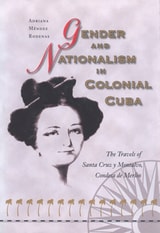
Gender and Nationalism in Colonial Cuba
The Travels of Santa Cruz y Montalvo, Condesa de MerlinAdriana Mendez Rodenas
Vanderbilt University Press, 1998
Born in colonial Havana to an aristocratic Creole family, the future countess of Merlin left Cuba for Spain at an early age. Later, her marriage to the French count Antoine Christophe Merlin and the invasion of French Napoleonic troops precipitated another move to France, where she became one of the belle dames of Paris and began her literary career. She returned only once to Cuba after the death of her husband in 1840, a journey that produced Viaje a la Habana. Upon her return to Paris, Merlin expanded this into La Havane, an ambitious three-volume account of the political, social, and economic organization of the island.
From the viewpoint of feminist and psychoanalytical theory, Gender and Nationalism in Colonial Cuba brilliantly explores the many ways in which issues of gender have contributed to Merlin's virtual absence from the canons of literature and from the discourses on Cuban national identity. Merlin's double identity as both Cuban and French is symbolic of the Cuban exiled condition, a fact taken up by contemporary exiled Cuban writers who see the countess as an alter-ego.
Mendez Rodenas seeks to restore Merlin as the first woman writer in Cuban literary history to articulate a sense of national identity, as well as being Cuba's first female historian. She focuses on Merlin's travel writings because they examine such issues as slavery, independence, nationhood, the role of women, education, and local literature. Together her writings construct an alternative, gendered history of nineteenth-century Cuba that must be acknowledged as both functional and authentic.
By situating Merlin at the intersection of the discourses of gender and nationalism, Mendez Rodenas reveals not only her pioneering role but also the need to expand current critical categories to account for the specificity of the Latin American literary tradition. In the process of restoring Merlin to her appropriate place in the canon of Latin American literature, she broadens our understanding of colonial Cuban history and expands our knowledge of the ways in which travel writing can influence a country's national literature .
Havana and Other Missing Fathers
Mia Leonin
University of Arizona Press, 2009
Shortly after her sixteenth birthday, Leonin learned from her mother that her father, a Cuban exile, was very much alive and living in Florida. Her attempts to contact him, however, were thwarted until four years later, when she left home in search of her roots.
She meets her father, but trying to discover the truth behind him proves to be a more daunting task. Her journey takes her to Miami, Colombia, and Cuba, and her search for cultural identity leads her to create memories, friendships, and romances. She finds moments of connection and redemption, ending up in Havana not as a cultural tourist but as an illegitimate daughter of Cuba looking for validation. What she discovers is an island bereft of fathers and brimming with paternalism. As she becomes entangled with two different men, she descends further into the Havana of poverty, humiliation, and despair, as well as the ever-inventive city that is as passionate as it is contradictory.
Insightful, imaginative, and often poetic, Havana and Other Missing Fathers is Mia Leonin’s recollection of this journey and her longing to learn more about her origins. In the end, she must learn to accept the answers she discovers as well as the questions that remain.
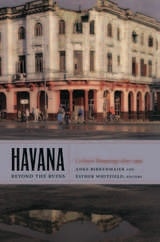
Havana beyond the Ruins
Cultural Mappings after 1989Anke Birkenmaier and Esther Whitfield, eds.
Duke University Press, 2011
Contributors
Emma Álvarez-Tabío Albo
Eric Felipe-Barkin
Anke Birkenmaier
Velia Cecilia Bobes
Mario Coyula-Cowley
Elisabeth Enenbach
Sujatha Fernandes
Jill Hamberg
Patricio del Real
Cecelia Lawless
Jacqueline Loss
Orlando Luis Pardo Lazo
Antonio José Ponte
Nicolás Quintana
Jose Quiroga
Laura Redruello
Rafael Rojas
Joseph L. Scarpaci
Esther Whitfield

Making Home in Havana
Pietropaolo, Vincenzo
Rutgers University Press, 2002
Havana is a city that rarely fails to captivate. But much of the unique beauty and culture of this historic city is rapidly disappearing. As Cuban society finds itself at a crossroads, Havana is more than ever a city on the edge, for although frozen in time as a consequence of Fidel Castro’s revolution, it has certainly not been well preserved. Time, climate, and neglect have eroded a rare architectural legacy, making the need to document this heritage even more pressing than ever before.
Making Home in Havana is an elegant book of photographs and testimonies, recording, questioning, and evoking the meaning of place — in particular, the meaning of home. The combination of fine photography and the words of residents of former palaces, humble apartments, and other dwellings offer us an irresistible portrait of Havana that might otherwise be lost forever.Vincenzo Pietropaolo and Cecelia Lawless have made numerous visits to Havana in order to fully understand and convey the essence of what home means to the inhabitants of the dwellings of the El Vedado and Centro Habana neighborhoods. Together, they—and we—explore how a building becomes a home through its human history as well as its architectural features. With some renovation already underway in colonial Havana, they concentrate on largely unexplored and unrecognized sections that continue to fall into ruin. The intimacy of their connection with the buildings and people offers us a rare combination of documentary realism and high art. Buildings and people speak their histories to us in classic humanistic style. Residents of Havana tell their stories of lifelong efforts to turn decay into beauty, while the photographer’s evocative pictures enable us to feel exactly what they are talking about — a creation of time and space called home.
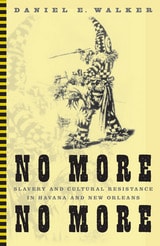
No More, No More
Slavery And Cultural Resistance In Havana And New OrleansDaniel E. Walker
University of Minnesota Press, 2004
An illuminating look at the festival performances of slaves in Havana and New Orleans
However urban slave societies might have differed from their rural counterparts, they still relied on a concerted assault on the psychological, social, and cultural identity of their African-descended inhabitants to maintain power and control. This ambitious book looks at how people of African descent in two such societies—Havana and New Orleans in the nineteenth century—created and maintained their own forms of cultural resistance to the slave regime’s assault and, in the process, put forth autonomous views of self and the social landscape.
In Havana’s annual Día de Reyes festival and in the weekly activities that took place at New Orleans’s Congo Square, author Daniel Walker identifies specific cultural beliefs and activities that Africans brought to the New World and modified in order to withstand and contest the dehumanizing effects of oppression. No More, No More crosses disciplinary boundaries as well, elucidating the economic, social, cultural, and demographic operations at work in two cities and the wide-scale efforts at cultural resistance embodied in public performances.