Results by title
15 books match the query 'Hawai'i'

A Chosen People, a Promised Land
Mormonism and Race in Hawai’iHokulani K. Aikau
University of Minnesota Press, 2012
Christianity figured prominently in the imperial and colonial exploitation and dispossession of indigenous peoples worldwide, yet many indigenous people embrace Christian faith as part of their cultural and ethnic identities. A Chosen People, a Promised Land gets to the heart of this contradiction by exploring how Native Hawaiian members of the Church of Jesus Christ of Latter-Day Saints (more commonly known as Mormons) understand and negotiate their place in this quintessentially American religion.
Mormon missionaries arrived in Hawai‘i in 1850, a mere twenty years after Joseph Smith founded the church. Hokulani K. Aikau traces how Native Hawaiians became integrated into the religious doctrine of the church as a “chosen people”—even at a time when exclusionary racial policies regarding black members of the church were being codified. Aikau shows how Hawaiians and other Polynesian saints came to be considered chosen and how they were able to use their venerated status toward their own spiritual, cultural, and pragmatic ends.
Using the words of Native Hawaiian Latter-Day Saints to illuminate the intersections of race, colonization, and religion, A Chosen People, a Promised Land examines Polynesian Mormon articulations of faith and identity within a larger political context of self-determination.

Aloha Compadre
Latinxs in Hawai'iRudy P. Guevarra
Rutgers University Press, 2023
Aloha Compadre: Latinxs in Hawaiʻi is the first book to examine the collective history and contemporary experiences of the Latinx population of Hawaiʻi. This study reveals that contrary to popular discourse, Latinx migration to Hawaiʻi is not a recent event. In the national memory of the United States, for example, the Latinx population of Hawaiʻi is often portrayed as recent arrivals and not as long-term historical communities with a presence that precedes the formation of statehood itself. Historically speaking, Latinxs have been voyaging to the Hawaiian Islands for over one hundred and ninety years. From the early 1830s to the present, they continue to help shape Hawaiʻi’s history, yet their contributions are often overlooked. Latinxs have been a part of the cultural landscape of Hawaiʻi prior to annexation, territorial status, and statehood in 1959. Aloha Compadre also explores the expanding boundaries of Latinx migration beyond the western hemisphere and into Oceania.
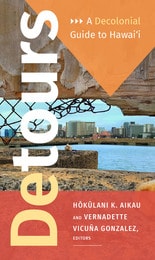
Detours
A Decolonial Guide to Hawai'iHokulani K. Aikau and Vernadetta Vicuña Gonzalez, editors
Duke University Press, 2019
Contributors. Hōkūlani K. Aikau, Malia Akutagawa, Adele Balderston, Kamanamaikalani Beamer, Ellen-Rae Cachola, Emily Cadiz, Iokepa Casumbal-Salazar, David A. Chang, Lianne Marie Leda Charlie, Greg Chun, Joy Lehuanani Enomoto, S. Joe Estores, Nicholas Kawelakai Farrant, Jessica Ka‘ui Fu, Candace Fujikane, Linda H. L. Furuto, Sonny Ganaden, Cheryl Geslani, Vernadette Vicuña Gonzalez, Noelani Goodyear-Ka‘ōpua, Tina Grandinetti, Craig Howes, Aurora Kagawa-Viviani, Noelle M. K. Y. Kahanu, Haley Kailiehu, Kyle Kajihiro, Halena Kapuni-Reynolds, Terrilee N. Kekoolani-Raymond, Kekuewa Kikiloi, William Kinney, Francesca Koethe, Karen K. Kosasa, N. Trisha Lagaso Goldberg, Kapulani Landgraf, Laura E. Lyons, David Uahikeaikalei‘ohu Maile, Brandy Nālani McDougall, Davianna Pōmaika‘i McGregor, Laurel Mei-Singh, P. Kalawai‘a Moore, Summer Kaimalia Mullins-Ibrahim, Jordan Muratsuchi, Hanohano Naehu, Malia Nobrega-Olivera, Katrina-Ann R. Kapā‘anaokalāokeola Nākoa Oliveira, Jamaica Heolimelekalani Osorio, No‘eau Peralto, No‘u Revilla, Kalaniua Ritte, Maya L. Kawailanaokeawaiki Saffery, Dean Itsuji Saranillio, Noenoe K. Silva, Ty P. Kāwika Tengan, Stephanie Nohelani Teves, Stan Tomita, Mehana Blaich Vaughan, Wendy Mapuana Waipā, Julie Warech
Ethnicity and Inequality in Hawai'i
Jonathan Y. Okamura
Temple University Press, 2008
Challenging the dominant view of Hawai’i as a “melting pot paradise”—a place of ethnic tolerance and equality—Jonathan Okamura examines how ethnic inequality is structured and maintained in island society. He finds that ethnicity, not race or class, signifies difference for Hawaii’s people and therefore structures their social relations. In Hawai’i, residents attribute greater social significance to the presumed cultural differences between ethnicities than to more obvious physical differences, such as skin color.
According to Okamura, ethnicity regulates disparities in access to resources, rewards, and privileges among ethnic groups, as he demonstrates in his analysis of socioeconomic and educational inequalities in the state. He shows that socially and economically dominant ethnic groups—Chinese Americans, Japanese Americans, and Whites—have stigmatized and subjugated the islands’ other ethnic groups—especially Native Hawaiians, Filipino Americans, and Samoans. He demonstrates how ethnic stereotypes have been deployed against ethnic minorities and how these groups have contested their subordinate political and economic status by articulating new identities for themselves.

From Honolulu to Brooklyn
Running the American Empire’s Base Paths with Buck Lai and the Travelers from Hawai’iJoel S. Franks
Rutgers University Press, 2022
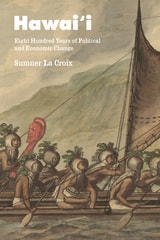
Hawai'i
Eight Hundred Years of Political and Economic ChangeSumner La Croix
University of Chicago Press, 2019
Building on new archaeological and historical research, Sumner La Croix assembles here the economic history of Hawai‘i from the first Polynesian settlements in 1200 through US colonization, the formation of statehood, and to the present day. He shows how the political and economic institutions that emerged and evolved in Hawai‘i during its three centuries of global isolation allowed an economically and culturally rich society to emerge, flourish, and ultimately survive annexation and colonization by the United States. The story of a small, open economy struggling to adapt its institutions to changes in the global economy, Hawai‘i offers broadly instructive conclusions about economic evolution and development, political institutions, and native Hawaiian rights.
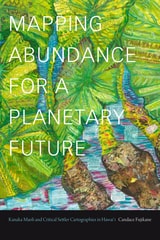
Mapping Abundance for a Planetary Future
Kanaka Maoli and Critical Settler Cartographies in Hawai'iCandace Fujikane
Duke University Press, 2021

Missionaries in Hawai'i
The Lives of Peter and Fanny Gulick, 1797-1883Clifford Putney
University of Massachusetts Press, 2010
Ever since Protestant missionaries from the United States first reached Hawai'i in 1820, they have inspired conflicting passions. In evangelical circles, the missionaries are praised for Christianizing Hawai'i, transforming Hawaiian into a written language, and inoculating the islanders against smallpox. But this celebratory assessment is rejected by modern-day Hawaiian nationalists, who excoriate the missionaries as advance agents of U.S. imperialism.
In this biography of pioneer missionaries Peter and Fanny Gulick, Clifford Putney offers a balanced view of their contributions. He says the nationalists are right to credit the missionaries with drawing Hawai'i into America's political orbit, but argues that the missionary enterprise helped in some ways to preserve key elements of Hawaiian culture.
Based primarily on letters, journals, and other archival materials, Putney's book provides readers with a detailed portrait of the lives of Peter and Fanny Gulick. Inspired by America's Second Great Awakening to spread the Gospel overseas, the Gulicks voyaged to Hawai'i in 1828 and lived there for the next forty-six years, actively proselytizing and working to change the islands. On Kaua'i, they helped to ensure the success of Hawai'i's first sugar plantation and acquainted Hawaiians with inventions such as the wagon. On Moloka'i (later the site of a leper colony) the couple struggled merely to survive. And on O'ahu, they took up ranching and helped to found Punahou School, the alma mater of President Barack Obama.
While laboring in Hawai'i, the Gulicks interacted with kings, queens, and other historically important figures, and Putney chronicles those relationships. He also explores issues of race and gender, and sheds new light on the democratization of government, the spread of capitalism, and the privatization of land. From these last two developments, a number of missionaries grew immensely rich, but the Gulicks did not, and neither did their descendants. A group that includes influential missionaries, educators, and physical fitness experts, the descendants of Peter and Fanny have had numerous books written about them, but Putney is the first to write extensively about the progenitors of the Gulick clan.

Oh, Say, Can You See
The Semiotics of the Military in Hawai’iKathy E. Ferguson
University of Minnesota Press, 1998
Considers what the military presence in Hawai’i tells us about colonialism, gender, race, and class.
Everywhere you look in Hawai’i, you might see the military. And yet, in daily life few residents see the military at all-it is hidden in plain sight. This paradox of invisibility and visibility, of the available and the hidden, is the subject of Oh, Say, Can You See?, which maps the power relations involving gender, race, and class that define Hawai’i in relation to the national security state.
Western intruders into Hawai’i-from the early explorers, missionaries, and sugar planters to the military, tourists, and foreign investors-have seen the island nation as a feminine place, waiting to embrace those who come to penetrate, protect, mold, and develop, yet conveniently lacking whatever the newcomers claim to possess. Thus feminized, this book contends, the islands and the people have been reinscribed with meanings according to the needs, fears, and desires of outsiders. Authors Kathy E. Ferguson and Phyllis Turnbull locate and “excavate” sites of memory, such as cemeteries, memorials, monuments, and museums, to show how the military constructs its gendered narrative upon prior colonial discourses. Among the sites considered are Fort DeRussy, Pearl Harbor, and Punchbowl Cemetery, as well as the practices of citizenship that are produced or foreclosed by the narratives of order and security written upon Hawai’i by the military.This semiotic investigation of ways the military marks Hawai’i necessarily explores the intersection of immigration, colonialism, military expansion, and tourism on the islands. Attending to the ways in which the military represents itself and others represent the military, the authors locate the particular representational elements that both conceal and reveal the military’s presence and power; in doing so, they seek to expand discursive space so that other voices can be heard. ISBN 0-8166-2978-1 Cloth $49.95xxISBN 0-81662979-X Paper $19.95x240 pages 5 7/8 x 9 DecemberBorderlines Series, Volume 10Translation inquiries: University of Minnesota Press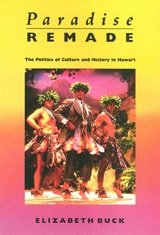
Paradise Remade
The Politics of Culture and History in Hawai'iElizabeth Buck
Temple University Press, 1994
This is a book about the politics of competing cultures and myths in a colonized nation. Elizabeth Buck considers the transformation of Hawaiian culture focusing on the indigenous population rather than on the colonizers. She describes how Hawaii's established religious, social, political, and economic relationships have changed in the past 200 years as a result of Western imperialism. Her account is particularly timely in light of the current Hawaiian demands for sovereignty 100 years after the overthrow of the monarchy in 1893.
Buck examines the social transformation Hawaii from a complex hierarchical, oral society to an American state dominated by corporate tourism and its myths of paradise. She pays particular attention to the ways contemporary Hawaiians are challenging the use of their traditions as the basis for exoticized entertainment.
Buck demonstrates that sacred chants and hula were an integral part of Hawaiian social life; as the repository of the people's historical memory, chants and hula practices played a vital role in maintaining the links between religious, political, and economic relationships. Tracing the ways in which Hawaiian culture has been variously suppressed and constructed by Western explorers, New England missionaries, the tourist industry, ethnomusicologists, and contemporary Hawaiians, Buck offers a fascinating "rereading" of Hawaiian history.

Possessing Polynesians
The Science of Settler Colonial Whiteness in Hawai`i and OceaniaMaile Arvin
Duke University Press, 2019
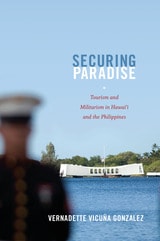
Securing Paradise
Tourism and Militarism in Hawai'i and the PhilippinesVernadette Vicuña Gonzalez
Duke University Press, 2013
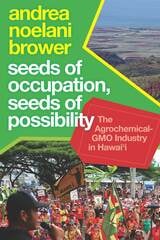
Seeds of Occupation, Seeds of Possibility
The Agrochemical-GMO Industry in Hawai‘iAndrea Noelani Brower
West Virginia University Press, 2022
Hawaiʻi is a primary site for development of herbicide-resistant corn seed and, until recently, was host to more experimental field trials of genetically engineered crops than anywhere else in the world. It is also a node of powerful resistance. While documentaries and popular news stories have profiled the biotech seed industry in Hawaiʻi, Seeds of Occupation, Seeds of Possibility is the first book to detail the social and historical conditions by which the chemical-seed oligopoly came to occupy the most geographically isolated islands in the world and made the soils of Hawaiʻi the epicenter of agrochemical and agricultural biotechnology testing.
Andrea Brower, an activist-scholar from Hawaiʻi, examines the consequences related to genetically engineered seed development for Hawaiʻi’s people and the social movement that has risen in response. With insights beyond the islands, Seeds of Occupation, Seeds of Possibility illuminates why visions for a radically better world must be expanded by intersectional and systemically oriented movements.
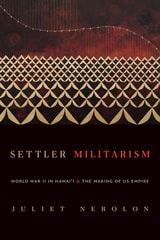
Settler Militarism
World War II in Hawai'i and the Making of US EmpireJuliet Nebolon
Duke University Press, 2024
Staking Claim
Settler Colonialism and Racialization in Hawai'iJudy Rohrer
University of Arizona Press, 2016
Author Judy Rohrer brings together an analysis of racial formation and colonization in the islands through a study of legal cases, contemporary public discourse (local media and literature), and Hawai‘i scholarship. Her analysis exposes how racialization works to obscure—with the ultimate goal of eliminating—native Hawaiian indigeneity, homeland, nation, and sovereignty.
Staking Claim argues that the dual settler colonial processes of racializing native Hawaiians (erasing their indigeneity), and indigenizing non-Hawaiians, enable the staking of non-Hawaiian claims to Hawai‘i. It encourages us to think beyond a settler-native binary by analyzing the ways racializations of Hawaiians and various non-Hawaiian settlers and arrivants bolster settler colonial claims, structures, and white supremacist ideologies.