Results by title
2 books match the query 'Hawaiian guitar music'
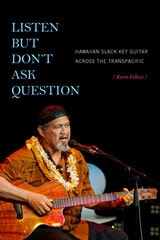
Listen but Don't Ask Question
Hawaiian Slack Key Guitar across the TransPacificKevin Fellezs
Duke University Press, 2019
Performed on an acoustic steel-string guitar with open tunings and a finger-picking technique, Hawaiian slack key guitar music emerged in the mid-nineteenth century. Though performed on a non-Hawaiian instrument, it is widely considered to be an authentic Hawaiian tradition grounded in Hawaiian aesthetics and cultural values. In Listen But Don’t Ask Question Kevin Fellezs listens to Kanaka Maoli (Native Hawaiian) and non-Hawaiian slack key guitarists in Hawai‘i, California, and Japan, attentive to the ways in which notions of Kanaka Maoli belonging and authenticity are negotiated and articulated in all three locations. In Hawai‘i, slack key guitar functions as a sign of Kanaka Maoli cultural renewal, resilience, and resistance in the face of appropriation and occupation, while in Japan it nurtures a merged Japanese-Hawaiian artistic and cultural sensibility. For diasporic Hawaiians in California, it provides a way to claim Hawaiian identity. By demonstrating how slack key guitar is a site for the articulation of Hawaiian values, Fellezs illuminates how slack key guitarists are reconfiguring notions of Hawaiian belonging, aesthetics, and politics throughout the transPacific.
[more]
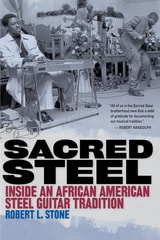
Sacred Steel
Inside an African American Steel Guitar TraditionRobert Stone
University of Illinois Press, 2010
In this book, Robert L. Stone follows the sound of steel guitar into the music-driven Pentecostal worship of two related churches: the House of God and the Church of the Living God. A rare outsider who has gained the trust of members and musicians inside the church, Stone uses nearly two decades of research, interviews, and fieldwork to tell the story of a vibrant musical tradition that straddles sacred and secular contexts.
Most often identified with country and western bands, steel guitar is almost unheard of in African American churches--except for the House of God and the Church of the Living God, where it has been part of worship since the 1930s. Sacred Steel traces the tradition through four generations of musicians and in some two hundred churches extending across the country from Florida to California, Michigan to Alabama. Presenting detailed portraits of musical pioneers such as brothers Troman and Willie Eason and contemporary masters such as Chuck Campbell, Glenn Lee, and Robert Randolph, Stone expertly outlines the fundamental tensions between sacred steel musicians and church hierarchy.
In this thorough analysis of the tradition, Stone explores the function of the music in church meetings and its effect on the congregations. He also examines recent developments such as the growing number of female performers, the commercial appeal of the music, and younger musicians' controversial move of the music from the church to secular contexts.
[more]