Results by title
4 books match the query 'Hawhee, Debra'
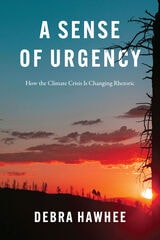
A Sense of Urgency
How the Climate Crisis Is Changing RhetoricDebra Hawhee
University of Chicago Press, 2023
Why is it difficult to talk about climate change? Debra Hawhee argues that contemporary rhetoric relies on classical assumptions about humanity and history that cannot conceive of the present crisis. How do we talk about an unprecedented future or represent planetary interests without privileging our own species? A Sense of Urgency explores four emerging answers, their sheer novelty a record of both the devastation and possible futures of climate change. In developing the arts of magnitude, presence, witness, and feeling, A Sense of Urgency invites us to imagine new ways of thinking with our imperiled planet.
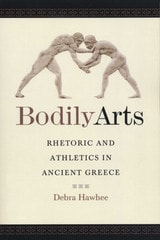
Bodily Arts
Rhetoric and Athletics in Ancient GreeceBy Debra Hawhee
University of Texas Press, 2005
The role of athletics in ancient Greece extended well beyond the realms of kinesiology, competition, and entertainment. In teaching and philosophy, athletic practices overlapped with rhetorical ones and formed a shared mode of knowledge production. Bodily Arts examines this intriguing intersection, offering an important context for understanding the attitudes of ancient Greeks toward themselves and their environment.
In classical society, rhetoric was an activity, one that was in essence "performed." Detailing how athletics came to be rhetoric's "twin art" in the bodily aspects of learning and performance, Bodily Arts draws on diverse orators and philosophers such as Isocrates, Demosthenes, and Plato, as well as medical treatises and a wealth of artifacts from the time, including statues and vases.
Debra Hawhee's insightful study spotlights the notion of a classical gymnasium as the location for a habitual "mingling" of athletic and rhetorical performances, and the use of ancient athletic instruction to create rhetorical training based on rhythm, repetition, and response. Presenting her data against the backdrop of a broad cultural perspective rather than a narrow disciplinary one, Hawhee presents a pioneering interpretation of Greek civilization from the sixth, fifth, and fourth centuries BCE by observing its citizens in action.

Rhetoric in Tooth and Claw
Animals, Language, SensationDebra Hawhee
University of Chicago Press, 2017
Yet when you look at ancient and early modern treatises on rhetoric, what you find is surprising: they’re crawling with animals. With Rhetoric in Tooth and Claw, Debra Hawhee explores this unexpected aspect of early thinking about rhetoric, going on from there to examine the enduring presence of nonhuman animals in rhetorical theory and education. In doing so, she not only offers a counter-history of rhetoric but also brings rhetorical studies into dialogue with animal studies, one of the most vibrant areas of interest in humanities today. By removing humanity and human reason from the center of our study of argument, Hawhee frees up space to study and emphasize other crucial components of communication, like energy, bodies, and sensation.
Drawing on thinkers from Aristotle to Erasmus, Rhetoric in Tooth and Claw tells a new story of the discipline’s history and development, one animated by the energy, force, liveliness, and diversity of our relationships with our “partners in feeling,” other animals.
The Practice of Rhetoric
Poetics, Performance, PhilosophyEdited by Debra Hawhee and Vessela Valiavitcharska
University of Alabama Press, 2022
Essays that show what a broad conception of rhetoric means and does in relation to practice
Rhetoric is the art of emphasis, in the ancient sense of bringing to light or obscuring in shadow, and it is both a practice and a theory about that practice. In recent decades, scholars of rhetoric have turned to approaches that braid together poetics, performance, and philosophy into a “practical art.” The Practice of Rhetoric: Poetics, Performance, Philosophy presents just such an account of rhetoric that presumes and incorporates theoretical approaches, offering a collection of principles assembled in the heat and trials of public practice. The essays gathered in this volume are inspired by the capacious conception of rhetoric put forth by historian of rhetoric Jeffrey Walker, who is perhaps best known for stressing rhetoric’s educational mission and its investments in both theory and practice.
The book extends that vision through the prisms of poetics, performance, and philosophy of argument. Poetics shows rhetoric’s meaning making in all its verbal possibilities and material manifestations, in contexts ranging from mouse-infested medieval fields to the threat of toxin-ridden streams in the twentieth century. Performance puts what is created into the heat of public life, tapping out the rhythms of Byzantine prose or using collage to visually depict the beliefs and convictions of Martin Luther King Jr. Philosophy of argument enacts the mutually constitutive relationship between rhetoric and dialectic, offering new insights on and contexts for old tools like stasis and disputation, while keeping the focus on usefulness and teachability.
Ranging across centuries and contexts, the essays collected here demonstrate the continued need to attend carefully to the cooperation of descriptive language and normative reality, conceptual vocabulary and material practice, public speech and moral self-shaping. This volume will rekindle long-standing conversations about the public, world-making practice of rhetoric, thereby enlivening anew its civic mission.