Results by title
4 books match the query 'Hawkins, Gordon J.'
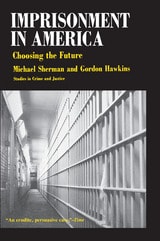
Imprisonment in America
Choosing the FutureMichael Sherman and Gordon J. Hawkins
University of Chicago Press, 1983
"For a few decades American prisons were the wonder of the world. [However] early hopes that a prison regime could be a powerful means of reforming most convicts have been abandoned, and prisons are seen even by some of those who think we need more of them as savage repositories, to be shunned or veiled rather than admired. This sad history is drawn with great insight and learning in [this] important new book about prisons and punishment in America by Michael Sherman and Gordon Hawkins. . . . The views of these professionals must be taken seriously."—Graham Hughes, New York Review of Books
"This is a serious and enlightened and concerned attempt to fuse liberal and conservative attitudes and values to achieve a breakthrough in American penal policy."—Congressional Staff Journal
"This is a serious and enlightened and concerned attempt to fuse liberal and conservative attitudes and values to achieve a breakthrough in American penal policy."—Congressional Staff Journal
[more]

The Honest Politician's Guide to Crime Control
Norval Morris and Gordon J. Hawkins
University of Chicago Press, 1970
Norval Morris and Gordon Hawkins's first premise is that our criminal justice system is a moral busybody, unwisely extended beyond its proper role of protecting persons and property. But they go further and systematically cover the amount, costs, causes, and victims of crime: the reduction of violence; the police; corrections; juvenile delinquency; the function of psychiatry in crime control; organized crime; and the uses of criminological research. On each topic precise recommendations are made and carefully defended.
[more]

The Prison
Policy and PracticeGordon J. Hawkins
University of Chicago Press, 1977
Despite lethal explosions of violence from within and critical assaults from without, it seems certain that prisons will continue to exist for the foreseeable future. Gordon Hawkins argues that certain key issues which attend the use of imprisonment as a penal method must be dealt with realistically. Beginning with a discussion of the ideology of imprisonment and the principal lines of criticism directed at it, Hawkins examines such issues as the prisonization hypothesis (the theory that prisons serve as a training ground for criminals), the role of the prison guard, work in prisons, and the use of prisoners as research subjects for medical experiments. He also deals with the prisoners' rights movement and its implications for the future of prison administration. Hawkins not only makes specific recommendations for reform, he also carefully appraises the barriers which obstruct their implementation.
"Hawkins devotes a large portion of this relatively short book to a discussion of some of the really crucial policy activities that tend to stifle meaningful reform and then goes on to tell how at least some of these policies can be altered. . . . The book concludes with a chapter devoted to a discussion of impediments to change that should be required reading for all serious students of penology."—Choice
"Hawkins has added a much needed down-to-earch analysis of prison. . . . This is not a pessimistic book. It is a realistic book. It avoids the pitfall of utopian and single-factor solutions to an extremely complex problem."—Graeme R. Newman, Annals of the American Academy of Political and Social Science
[more]
The Scale of Imprisonment
Franklin E. Zimring and Gordon J. Hawkins
University of Chicago Press, 1991
Two of the nation's foremost criminal justice scholars present a comprehensive assessment of the factors behind the growth and subsequent overcrowding of American prisons. By critiquing the existing scholarship on prison scale from sociology and history to correctional forecasting and economics, they both reveal that explicit policy changes have had little influence on the increases in imprisonment in recent years and analyze whether it is possible to place limits effectively on prison population.
"The Scale of Imprisonment has an exceptionally well designed literature review of interest to public policy, criminal justice, and public law scholars. Its careful review, analysis, and critique of research is stimulating and inventive."—American Political Science Review
"The authors fram our thoughts about the soaring use of imprisonment and stimulate our thinking about the best way we as criminologists can conduct rational analysis and provide meaningful advice."—Susan Guarino-Ghezzi, Journal of Quantitative Criminology
"Zimring and Hawkins bring a long tradition of excellent criminological scholarship to the seemingly intractable problems of prisons, prison overcrowding, and the need for alternative forms of punishment."—J. C. Watkins, Jr., Choice
[more]