Results by title
9 books match the query 'Hayles, N. Katherine'
#WomenTechLit
Maria Mencia
West Virginia University Press, 2017
This volume will be a useful reference for educators, practice-based researchers, and scholars, not only of electronic literature but also in the adjacent areas of language art, new media art practices, digital humanities, and feminist studies.
Bacteria to AI
Human Futures with Our Nonhuman SymbiontsN. Katherine Hayles
University of Chicago Press, 2025
A new theory of mind that includes nonhuman and artificial intelligences.
The much-lauded superiority of human intelligence has not prevented us from driving the planet into ecological disaster. For N. Katherine Hayles, the climate crisis demands that we rethink basic assumptions about human and nonhuman intelligences. In Bacteria to AI, Hayles develops a new theory of mind—what she calls an integrated cognitive framework (ICF)—that includes the meaning-making practices of lifeforms from bacteria to plants, animals, humans, and some forms of artificial intelligence. Through a sweeping survey of evolutionary biology, computer science, and contemporary literature, Hayles insists that another way of life, with ICF at its core, is not only possible but necessary to safeguard our planet’s future.
Chaos and Order
Complex Dynamics in Literature and ScienceEdited by N. Katherine Hayles
University of Chicago Press, 1991
N. Katherine Hayles traces shifts in meaning that chaos has undergone within the Western tradition, suggesting that the science of chaos articulates categories that cannot be assimilated into the traditional dichotomy of order and disorder. She and her contributors take the relation between order and disorder as a theme and develop its implications for understanding texts, metaphors, metafiction, audience response, and the process of interpretation itself. Their innovative and diverse work opens the interdisciplinary field of chaotics to literary inquiry.
Comparative Textual Media
Transforming the Humanities in the Postprint EraN. Katherine Hayles
University of Minnesota Press, 2013
For the past few hundred years, Western cultures have relied on print. When writing was accomplished by a quill pen, inkpot, and paper, it was easy to imagine that writing was nothing more than a means by which writers could transfer their thoughts to readers. The proliferation of technical media in the latter half of the twentieth century has revealed that the relationship between writer and reader is not so simple. From telegraphs and typewriters to wire recorders and a sweeping array of digital computing devices, the complexities of communications technology have made mediality a central concern of the twenty-first century.
Despite the attention given to the development of the media landscape, relatively little is being done in our academic institutions to adjust. In Comparative Textual Media, editors N. Katherine Hayles and Jessica Pressman bring together an impressive range of essays from leading scholars to address the issue, among them Matthew Kirschenbaum on archiving in the digital era, Patricia Crain on the connection between a child’s formation of self and the possession of a book, and Mark Marino exploring how to read a digital text not for content but for traces of its underlying code.
Primarily arguing for seeing print as a medium along with the scroll, electronic literature, and computer games, this volume examines the potential transformations if academic departments embraced a media framework. Ultimately, Comparative Textual Media offers new insights that allow us to understand more deeply the implications of the choices we, and our institutions, are making.
Contributors: Stephanie Boluk, Vassar College; Jessica Brantley, Yale U; Patricia Crain, NYU; Adriana de Souza e Silva, North Carolina State U; Johanna Drucker, UCLA; Thomas Fulton, Rutgers U; Lisa Gitelman, New York U; William A. Johnson, Duke U; Matthew G. Kirschenbaum, U of Maryland; Patrick LeMieux; Mark C. Marino, U of Southern California; Rita Raley, U of California, Santa Barbara; John David Zuern, U of Hawai‘i at Mānoa.
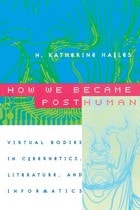
How We Became Posthuman
Virtual Bodies in Cybernetics, Literature, and InformaticsN. Katherine Hayles
University of Chicago Press, 1999
Hayles relates three interwoven stories: how information lost its body, that is, how it came to be conceptualized as an entity separate from the material forms that carry it; the cultural and technological construction of the cyborg; and the dismantling of the liberal humanist "subject" in cybernetic discourse, along with the emergence of the "posthuman."
Ranging widely across the history of technology, cultural studies, and literary criticism, Hayles shows what had to be erased, forgotten, and elided to conceive of information as a disembodied entity. Thus she moves from the post-World War II Macy Conferences on cybernetics to the 1952 novel Limbo by cybernetics aficionado Bernard Wolfe; from the concept of self-making to Philip K. Dick's literary explorations of hallucination and reality; and from artificial life to postmodern novels exploring the implications of seeing humans as cybernetic systems.
Although becoming posthuman can be nightmarish, Hayles shows how it can also be liberating. From the birth of cybernetics to artificial life, How We Became Posthuman provides an indispensable account of how we arrived in our virtual age, and of where we might go from here.
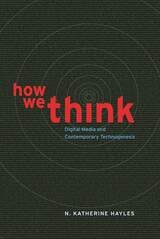
How We Think
Digital Media and Contemporary TechnogenesisN. Katherine Hayles
University of Chicago Press, 2012
“How do we think?” N. Katherine Hayles poses this question at the beginning of this bracing exploration of the idea that we think through, with, and alongside media. As the age of print passes and new technologies appear every day, this proposition has become far more complicated, particularly for the traditionally print-based disciplines in the humanities and qualitative social sciences. With a rift growing between digital scholarship and its print-based counterpart, Hayles argues for contemporary technogenesis—the belief that humans and technics are coevolving—and advocates for what she calls comparative media studies, a new approach to locating digital work within print traditions and vice versa.
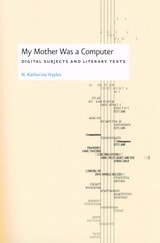
My Mother Was a Computer
Digital Subjects and Literary TextsN. Katherine Hayles
University of Chicago Press, 2005
My Mother Was a Computer explores how the impact of code on everyday life has become comparable to that of speech and writing: language and code have grown more entangled, the lines that once separated humans from machines, analog from digital, and old technologies from new ones have become blurred. My Mother Was a Computer gives us the tools necessary to make sense of these complex relationships. Hayles argues that we live in an age of intermediation that challenges our ideas about language, subjectivity, literary objects, and textuality. This process of intermediation takes place where digital media interact with cultural practices associated with older media, and here Hayles sharply portrays such interactions: how code differs from speech; how electronic text differs from print; the effects of digital media on the idea of the self; the effects of digitality on printed books; our conceptions of computers as living beings; the possibility that human consciousness itself might be computational; and the subjective cosmology wherein humans see the universe through the lens of their own digital age.
We are the children of computers in more than one sense, and no critic has done more than N. Katherine Hayles to explain how these technologies define us and our culture. Heady and provocative, My Mother Was a Computer will be judged as her best work yet.

NanoCulture
Implications of the New TechnoscienceEdited by N. Katherine Hayles
Intellect Books, 2004
Extraordinary visions of material abundance, unprecedented materials, and powerful engineering capabilities have marked the arrival of nanotechnology, as well as dystopian scenarios of self-replicating devices running amok and causing global catastrophe. Largely a future possibility rather than present actuality, nanotechnology has become a potent cultural signifier.
NanoCulture explores the ways in which nanotechnology interacts with, and itself becomes, a cultural construction. Topics include the co-construction of nanoscience and science fiction; the influence of risk assessment and nanotechnology on the shapes of narratives; intersections between nanoscience as a writing practice and experimental literature at the limits of fabrication; the Alice-in-Wonderland metaphor for nanotechnology; and the effects of mediation on nanotechnology and electronic literature.
NanoCulture is produced in collaboration with the nano art exhibit at the Los Angeles County Museum of Art (December 2003-September 2004), created by an interdisciplinary team led by media artist Victoria Vesna and nanoscientist James Gimzewski. NanoCulture is richly illustrated with images from the nano exhibit, which also provides the basis for an ethnographic analysis of collaborative process and an exploration of changing concepts of museum space.
The dynamic uniting these diverse perspectives is boundary crossing: between art, science, and literature; cultural imaginaries, scientific facts, and technological possibilities; actual. virtual, and hybrid spaces; the science of fictions and the fictions of science; and utopian dreams, material constraints, and dystopian nightmares.
The first book-length study focus on cultural implications of nanotechnology, NanoCulture breaks new ground in showing the importance of the new technoscience to contemporary culture and of culture to the development, interpretation, and future of this technoscience.
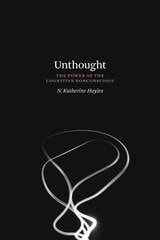
Unthought
The Power of the Cognitive NonconsciousN. Katherine Hayles
University of Chicago Press, 2017
Marshalling fresh insights from neuroscience, cognitive science, cognitive biology, and literature, Hayles expands our understanding of cognition and demonstrates that it involves more than consciousness alone. Cognition, as Hayles defines it, is applicable not only to nonconscious processes in humans but to all forms of life, including unicellular organisms and plants. Startlingly, she also shows that cognition operates in the sophisticated information-processing abilities of technical systems: when humans and cognitive technical systems interact, they form “cognitive assemblages”—as found in urban traffic control, drones, and the trading algorithms of finance capital, for instance—and these assemblages are transforming life on earth. The result is what Hayles calls a “planetary cognitive ecology,” which includes both human and technical actors and which poses urgent questions to humanists and social scientists alike.
At a time when scientific and technological advances are bringing far-reaching aspects of cognition into the public eye, Unthought reflects deeply on our contemporary situation and moves us toward a more sustainable and flourishing environment for all beings.