Results by title
3 books match the query 'Hazardous wastes'
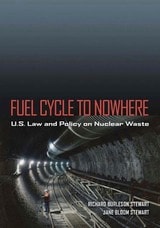
Fuel Cycle to Nowhere
U.S. Law and Policy on Nuclear WasteRichard Burleson Stewart
Vanderbilt University Press, 2011
The first comprehensive history and overview of U.S. nuclear waste law and regulation, Fuel Cycle to Nowhere traces sixty years of nuclear weapons programs, the growth of nuclear power, and their waste legacies, the rise of environmentalism, and the responses of federal agencies. Richard and Jane Stewart expertly analyze the changing policies for storing low-level waste, transuranic waste, spent nuclear fuel, and high-level waste and for regulating their transport by rail and by truck. They also chronicle "a tale of two repositories"--one, the Waste Isolation Pilot Plant in New Mexico, known as WIPP, the world's only operating deep geologic nuclear waste disposal facility, which emerged from a contentious but ultimately successful struggle between federal and state interests; the other, Yucca Mountain, mandated top down by Congress and a failure.
Fuel Cycle to Nowhere provides the critical information and analysis on the waste disposal issues and solutions that the commission, Congress, the administration, journalists, policymakers, and the public so urgently need.
This book is a project of the Consortium for Risk Evaluation with Stakeholder Participation (CRESP), a Vanderbilt University-led, multi-university consortium supported as a cooperative agreement by the U.S. Department of Energy, Office of Environmental This book is a project of the Consortium for Risk Evaluation with Stakeholder Participation (CRESP), a Vanderbilt University-led, multi-university consortium supported as a cooperative agreement by the U.S. Department of Energy, Office of Environmental Management to support safe, effective, publicly credible, risk informed management of existing and future nuclear waste from government and civilian sources through independent strategic analysis, review, applied research and education.

The Politics of Hazardous Waste Management
James P. Lester and Ann O M. Bowman, eds.
Duke University Press, 1983
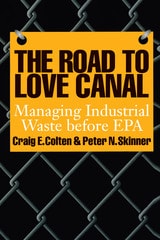
The Road to Love Canal
Managing Industrial Waste before EPABy Craig E. Colten and Peter N. Skinner
University of Texas Press, 1995
The toxic legacy of Love Canal vividly brought the crisis in industrial waste disposal to public awareness across the United States and led to the passage of the Superfund legislation in 1980. To discover why disasters like Love Canal have occurred and whether they could have been averted with knowledge available to waste managers of the time, this book examines industrial waste disposal before the formation of the Environmental Protection Agency in 1970.
Colten and Skinner build their study around three key questions. First, what was known before 1970 about the hazards of certain industrial wastes and their potential for causing public health problems? Second, what were the technical capabilities for treating or containing wastes during that time? And third, what factors other than technical knowledge guided the actions of waste managers before the enactment of explicit federal laws?
The authors find that significant information about the hazards of industrial wastes existed before 1970. Their explanations of why this knowledge did not prevent the toxic legacy now facing us will be essential reading for environmental historians and lawyers, public health personnel, and concerned citizens.