Results by title
64 books match the query 'Healing' and 3 start with a
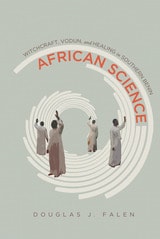
African Science
Witchcraft, Vodun, and Healing in Southern BeninDouglas J. Falen
University of Wisconsin Press, 2020
In this sensitive and personal investigation into Benin's occult world, Douglas J. Falen wrestles with the challenges of encountering a reality in which magic, science, and the Vodun religion converge into a single universal force. He takes seriously his Beninese interlocutors' insistence that the indigenous phenomenon known as àze ("witchcraft") is an African science, credited with fantastic and productive deeds, such as teleportation and supernatural healing.
Although the Beninese understanding of àze reflects positive scientific properties in its use of specialized knowledge to harness nature's energy and realize economic success, its boundless power is inherently ambivalent because it can corrupt its users, who dispense death and destruction. Witches and healers are equivalent to supervillains and superheroes, locked in epic battles over malevolent and benevolent human desires. Beninese people's discourse about such mystical confrontations expresses a philosophy of moral duality and cosmic balance. Falen demonstrates how a deep engagement with another lived reality opens our minds and contributes to understanding across cultural difference.
Although the Beninese understanding of àze reflects positive scientific properties in its use of specialized knowledge to harness nature's energy and realize economic success, its boundless power is inherently ambivalent because it can corrupt its users, who dispense death and destruction. Witches and healers are equivalent to supervillains and superheroes, locked in epic battles over malevolent and benevolent human desires. Beninese people's discourse about such mystical confrontations expresses a philosophy of moral duality and cosmic balance. Falen demonstrates how a deep engagement with another lived reality opens our minds and contributes to understanding across cultural difference.
[more]
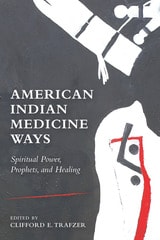
American Indian Medicine Ways
Spiritual Power, Prophets, and HealingEdited by Clifford E. Trafzer
University of Arizona Press, 2017
Indigenous people of wisdom have offered prayers of power, protection, and healing since the dawn of time. From Wovoka, the Ghost Dance prophet, to contemporary healer Kenneth Coosewoon, medicine people have called on the spiritual world to help humans in their relationships with each other and the natural world. Many American Indians—past and present—have had the ability to use power to access wisdom, knowledge, and spiritual understanding.
This groundbreaking collection provides fascinating stories of wisdom, spiritual power, and forces within tribal communities that have influenced the past and may influence the future. Through discussions of omens, prophecies, war, peace, ceremony, ritual, and cultural items such as masks, prayer sticks, sweat lodges, and peyote, this volume offers examples of the ways in which Native American beliefs in spirits have been and remain a fundamental aspect of history and culture. Drawing from written and oral sources, the book offers readers a greater understanding of creation narratives, oral histories, and songs that speak of healers, spirits, and power from tribes across the North American continent.
American Indian medicine ways and spiritual power remain vital today. With the help of spirits, people can heal the sick, protect communities from natural disasters, and mediate power of many kinds between the spiritual and corporeal worlds. As the contributors to this volume illustrate, healers are the connective cloth between the ancient past and the present, and their influence is significant for future generations.
CONTRIBUTORS
R. David Edmunds
Joseph B. Herring
Benjamin Jenkins
Troy R. Johnson
Michelle Lorimer
L. G. Moses
Richard D. Scheuerman
Al Logan Slagle
Clifford E. Trafzer
[more]
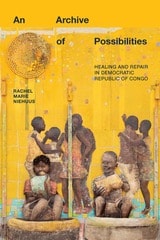
An Archive of Possibilities
Healing and Repair in Democratic Republic of CongoRachel Marie Niehuus
Duke University Press, 2024
In An Archive of Possibilities, anthropologist and surgeon Rachel Marie Niehuus explores possibilities of healing and repair in the eastern Democratic Republic of Congo against a backdrop of 250 years of Black displacement, enslavement, death, and chronic war. Niehuus argues that in a context in which violence characterizes everyday life, Congolese have developed innovative and imaginative ways to live amid and mend from repetitive harm. Drawing on ethnographic fieldwork and the Black critical theory of Achille Mbembe, Christina Sharpe, Alexis Pauline Gumbs and others, Niehuus explores the renegotiation of relationships with land as a form of public healing, the affective experience of living in insecurity, the hospital as a site for the socialization of pain, the possibility of necropolitical healing, and the uses of prophesy to create collective futures. By considering the radical nature of cohabitating with violence, Niehuus demonstrates that Congolese practices of healing imagine and articulate alternative ways of living in a global regime of antiblackness.
[more]