Results by title
10 books match the query 'Health & Safety'

Aging And The Law
Lawrence Frolik
Temple University Press, 1999
After an introduction covering the nature of elder law, social attitudes toward the elderly, aging and ethnicity, and generational justice, the book includes sections on work, income, and wealth; housing; mental capacity; health care decision making; long-term care; health care finance; family and social issues; and abuse, neglect, victimization, and elderly criminals. It concludes with essays on legal representation and ethical issues. The essays have been edited to make them easily accessible to students and the general reader, and Professor Frolik has supplied introductions to the sections, as well as summaries of issues for which the essays could not be included.
Both comprehensive and engaging, Aging and the Law brings together essays by lawyers, social workers, health care professionals, and policy makers, as well as selected case law and congressional hearings.

Bending the Law
The Story of the Dalkon Shield BankruptcyRichard B. Sobol
University of Chicago Press, 1991
"Mr. Sobol has produced a readable yet fully researched and detailed study of the operation of the bankruptcy and its effects upon all concerned—the women who were injured, the swarms of lawyers who represented parties in the bankruptcy, and the court which oversaw the bankruptcy in Richmond. . . . This book adds greatly to the current debate about how strong a managerial federal judge our system should have."—Paul D. Rheingold, New York Law Journal
"Bending the Law is polemical and relentless. It is also minutely researched, fluidly written, and persuasive."—Paul Reidinger, ABA Journal
"Bending the Law is a must read for bankruptcy practitioners, and for anyone else concerned about the use of bankruptcy law to deal with mass torts. Although its author is a civil rights lawyer, he details the subtle art of practicing bankruptcy law with a discerning eye, and is a gifted storyteller as well."—Joryn Jenkins, Federal Bar News and Journal
"This is an accessible history of the case by a veteran civil-rights lawyer."—Washington Post Book World

Conceiving Normalcy
Rhetoric, Law, and the Double Binds of InfertilityElizabeth C. Britt
University of Alabama Press, 2001
This ground-breaking rhetorical analysis examines a 1987 Massachusetts law affecting infertility treatment and the cultural context that makes such a law possible
Elizabeth C. Britt uses a Massachusetts statute requiring insurance coverage for infertility as a lens through which the work of rhetoric in complex cultural processes can be better understood. Countering the commonsensical notion that mandatory insurance coverage functions primarily to relieve the problem of infertility, Britt argues instead that the coverage serves to expose its contours.
Britt finds that the mandate, operating as a technology of normalization, helps to identify the abnormal (the infertile) and to create procedures by which the abnormal can be subjected to reform. In its role in normalizing processes, the mandate is more successful when it sustains, rather than resolves, the distinction between the normal and the abnormal. This distinction is achieved in part by the rhetorical mechanism of the double bind. For the middle-class white women who are primarily served by the mandate, these double binds are created both by the desire for success, control, and order and by adherence to medical models that often frustrate these same desires. The resulting double binds help to create and sustain the tension between fertility and infertility, order and discontinuity, control and chaos, success and failure, tensions that are essential for the process of normalization to continue.
Britt uses extensive interviews with women undergoing fertility treatments to provide the foundation for her detailed analysis. While her study focuses on the example of infertility, it is also more broadly a commentary on the power of definition to frame experience, on the burdens and responsibilities of belonging to social collectives, and on the ability of rhetorical criticism to interrogate cultural formations.
Governing the Global Clinic
HIV and the Legal Transformation of MedicineCarol A. Heimer
University of Chicago Press, 2025
A deep examination of how new, legalistic norms affected the trajectory of global HIV care and altered the practice of medicine.
HIV emerged in the world at a time when medicine and healthcare were undergoing two major transformations: globalization and a turn toward legally inflected, rule-based ways of doing things. It accelerated both trends. While pestilence and disease are generally considered the domain of biological sciences and medicine, social arrangements—and law in particular—are also crucial.
Drawing on years of research in HIV clinics in the United States, Thailand, South Africa, and Uganda, Governing the Global Clinic examines how growing norms of legalized accountability have altered the work of healthcare systems and how the effects of legalization vary across different national contexts. A key feature of legalism is universalistic language, but, in practice, rules are usually imported from richer countries (especially the United States) to poorer ones that have less adequate infrastructure and fewer resources with which to implement them. Challenging readers to reconsider the impulse to use law to organize and govern social life, Governing the Global Clinic poses difficult questions: When do rules solve problems, and when do they create new problems? When do rules become decoupled from ethics, and when do they lead to deeper moral commitments? When do rules reduce inequality? And when do they reflect, reproduce, and even amplify inequality?
Pickleball for Life
Prevent Injury, Play Your Best, & Enjoy the GameJes Reynolds and Sanjay Saint
Michigan Publishing Services, 2022
"Reynolds & Saint share a totally engaging, personalized, honest and insightful guide to growing any players enjoyment of and benefit from pickle ball, with tools toward avoiding injury." - Robert Hogikyan
“This short book is full of tips that will help you to improve your overall health, reduce chance of injury, and improve your game, while maximizing your enjoyment of this amazing sport!” - Larry Junck
"Pickleball for Life is a concise guide to keeping you flexible and mobile not just for a better dinking game but to keep you on the court into your 80s." - Christy Howden, Co-owner of Wolverine Pickleball
"Reynolds & Saint place personal training at your fingertips. Their instruction not only improves your game but offers a safer solution to reduce pain after you play." - Vineet Chopra
Psychiatric Malpractice
Stories of Patients, Psychiatrists, and the LawKelley, James L
Rutgers University Press, 1996
• Two weeks after Johnny Moore was discharged from a psychiatric hospital, the deeply troubled teenager took a lethal overdose of the antidepressant prescribed by his psychiatrist.
• Dennis Gould suffered from paranoid schizophrenia. He let a streetcar cut off his right arm rather than carry out his divine mission to kill his ex-girlfriend, Shelley Rotman; three years later––while under psychiatric care and after several hospitalizations––Gould stabbed the young woman to death with his left arm.
• After seven months of psychotherapy as his only treatment in a private psychiatric hospital, Raphael Osheroff’s symptoms of the agitated depression that had destroyed his medical practice and personal life were more severe than ever. At a second hospital, Osheroff was given the antidepressant drugs he had been asking for––and he rapidly improved.
• Joan Barkley went to Dr. Jonathan Fox for help in overcoming her addiction to Darvon. After a year of therapy, the twice-weekly sessions turned into intense sexual encounters, which continued for two years.
James Kelley tells the true stories of people who sought help from psychiatrists and ended up suing them for malpractice. These tales are compelling, tragic, and sometimes bizarre. They offer a unique view into a relationship that is normally confidential and caring––but can be catastrophic when it goes wrong. Kelley discusses several cases that received national attention: former Reagan administration press secretary James Brady's suit against the psychiatrist who had been treating John Hinckley; the Tarasoff decision that established the psychiatrist’s duty to warn potential victims of a patient’s threats; and the disciplinary proceedings against Dr. Margaret Bean-Bayog for her unusual “mothering” treatment of Paul Lozano.
Kelley accompanies detailed accounts of courtroom clashes––based on court records––with clear, even-handed treatments of four kinds of psychiatric malpractice cases: a patient’s suicide, a patient’s violence against other people, a psychotherapist's sexual misconduct, and the use of unconventional treatments. With a wealth of examples, he explains the role of psychiatrists as expert witnesses against each other, the difficulties of predicting the outcomes of these suits, and the balances psychiatrists and judges have to strike between the duties owed to patients, on the one hand, and to society on the other.
Whether you identify with the patients or the psychiatrists, you will find these tales unforgettable. Kelley writes in nontechnical language for the general reader, stressing the human elements. His lucid analyses of key, current issues make his book essential reading for professionals in mental health or law––and for anyone contemplating a malpractice suit.

Suing for Medical Malpractice
Frank A. Sloan, Penny B. Githens, Ellen Wright Clayton, Gerald B. Hickson, Dougl
University of Chicago Press, 1993
The authors survey claims filed in Florida between 1986 and 1989 by people who suffered permanent injury or death during birth or during treatment in an emergency room. How often did illegitimate claims result in financial awards? What was the relation between the injury and the amount the patient lost economically? How much did the plaintiffs actually recover? How did the claimants choose their lawyers and what kind of relationship did they have?
Contrary to common perceptions, in the majority of cases the claims were merited, and the authors found that claimants were on average substantially undercompensated—only about one-fifth of plaintiffs recovered more than their economic loss caused by injury or death. The evidence in this book suggests that placing dollar limits on malpractice cases is unjustified and that our tort system is not so faulty after all.
The Future of Healthcare Reform in the United States
Edited by Anup Malani and Michael H. Schill
University of Chicago Press, 2015
In the years since the passage of the Patient Protection and Affordable Care Act (PPACA, or, colloquially, Obamacare), most of the discussion about it has been political. But as the politics fade and the law's many complex provisions take effect, a much more interesting question begins to emerge: How will the law affect the American health care regime in the coming years and decades?
This book brings together fourteen leading scholars from the fields of law, economics, medicine, and public health to answer that question. Taking discipline-specific views, they offer their analyses and predictions for the future of health care reform. By turns thought-provoking, counterintuitive, and even contradictory, the essays together cover the landscape of positions on the PPACA's prospects. Some see efficiency growth and moderating prices; others fear a strangling bureaucracy and spiraling costs. The result is a deeply informed, richly substantive discussion that will trouble settled positions and lay the groundwork for analysis and assessment as the law's effects begin to become clear.
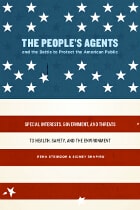
The People's Agents and the Battle to Protect the American Public
Special Interests, Government, and Threats to Health, Safety, and the EnvironmentRena Steinzor and Sidney Shapiro
University of Chicago Press, 2010
Reasonable people disagree about the reach of the federal government, but there is near-universal consensus that it should protect us from such dangers as bacteria-infested food, harmful drugs, toxic pollution, crumbling bridges, and unsafe toys. And yet, the agencies that shoulder these responsibilities are in shambles; if they continue to decline, lives will be lost and natural resources will be squandered. In this timely book, Rena Steinzor and Sidney Shapiro take a hard look at the tangled web of problems that have led to this dire state of affairs.
It turns out that the agencies are not primarily to blame and that regulatory failure actually stems from a host of overlooked causes. Steinzor and Shapiro discover that unrelenting funding cuts, a breakdown of the legislative process, an increase in the number of political appointees, a concurrent loss of experienced personnel, chaotic White House oversight, and ceaseless political attacks on the bureaucracy all have contributed to the broken system. But while the news is troubling, the authors also propose a host of reforms, including a new model for measuring the success of the agencies and a revitalization of the civil service. The People’s Agents and the Battle to Protect the American Public is an urgent and compelling appeal to renew America’s best traditions of public service.

Whither College Sports
Amateurism, Athlete Safety, and Academic IntegrityAndrew Zimbalist
Rutgers University Press, 2022