Results by title

12 books match the query 'Health and race'
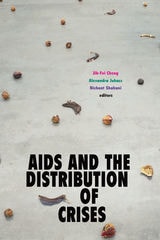
cover of AIDS and the Distribution of Crises

AIDS and the Distribution of Crises

Jih-Fei Cheng, Alexandra Juhasz, and Nishant Shahani, editors

Duke University Press, 2020

AIDS and the Distribution of Crises engages with the AIDS pandemic as a network of varied historical, overlapping, and ongoing crises born of global capitalism and colonial, racialized, gendered, and sexual violence. Drawing on their investments in activism, media, anticolonialism, feminism, and queer and trans of color critiques, the scholars, activists, and artists in this volume outline how the neoliberal logic of “crisis” structures how AIDS is aesthetically, institutionally, and politically reproduced and experienced. Among other topics, the authors examine the writing of the history of AIDS; settler colonial narratives and laws impacting risk in Indigenous communities; the early internet regulation of both content and online AIDS activism; the Black gendered and sexual politics of pleasure, desire, and (in)visibility; and how persistent attention to white men has shaped AIDS as intrinsic to multiple, unremarkable crises among people of color and in the Global South.

Contributors. Cecilia Aldarondo, Pablo Alvarez, Marlon M. Bailey, Emily Bass, Darius Bost, Ian Bradley-Perrin, Jih-Fei Cheng, Bishnupriya Ghosh, Roger Hallas, Pato Hebert, Jim Hubbard, Andrew J. Jolivette, Julia S. Jordan-Zachery, Alexandra Juhasz, Dredge Byung'chu Kang-Nguyễn, Theodore (Ted) Kerr, Catherine Yuk-ping Lo, Cait McKinney, Viviane Namaste, Elton Naswood, Cindy Patton, Margaret Rhee, Juana María Rodríguez, Sarah Schulman, Nishant Shahani, C. Riley Snorton, Eric A. Stanley, Jessica Whitbread, Quito Ziegler
[more]
cover of Inclusion: The Politics of Difference in Medical Research

Inclusion

The Politics of Difference in Medical Research

Steven Epstein

University of Chicago Press, 2007

With Inclusion, Steven Epstein argues that strategies to achieve diversity in medical research mask deeper problems, ones that might require a different approach and different solutions.

Formal concern with this issue, Epstein shows, is a fairly recent phenomenon. Until the mid-1980s, scientists often studied groups of white, middle-aged men—and assumed that conclusions drawn from studying them would apply to the rest of the population. But struggles involving advocacy groups, experts, and Congress led to reforms that forced researchers to diversify the population from which they drew for clinical research. While the prominence of these inclusive practices has offered hope to traditionally underserved groups, Epstein argues that it has drawn attention away from the tremendous inequalities in health that are rooted not in biology but in society.

“Epstein’s use of theory to demonstrate how public policies in the health profession are shaped makes this book relevant for many academic disciplines. . . . Highly recommended.”—Choice

“A masterful comprehensive overview of a wide terrain.”—Troy Duster, Biosocieties
[more]
cover of Managing Sickle Cell Disease: In Low-Income Families

Managing Sickle Cell Disease

In Low-Income Families

Shirley A. Hill

Temple University Press, 2003

As many as 30,000 African Americans have sickle cell disease (SCD). Though the political activism of the 1960s and a major 1970s health campaign spurred demands for testing, treatment, and education programs, little attention has been given to how families cope with SCD. This first study to give SCD a social, economic, and cultural context documents the daily lives of families living with this threatening illness. Specifically, Shirley A. Hill examines how low-income African American mothers with children suffering from this hereditary, incurable, and chronically painful disease, react to the diagnosis and manage their family's health care.The 23 mostly single mothers Hill studies survive in an inner-city world of social inequality. Despite limited means, they actively participate, create, and define the social world they live in, their reality shaped by day-to-day caregiving. These women overcome obstacles by utilizing such viable alternatives as sharing child care with relatives within established kinship networks.Highlighting the role of class, race, and gender in the illness experience, Hill interprets how these women reject, redefine, or modify the objective scientific facts about SCD. She acknowledges and explains the relevance of child-bearing and motherhood to African American women's identity, revealing how the revelation of the SCD trait or the diagnosis of one child often does not affect a woman's interpretation of her reproductive rights.
[more]
cover of Pedagogies of Woundedness: Illness, Memoir, and the Ends of the Model Minority

Pedagogies of Woundedness

Illness, Memoir, and the Ends of the Model Minority

James Kyung-Jin Lee

Temple University Press, 2022

The pressures Asian Americans feel to be socially and economically exceptional include an unspoken mandate to always be healthy. Nowhere is this more evident than in the expectation for Asian Americans to enter the field of medicine, principally as providers of care rather than those who require care. Pedagogies of Woundedness explores what happens when those considered model minorities critically engage with illness and medicine whether as patients or physicians. 

James Kyung-Jin Lee considers how popular culture often positions Asian Americans as medical authorities and what that racial characterization means. Addressing the recent trend of writing about sickness, disability, and death, Lee shows how this investment in Asian American health via the model minority is itself a response to older racial forms that characterize Asian American bodies as diseased. Moreover, he pays attention to what happens when academics get sick and how illness becomes both methodology and an archive for scholars. 

Pedagogies of Woundedness also explores the limits of biomedical “care,” the rise of physician chaplaincy, and the impact of COVID. Throughout his book and these case studies, Lee shows the social, ethical, and political consequences of these common (mis)conceptions that often define Asian Americans in regard to health and illness.
[more]
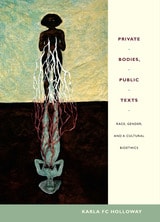
cover of Private Bodies, Public Texts: Race, Gender, and a Cultural Bioethics

Private Bodies, Public Texts

Race, Gender, and a Cultural Bioethics

Karla FC Holloway

Duke University Press, 2011
In Private Bodies, Public Texts, Karla FC Holloway examines instances where medical issues and information that would usually be seen as intimate, private matters are forced into the public sphere. As she demonstrates, the resulting social dramas often play out on the bodies of women and African Americans. Holloway discusses the spectacle of the Terri Schiavo right-to-die case and the injustice of medical researchers’ use of Henrietta Lacks’s cell line without her or her family’s knowledge or permission. She offers a provocative reading of the Tuskegee syphilis study and a haunting account of the ethical dilemmas that confronted physicians, patients, and families when a hospital became a space for dying rather than healing during Hurricane Katrina; even at that dire moment, race mattered. Private Bodies, Public Texts is a compelling call for a cultural bioethics that attends to the historical and social factors that render some populations more vulnerable than others in medical and legal contexts. Holloway proposes literature as a conceptual anchor for discussions of race, gender, bioethics, and the right to privacy. Literary narratives can accommodate thick description, multiple subjectivities, contradiction, and complexity.
[more]
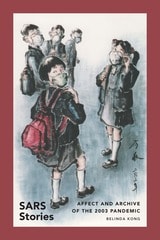
cover of SARS Stories: Affect and Archive of the 2003 Pandemic

SARS Stories

Affect and Archive of the 2003 Pandemic

Belinda Kong

Duke University Press, 2024

In SARS Stories, Belinda Kong delves into the cultural archive of the 2003 SARS pandemic, examining Chinese-language creative works and social practices at the epicenters of the outbreak in China and Hong Kong. As the COVID-19 pandemic has highlighted issues of anti-Asian racism and sinophobia, Kong traces how Chinese people navigated the SARS pandemic and created meaning amid crisis through cultures of epidemic expression. From sentimental romances and Cantopop songs to raunchy sex comedies and crowdsourced ghost tales, unexpected and minor genres and creators of Chinese popular culture highlight the resilience and humanity of those living through the pandemic. Rather than narrating pandemic life in terms of crisis and catastrophe, Kong argues that these works highlight Chinese practices of community, care, and love amid disease. She also highlights the persistence of orientalism in anglophone accounts of SARS index patients and global reporting on COVID-era China. Kong shows how the Chinese experiences of living with SARS can reshape global feelings toward pandemic social life and foster greater fellowship in the face of pandemics.
[more]
cover of Structures of Indifference: An Indigenous Life and Death in a Canadian City

Structures of Indifference

An Indigenous Life and Death in a Canadian City

Mary Jane Logan McCallum

University of Manitoba Press, 2018
[more]
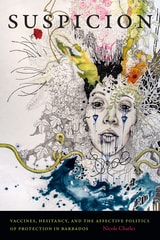
cover of Suspicion: Vaccines, Hesitancy, and the Affective Politics of Protection in Barbados

Suspicion

Vaccines, Hesitancy, and the Affective Politics of Protection in Barbados

Nicole Charles

Duke University Press, 2021

In 2014 Barbados introduced a vaccine to prevent certain strains of the human papillomavirus (HPV) and reduce the risk of cervical cancer in young women. Despite the disproportionate burden of cervical cancer in the Caribbean, many Afro-Barbadians chose not to immunize their daughters. In Suspicion, Nicole Charles reframes Afro-Barbadian vaccine refusal from a question of hesitancy to one of suspicion. Drawing on ethnographic fieldwork, black feminist theory, transnational feminist studies and science and technology studies, Charles foregrounds Afro-Barbadians' gut feelings and emotions and the lingering trauma of colonial and biopolitical violence. She shows that suspicion, far from being irrational, is a fraught and generative affective orientation grounded in concrete histories of mistrust of government and coercive medical practices foisted on colonized peoples. By contextualizing suspicion within these longer cultural and political histories, Charles troubles traditional narratives of vaccine hesitancy while offering new entry points into discussions on racialized biopolitics, neocolonialism, care, affect, and biomedicine across the Black diaspora.

Duke University Press Scholars of Color First Book Award recipient

[more]
cover of The African Exchange: Toward a Biological History of Black People

The African Exchange

Toward a Biological History of Black People

Kenneth F. Kiple

Duke University Press, 1988

David Eltis has observed that "in terms of immigration, America was an extension of Africa rather than Europe until late in the 19th century." The unwilling African immigrants were not spread evenly across the Americas; the overwhelming majority arrived in tropical and subtropical "plantation America" with the result that the disease and nutritional environments of this region also became extensions of Africa. While the implications of disease ecology for world history have been examined, and the details of the "Colombian exchange" of plants and pathogens between Europe and the Americas studied, we have no comparable study of the "African exchange."
The essays in this volume form the cutting edge of biohistorical research that promises to rewrite the story of humankind's past in significant ways.
[more]
cover of The Death Gap: How Inequality Kills

The Death Gap

How Inequality Kills

David A. Ansell, MD

University of Chicago Press, 2017

We hear plenty about the widening income gap between the rich and the poor in America and about the expanding distance separating the haves and the have-nots. But when detailing the many things that the poor have not, we often overlook the most critical—their health. The poor die sooner. Blacks die sooner. And poor urban blacks die sooner than almost all other Americans. In nearly four decades as a doctor at hospitals serving some of the poorest communities in Chicago, David A. Ansell, MD,  has witnessed firsthand the lives behind these devastating statistics. In The Death Gap, he gives a grim survey of these realities, drawn from observations and stories of his patients.

While the contrasts and disparities among Chicago’s communities are particularly stark, the death gap is truly a nationwide epidemic—as Ansell shows, there is a thirty-five-year difference in life expectancy between the healthiest and wealthiest and the poorest and sickest American neighborhoods. If you are poor, where you live in America can dictate when you die. It doesn’t need to be this way; such divisions are not inevitable. Ansell calls out the social and cultural arguments that have been raised as ways of explaining or excusing these gaps, and he lays bare the structural violence—the racism, economic exploitation, and discrimination—that is really to blame. Inequality is a disease, Ansell argues, and we need to treat and eradicate it as we would any major illness. To do so, he outlines a vision that will provide the foundation for a healthier nation—for all.

Inequality is all around us, and often the distance between high and low life expectancy can be a matter of just a few blocks. But geography need not be destiny, urges  Ansell. In The Death Gap he shows us how we can face this national health crisis head-on and take action against the circumstances that rob people of their dignity and their lives.
[more]
cover of The Death Gap: How Inequality Kills

The Death Gap

How Inequality Kills

David A. Ansell, MD

University of Chicago Press, 2021

We hear plenty about the widening income gap between the rich and the poor in America and about the expanding distance separating the haves and the have-nots. But when detailing the many things that the poor have not, we often overlook the most critical—their health. The poor die sooner. Blacks die sooner. And poor urban blacks die sooner than almost all other Americans. In nearly four decades as a doctor at hospitals serving some of the poorest communities in Chicago, David A. Ansell, MD,  has witnessed firsthand the lives behind these devastating statistics. In The Death Gap, he gives a grim survey of these realities, drawn from observations and stories of his patients.

While the contrasts and disparities among Chicago’s communities are particularly stark, the death gap is truly a nationwide epidemic—as Ansell shows, there is a thirty-five-year difference in life expectancy between the healthiest and wealthiest and the poorest and sickest American neighborhoods. If you are poor, where you live in America can dictate when you die. It doesn’t need to be this way; such divisions are not inevitable. Ansell calls out the social and cultural arguments that have been raised as ways of explaining or excusing these gaps, and he lays bare the structural violence—the racism, economic exploitation, and discrimination—that is really to blame. Inequality is a disease, Ansell argues, and we need to treat and eradicate it as we would any major illness. To do so, he outlines a vision that will provide the foundation for a healthier nation—for all.

As the COVID-19 mortality rates in underserved communities proved, inequality is all around us, and often the distance between high and low life expectancy can be a matter of just a few blocks. Updated with a new foreword by Chicago mayor Lori Lightfoot and an afterword by Ansell, The Death Gap speaks to the urgency to face this national health crisis head-on.
[more]
cover of The Pandemic Divide: How COVID Increased Inequality in America

The Pandemic Divide

How COVID Increased Inequality in America

Gwendolyn L. Wright, Lucas Hubbard, and William A. Darrity, editors

Duke University Press, 2022

As COVID-19 made inroads in the United States in spring 2020, a common refrain rose above the din: “We’re all in this together.” However, the full picture was far more complicated—and far less equitable. Black and Latinx populations suffered illnesses, outbreaks, and deaths at much higher rates than the general populace. Those working in low-paid jobs and those living in confined housing or communities already disproportionately beset by health problems were particularly vulnerable. The contributors to The Pandemic Divide explain how these and other racial disparities came to the forefront in 2020. They explore COVID-19’s impact on multiple arenas of daily life—including wealth, health, housing, employment, and education—while highlighting what steps could have been taken to mitigate the full force of the pandemic. Most crucially, the contributors offer concrete public policy solutions that would allow the nation to respond effectively to future crises and improve the long-term well-being of all Americans.

Contributors. Fenaba Addo, Steve Amendum, Leslie Babinski, Sandra Barnes, Mary T. Bassett, Keisha Bentley-Edwards, Kisha Daniels, William A. Darity Jr., Melania DiPietro, Jane Dokko, Fiona Greig, Adam Hollowell, Lucas Hubbard, Damon Jones, Steve Knotek, Arvind Krishnamurthy, Henry Clay McKoy Jr., N. Joyce Payne, Erica Phillips, Eugene Richardson, Paul Robbins, Jung Sakong, Marta Sánchez, Melissa Scott, Kristen Stephens, Joe Trotter, Chris Wheat, Gwendolyn L. Wright
[more]