Results by title

4 books match the query 'Health behavior'
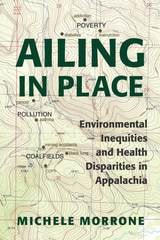
cover of Ailing in Place: Environmental Inequities and Health Disparities in Appalachia

Ailing in Place

Environmental Inequities and Health Disparities in Appalachia

Michele Morrone

Ohio University Press, 2020

In Ailing in Place, Michele Morrone explores the relationship between environmental conditions in Appalachia and health outcomes that are too often ascribed to individual choices only. She applies quantitative data to observations from environmental health professionals to frame the ways in which the environment, as a social determinant of health, leads to health disparities in Appalachian communities. These examples—these stories of place—trace the impacts of water quality, waste disposal, and natural resource extraction on the health and quality of life of Appalachian people.

Public health is inextricably linked to place. Environmental conditions such as contaminated water, unsafe food, and polluted air are as important as culture, community, and landscape in characterizing a place and determining the health outcomes of the people who live there. In some places, the state of the environment is a consequence of historical activities related to natural resources and cultural practices. In others, political decisions to achieve short-term economic objectives are made with little consideration of long-term public health consequences.

[more]
cover of Family Secrets: Risking Reproduction in Central Mozambique

Family Secrets

Risking Reproduction in Central Mozambique

Rachel R. Chapman

Vanderbilt University Press, 2010

Behind a thatched hut, a birthing woman bleeds to death only minutes from "life-saving" maternity care. Author Rachel Chapman begins Family Secrets with the deceptively simple question, "Why don't women in Mozambique use existing prenatal and maternity services?" then widens her analysis to include a whole universe of cultural, political, and economic forces. Fusing cultural anthropology with political economy, Chapman vividly demonstrates how neoliberalism and the increasing importance of the market have led to changing sexual and reproductive strategies for women.

Pregnant herself during her research, Chapman interviewed 83 women during pregnancy and postpartum. She discovered that the social relations surrounding traditional Shona practices, Christian faith healing, and Western biomedical treatments are as important to women's choices as the efficacy of the therapies.
[more]
cover of Lessons in Mortality: Doctors and Patients Struggling Together

Lessons in Mortality

Doctors and Patients Struggling Together

Allen B. Weisse, M.D.

University of Missouri Press, 2006
It doesn’t take a trip to the doctor to know that the bond between physicians and patients isn’t what it used to be. Specialization, rising costs, managed care, the insurance industry, the shadow of litigation—so many factors have changed what was once a traditional relationship grounded in respect and caring. 
            In light of the altered climate in health care, this thoughtful book deals with the way that today’s doctors and patients view themselves and one another. Allen Weisse has observed the changing medical scene during half a century of treating patients and training future physicians, and he writes frankly here about how doctors and patients have come to deal with illness in the twenty-first century. 
Weisse first recalls his own brush with death as a young man diagnosed with testicular cancer—a time when one thinks of God and Death and little else. He then shares true stories of how different people have dealt with cancer, heart disease, stroke, infectious disease, AIDS, and other dire diagnoses—narratives enhanced by professional savvy and enriched by the kind of empathy that the survivor of such a calamity can provide.
Drawing from a storehouse of experiences shared by colleagues, patients, and friends, Weisse writes with passion, conviction, and clarity to encourage a renewal of the openness and trust that seem to be lacking in today’s doctor-patient relationships. These are accounts both uplifting and disturbing—some sad, others tinged with humor—intended to make doctors and patients alike come to a fuller realization that we are all together in this delicate but crucial business of staying alive.
            While not quite foreseeing a return to the Norman Rockwell image of the family physician, Weisse urges the kind of care and compassion that patients often feel is lacking from their doctors, and he reassures victims of seemingly hopeless conditions that, despite the obstacles they often face, there are still health care professionals who truly have their patients’ welfare foremost in mind. Lessons in Mortality is just what the doctor ordered for a health care system in crisis: an honest look at the medical profession that encourages greater understanding on the part of both physicians and patients, reminding us that what we most need is one another.
[more]
cover of Once Upon A Virus

Once Upon A Virus

Diane E. Goldstein

Utah State University Press, 2004

Once Upon a Virus explores how contemporary, or "urban," legends are indicators of culturally complex attitudes toward health and illness.

Tracing the rich tradition of AIDS legends in relation to current scholarship on belief, Diane Goldstein shows how such stories not only articulate widespread perceptions of risk, health care, and health policy, they also influence official and scientific approaches to the disease and its management. Notions that appear in narratives of who gets AIDS, how and why, are indicators of broad issues involving health beliefs, concerns, and needs.

[more]