Results by title
4 books match the query 'Health status indicators'
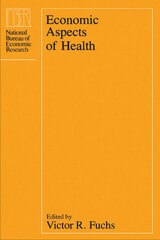
Economic Aspects of Health
Edited by Victor R. Fuchs
University of Chicago Press, 1982
Unlike earlier work in medical economics, which has focused on medical care, these ten papers stress the production and consequences of health itself. They reveal a serious concern with real-world health problems in their investigation of such subjects as infant mortality, life expectancy, morbidity, and disability. These papers are unusual, as well, in bringing to bear on these problems new and powerful theoretical and statistical tools. They draw on, and in some cases are, original sources for new bodies of data. As such, Economic Aspects of Health comprises a useful blend of relevance and rigor.
[more]
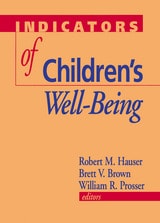
Indicators of Children's Well-Being
Robert M. Hauser
Russell Sage Foundation, 1997
The search for reliable information on the well-being of America's young is vital to designing programs to improve their lives. Yet social scientists are concerned that many measurements of children's physical and emotional health are inadequate, misleading, or outdated, leaving policymakers ill-informed. Indicators of Children's Well-Being is an ambitious inquiry into current efforts to monitor children from the prenatal period through adolescence. Working with the most up-to-date statistical sources, experts from multiple disciplines assess how data on physical development, education, economic security, family and neighborhood conditions, and social behavior are collected and analyzed, what findings they reveal, and what improvements are needed to create a more comprehensive and policy-relevant system of measurement. Today's climate of welfare reform has opened new possibilities for program innovation and experimentation, but it has also intensified the need for a clearly defined and wide-ranging empirical framework to pinpoint where help is needed and what interventions will succeed. Indicators of Children's Well-Being emphasizes the importance of accurate studies that address real problems. Essays on children's material well-being show why income data must be supplemented with assessments of housing, medical care, household expenditure, food consumption, and education. Other contributors urge refinements to existing survey instruments such as the Census and the Current Population Survey. The usefulness of records from human service agencies, child welfare records, and juvenile court statistics is also evaluated.
[more]

Measuring Functioning and Well-Being
The Medical Outcomes Study ApproachAnita L. Stewart and John E. Ware Jr., eds.
Duke University Press, 1992
Measuring Functioning and Well-Being is a comprehensive account a broad range of self-reported functioning and well-being measures developed for the Medical Outcomes Study, a large-sale study of how patients fare with health care in the United States. This book provides a set of ready-to-use generic measures that are applicable to all adults, including those well and chronically ill, as well as a methodological guide to collecting health data and constructing health measures. As demand increases for more practical methods to monitor the outcomes of health care, this volume offers a timely and valuable contribution to the field.
The contributors address conceptual and methodological issues involved in measuring such important health status concepts as: physical, social, and role functioning; psychological distress and well-being; general health perceptions; energy and fatigue; sleep; and pain. The authors present psychometric results and explain how to administer, score, and interpret the measures.
Comprising the work of a number of highly respected scholars in the field of health assessment, Measuring Functioning and Well-Being will be of great interest and value to the growing number of researchers, policymakers, and clinicians concerned with the management and evaluation of health care.
[more]
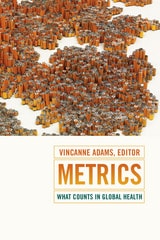
Metrics
What Counts in Global HealthVincanne Adams, editor
Duke University Press, 2016
This volume's contributors evaluate the accomplishments, limits, and consequences of using quantitative metrics in global health. Whether analyzing maternal mortality rates, the relationships between political goals and metrics data, or the links between health outcomes and a program's fiscal support, the contributors question the ability of metrics to solve global health problems. They capture a moment when global health scholars and practitioners must evaluate the potential effectiveness and pitfalls of different metrics—even as they remain elusive and problematic.
Contributors. Vincanne Adams, Susan Erikson, Molly Hales, Pierre Minn, Adeola Oni-Orisan, Carolyn Smith-Morris, Marlee Tichenor, Lily Walkover, Claire L. Wendland
[more]