Results by title
6 books match the query 'Hear'
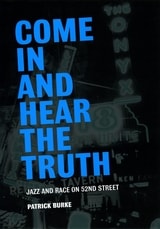
Come In and Hear the Truth
Jazz and Race on 52nd StreetPatrick Burke
University of Chicago Press, 2008
Come In and Hear the Truth uses a range of materials, from classic photographs to original interviews with musicians, to bring the street’s vibrant history to life and to shed new light on the interracial contacts and collaborations it generated.
Come and Hear
What I Saw in My Seven-and-a-Half-Year Journey through the TalmudAdam Kirsch
Brandeis University Press, 2021
Spurred by a curiosity about Daf Yomi—a study program launched in the 1920s in which Jews around the world read one page of the Talmud every day for 2,711 days, or about seven and a half years—Adam Kirsch approached Tablet magazine to write a weekly column about his own Daf Yomi experience. An avowedly secular Jew, Kirsch did not have a religious source for his interest in the Talmud; rather, as a student of Jewish literature and history, he came to realize that he couldn’t fully explore these subjects without some knowledge of the Talmud. This book is perfect for readers who are in a similar position. Most people have little sense of what the Talmud actually is—how the text moves, its preoccupations and insights, and its moments of strangeness and profundity. As a critic and journalist Kirsch has experience in exploring difficult texts, discussing what he finds there, and why it matters. His exploration into the Talmud is best described as a kind of travel writing—a report on what he saw during his seven-and-a-half-year journey through the Talmud. For readers who want to travel that same path, there is no better guide.

HEAR
Danilo Mandic, Caterina Nirta, Andrea Pavoni and Andreas Philippopoulos-Mihalopoulos
University of Westminster Press, 2023
Hearing is an intricate but delicate modality of sensory perception, continuously enfolded in the surroundings in which it takes place. While passive in its disposition, it is integral to the movement and fluctuations of one’s environment. Always attuned to the present and immersed in the murmur of its background, hearing remains a situated perception but fundamentally overarching and extended into the open. It is an immanent modality of being in and with the world. It is also the ultimate juridical act, a sense-making activity that adjudicates and informs the spatio-temporal acoustics of law and justice.
This collection gathers multidisciplinary contributions on the relationship between law and hearing, the human vocalisations and non-human echolocations, the spatial and temporal conditions in which hearing takes place, as well as the forms of order and control that listening entails. Contributors explore, challenge and expand the structural and sensorial qualities of law, and recognise how hearing directs us to perceiving and understanding the intrinsic acoustic sphere of simultaneous relations, which challenge and break the normative distinctions that law informs and maintains. In exploring the ambiguous, indefinable and unembodied nature of hearing, as well as its objects – sound and silence – this volume approaches it as both an ontological and epistemological device to think with and about law.
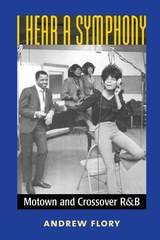
I Hear a Symphony
Motown and Crossover R&BAndrew Flory
University of Michigan Press, 2017
Made to Hear
Cochlear Implants and Raising Deaf ChildrenLaura Mauldin
University of Minnesota Press, 2016
A mother whose child has had a cochlear implant tells Laura Mauldin why enrollment in the sign language program at her daughter’s school is plummeting: “The majority of parents want their kids to talk.” Some parents, however, feel very differently, because “curing” deafness with cochlear implants is uncertain, difficult, and freighted with judgment about what is normal, acceptable, and right. Made to Hear sensitively and thoroughly considers the structure and culture of the systems we have built to make deaf children hear.
Based on accounts of and interviews with families who adopt the cochlear implant for their deaf children, this book describes the experiences of mothers as they navigate the health care system, their interactions with the professionals who work with them, and the influence of neuroscience on the process. Though Mauldin explains the politics surrounding the issue, her focus is not on the controversy of whether to have a cochlear implant but on the long-term, multiyear undertaking of implantation. Her study provides a nuanced view of a social context in which science, technology, and medicine are trusted to vanquish disability—and in which mothers are expected to use these tools. Made to Hear reveals that implantation has the central goal of controlling the development of the deaf child’s brain by boosting synapses for spoken language and inhibiting those for sign language, placing the politics of neuroscience front and center.
Examining the consequences of cochlear implant technology for professionals and parents of deaf children, Made to Hear shows how certain neuroscientific claims about neuroplasticity, deafness, and language are deployed to encourage compliance with medical technology.
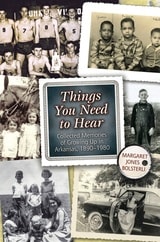
Things You Need to Hear
Collected Memories of Growing Up in Arkansas, 1890–1980Margaret Jones Bolsterli
University of Arkansas Press, 2016