Results by title
4 books match the query 'Heble, Ajay'
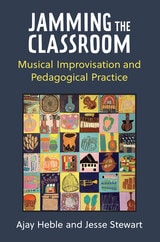
Jamming the Classroom
Musical Improvisation and Pedagogical PracticeAjay Heble and Jesse Stewart
University of Michigan Press, 2023
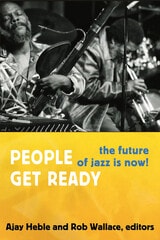
People Get Ready
The Future of Jazz Is Now!Ajay Heble and Rob Wallace, eds.
Duke University Press, 2013
Contributors. Tamar Barzel, John Brackett, Douglas Ewart, Ajay Heble, Vijay Iyer, Thomas King, Tracy McMullen, Paul D. Miller/DJ Spooky, Nicole Mitchell, Roscoe Mitchell, Famoudou Don Moye, Aldon Lynn Nielsen, Eric Porter, Marc Ribot, Matana Roberts, Jaribu Shahid, Julie Dawn Smith, Wadada Leo Smith, Alan Stanbridge, John Szwed, Greg Tate, Scott Thomson, Rob Wallace, Ellen Waterman, Corey Wilkes

Ripple Effects
The Work That Music Festivals Do in the WorldEdited by Eric Fillion and Ajay Heble
Temple University Press, 2027
What is the work that music festivals do in the world? In asking this question, Ripple Effects explores the varied ways in which festivals can act as spaces where new social relations are cultivated, as places for envisioning and enacting repertories of embodied memory and care, as alternatives to fragmented private consumption of culture, as sites for unexpected conversations.
While some case studies discuss structures of dominance inside mammoth corporate-sponsored festivals, other chapters find insubordinate spaces in festivals designed to honor traditional folk musics, to protest the proliferation of nuclear weapons, to deploy cultural exchanges in defiance of Cold War politics, to build pan-African unity, and to embrace the links between humans and the more-than-human world.
Ripple Effects brings together leading and emerging scholars, artists, and arts presenters to consider the challenges, rewards, and responsibilities associated with the improvisational culture and ethos of music festivals as alternative public spheres.
Contributors: Amina Boubia, Jody H. Cripps, Chris Dodd, Ben Finley, Simon Frith, Maria Giaever Lopez, Chris Greencorn, Jo Haynes, Michael J. Kramer, David A. McDonald, Patricia Nicholson, Melissa Noventa, William Parker, Jeremy Reed, Andrew Snyder, Cheryl Thompson, Steve Waksman, Katharine White, Deborah Wong, and the editors.
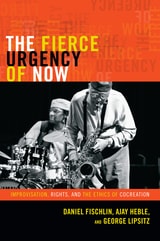
The Fierce Urgency of Now
Improvisation, Rights, and the Ethics of CocreationDaniel Fischlin, Ajay Heble, and George Lipsitz
Duke University Press, 2013
Improvisation is the creation and development of new, unexpected, and productive cocreative relations among people. It cultivates the capacity to discern elements of possibility, potential, hope, and promise where none are readily apparent. Improvisers work with the tools they have in the arenas that are open to them. Proceeding without a written score or script, they collaborate to envision and enact something new, to enrich their experience in the world by acting on it and changing it. By analyzing the dynamics of particular artistic improvisations, mostly by contemporary American jazz musicians, the authors reveal improvisation as a viable and urgently needed model for social change. In the process, they rethink politics, music, and the connections between them.