Results by title
4 books match the query 'Hedlund, Ann Lane'
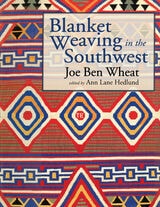
Blanket Weaving in the Southwest
Joe Ben Wheat; edited by Ann Lane Hedlund
University of Arizona Press, 2003
During much of his career, anthropologist Joe Ben Wheat (1916-1997) earned a reputation as a preeminent authority on southwestern and plains prehistory. Beginning in 1972, he turned his scientific methods and considerable talents to historical questions as well. He visited dozens of museums to study thousands of nineteenth-century textiles, oversaw chemical tests of dyes from hundreds of yarns, and sought out obscure archives to research the material and documentary basis for textile development. His goal was to establish a key for southwestern textile identification based on the traits that distinguish the Pueblo, Navajo, and Spanish American blanket weaving traditions—and thereby provide a better way of identifying and dating pieces of unknown origin.
Wheat's years of research resulted in a masterful classification scheme for southwestern textiles—and a book that establishes an essential baseline for understanding craft production. Nearly completed before Wheat's death, Blanket Weaving in the Southwest describes the evolution of southwestern textiles from the early historic period to the late nineteenth century, establishes a revised chronology for its development, and traces significant changes in materials, techniques, and designs.
Wheat first relates what Spanish observers learned about the state of native weaving in the region—a historical review that reveals the impact of new technologies and economies on a traditional craft. Subsequent chapters deal with fibers, yarns, dyes, and fabric structures—including an unprecedented examination of the nature, variety, and origins of bayeta yarns—and with tools, weaves, and finishing techniques.
A final chapter, constructed by editor Ann Hedlund from Wheat's notes, provides clues to his evolving ideas about the development of textile design. Hedlund—herself a respected textile scholar and a protégée of Wheat's—is uniquely qualified to interpret the many notes he left behind and brings her own understanding of weaving to every facet of the text. She has ensured that Wheat's research is applicable to the needs of scholars, collectors, and general readers alike. Throughout the text, Wheat discusses and evaluates the distinct traits of the three textile traditions. More than 200 photos demonstrate these features, including 191 color plates depicting a vast array of chief blankets, shoulder blankets, ponchos, sarapes, diyugi, mantas, and dresses from museum collections nationwide. In addition, dozens of line drawings demonstrate the fine points of technique concerning weaves, edge finishes, and corner tassels. Through his groundbreaking and painstaking research, Wheat created a new view of southwestern textile history that goes beyond any other book on the subject. Blanket Weaving in the Southwest addresses a host of unresolved issues in textile research and provides critical tools for resolving them. It is an essential resource for anyone who appreciates the intricacy of these outstanding creations.
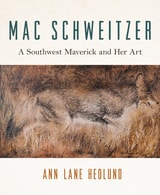
Mac Schweitzer
A Southwest Maverick and Her ArtAnn Lane Hedlund
University of Arizona Press, 2025
Southwest Books of the Year Top Pick
In Tucson during the 1950s, nearly everyone knew, or wanted to know, the southwestern artist Mac Schweitzer. Born Mary Alice Cox in Cleveland, Ohio, in 1921, she grew up a tomboy who adored horses, cowboys, and art. After training at the Cleveland School of Art and marrying, she adopted her maiden initials (M. A. C.) as her artistic name and settled in Tucson in 1946. With a circle of influential friends that included anthropologists, designer-craftsmen, and Native American artists, she joined Tucson’s “Early Moderns,” receiving exhibits, commissions, and awards for her artwork. When she died in 1962, Mac’s artistic legacy faded from public view, but her prize-winning works attest to a thriving career.
Author Ann Lane Hedlund draws from the artist’s letters, photo albums, and published reviews to tell the story of Mac’s creative and adventuresome life. Her watercolors, oil paintings, prints, and sculptures—a diverse body of work never before seen in public—range from naturalistic studies of Sonoran Desert animals to impressionistic landscapes to moody abstractions. A sharp observer of Indigenous life, she sketched and painted scenes of Navajo (Diné), Hopi, O’odham, and Yaqui people and events. These unique portrayals of the Southwest illustrate this saga of a maverick artist rediscovered.
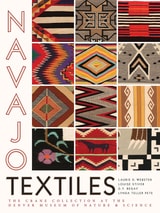
Navajo Textiles
The Crane Collection at the Denver Museum of Nature and ScienceLaurie D. Webster
University Press of Colorado, 2017
Navajo Textiles provides a nuanced account the Navajo weavings in the Crane Collection at the Denver Museum of Nature & Science—one of the largest collections of Navajo textiles in the world. Bringing together the work of anthropologists and indigenous artists, the book explores the Navajo rug trade in the mid-nineteenth century and changes in the Navajo textile market while highlighting the museum’s important, though still relatively unknown, collection of Navajo textiles.
In this unique collaboration among anthropologists, museums, and Navajo weavers, the authors provide a narrative of the acquisition of the Crane Collection and a history of Navajo weaving. Personal reflections and insights from foremost Navajo weavers D. Y. Begay and Lynda Teller Pete are also featured, and more than one hundred stunning full-color photographs of the textiles in the collection are accompanied by technical information about the materials and techniques used in their creation. An introduction by Ann Lane Hedlund documents the growing collaboration between Navajo weavers and museums in Navajo textile research.
The legacy of Navajo weaving is complex and intertwined with the history of the Diné themselves. Navajo Textiles makes the history and practice of Navajo weaving accessible to an audience of scholars and laypeople both within and outside the Diné community.
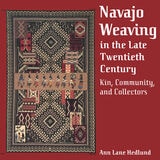
Navajo Weaving in the Late Twentieth Century
Kin, Community, and CollectorsAnn Lane Hedlund
University of Arizona Press, 2004
In testimony to this living art form, this book presents 74 dazzling color plates of Navajo rugs and wall hangings woven between 1971 and 1996. Drawn from a private southwestern collection, they represent the work of sixty of the finest native weavers in the American Southwest. The creations depicted here reflect a number of styles—revival, sandpainting, pictorial, miniature, sampler—and a number of major regional variations, from Ganado to Teec Nos Pos.
Textile authority Ann Hedlund provides an introductory narrative about the development of Navajo textile collecting—including the shift of attention from artifacts to art—and a brief review of the history of Navajo weaving. She then comments on the shaping of the particular collection represented in the book, offering a rich source of knowledge and insight for other collectors.
Explaining themes in Navajo weaving over the quarter-century represented by the Santa Fe Collection, Hedlund focuses on the development of modern rug designs and the influence on weavers of family, community, artistic identity, and the marketplace. She also introduces each section of plates with a description of the representative style, its significance, and the weavers who perpetuate and deviate from it. In addition to the textile plates, Hedlund’s color photographs show the families, landscapes, livestock, hogans, and looms that surround today’s Navajo weavers.
Navajo Weaving in the Late Twentieth Century explores many of the important connections that exist today among weavers through their families and neighbors, and the significant role that collectors play in perpetuating this dynamic art form. For all who appreciate American Indian art and culture, this book provides invaluable guidance to the fine points of collecting and a rich visual feast.