Results by title
69 books match the query 'Hegel, Georg Wilhelm Friedrich' and 3 start with a
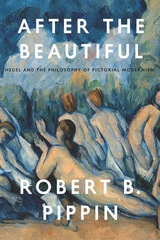
After the Beautiful
Hegel and the Philosophy of Pictorial ModernismRobert B. Pippin
University of Chicago Press, 2013
While Hegel could never engage modernist painting, he did have an understanding of modernity, and in it, art—he famously asserted—was “a thing of the past,” no longer an important vehicle of self-understanding and no longer an indispensable expression of human meaning. Pippin offers a sophisticated exploration of Hegel’s position and its implications. He also shows that had Hegel known how the social institutions of his day would ultimately fail to achieve his own version of genuine equality, a mutuality of recognition, he would have had to explore a different, new role for art in modernity. After laying this groundwork, Pippin goes on to illuminate the dimensions of Hegel’s aesthetic approach in the path-breaking works of Manet, the “grandfather of modernism,” drawing on art historians T. J. Clark and Michael Fried to do so. He concludes with a look at Cézanne, the “father of modernism,” this time as his works illuminate the relationship between Hegel and the philosopher who would challenge Hegel’s account of both modernity and art—Martin Heidegger.
Elegantly inter-weaving philosophy and art history, After the Beautiful is a stunning reassessment of the modernist project. It gets at the core of the significance of modernism itself and what it means in general for art to have a history. Ultimately, it is a testament, via Hegel, to the distinctive philosophical achievements of modernist art in the unsettled, tumultuous era we have inherited.

An Introduction To Hegel
The Stages of Modern PhilosophyHoward P. Kainz
Ohio University Press, 1996
In a sense it would be inappropriate to speak of “Hegel’s system of philosophy,” because Hegel thought that in the strict sense there is only one system of philosophy evolving in the Western world. In Hegel’s view, although at times philosophy’s history seems to be a chaotic series of crisscrossing interpretations of meanings and values, with no consensus, there has been a teleological development and consistent progress in philosophy and philosophizing from the beginning; Hegel held that his own version of “German idealism” was simply bringing to final expression the latest refinements of an ongoing, perennial system.
If we take Hegel at his word, then one of the best entries into his system would be through the history of philosophy, showing how systems and schools of thought prior to Hegel led up to his system. The most important currents to focus on, however, would be in modern philosophy, in which especially intensive changes led ultimately to German idealism and Hegel’s immediate predecessors.
Fortunately, Hegel lectured extensively on the history of modern philosophy and structured his lectures in such a way as to throw light on the status of the “one system” of Western philosophy at the time — the status to which Hegel felt he had been contributing and was continuing to contribute. These lectures are of interest, first of all, as a systematic chronicle of philosophical positions in the heyday of modern philosophy, from Bacon to Hegel. Second, they are interesting because Hegel’s critical comments on his predecessors clarify his own positions: for example, the dialectic method and the importance of triplicity, the relationship of philosophy to the scientific method, the necessity for avoidance of the extremes of empiricism and of idealism, the subject/object problematic, the “identity” of rationality and reality, and the technical meaning in Hegel’s philosophy of “absolute,” “infinity,” and the “idea.”
Antigone as Political Philosophy
Gregor Moder, Tanja Dominko
Northwestern University Press, 2026
Offering a new perspective on Sophocles’s Antigone as a model for reimagining humanity’s future—and its end
Why read Antigone today? The premise of this accessible, essayistic work is that humanity finds itself at a crossroads, where it must reinvent itself or perish—a condition similar to Antigone’s own. Rereading Antigone via Hegel’s engagement with the text can help us understand what it means for a human age to come to an end: that is, to think of our age as an episode whose collapse is also an engine of historical change.
Gregor Moder argues that the task of humanity today may not be to defend the minimal remnants of our civilization but to say farewell to it—to give it a proper burial. As Moder explicates, the central problem of this foundational tragedy lies in the positions of brother and sister, man and woman, representing human and divine law and the institutions of the state and the family. Through a fresh reading of both Sophocles’s play and Hegel’s productive reworking of the Greek myth, Moder’s analysis shows that sometimes the only way through deep social contradictions is in unraveling the framework that has constructed them.