Results by title
3 books match the query 'Helen, of Troy, Queen of Sparta'

A Bead of Amber on Her Tongue
Jennifer Pullen
Omnidawn, 2019
Helen of Troy and Aphrodite: two classical paragons of beauty and love. These two figures have served as the inspiration for innumerable works of art in the Western cannon. In the twenty-first century, however, what do their stories provide but a reminder of the predictable roles which sexism has assigned women throughout history and literature?
In this fresh new take on the two women’s stories, Jennifer Pullen takes us away from the familiar and deeper into their experiences. Rewriting Homer, Pullen revitalizes these two figures for the contemporary era. In A Bead of Amber on Her Tongue, Aphrodite maintains autonomy through her experience of her own body, even when forced into marriage. Helen of Troy, meanwhile, harbors a love for her maid, Esme, that no conquering hero can vanquish. Revisiting these classic stories with an inventive twist, Pullen shows that, with a little imagination, the classics may yet bear new insights.
In this fresh new take on the two women’s stories, Jennifer Pullen takes us away from the familiar and deeper into their experiences. Rewriting Homer, Pullen revitalizes these two figures for the contemporary era. In A Bead of Amber on Her Tongue, Aphrodite maintains autonomy through her experience of her own body, even when forced into marriage. Helen of Troy, meanwhile, harbors a love for her maid, Esme, that no conquering hero can vanquish. Revisiting these classic stories with an inventive twist, Pullen shows that, with a little imagination, the classics may yet bear new insights.
[more]
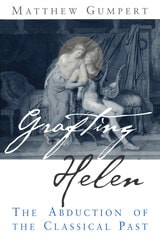
Grafting Helen
The Abduction of the Classical PastMatthew Gumpert
University of Wisconsin Press, 2001
History is a love story: a tale of desire and jealousy, abandonment and fidelity, abduction and theft, rupture and reconciliation. This contention is central to Grafting Helen, Matthew Gumpert's original and dazzling meditation on Helen of Troy as a crucial anchor for much of Western thought and literature.
Grafting Helen looks at "classicism"—the privileged rhetorical language for describing cultural origins in the West—as a protracted form of cultural embezzlement. No coin in the realm has been more valuable, more circulated, more coveted, or more counterfeited than the one that bears the face of Helen of Troy. Gumpert uncovers Helen as the emblem for the past as something to be stolen, appropriated, imitated, extorted, and coveted once again.
Tracing the figure of Helen from its classical origins through the Middle Ages, the French Renaissance, and the modern era, Gumpert suggests that the relation of current Western culture to the past is not like the act of coveting; it is the act of coveting, he argues, for it relies on the same strategies, the same defenses, the same denials, and the same delusions.
[more]
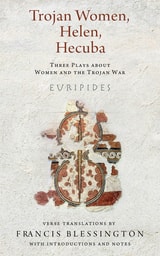
Trojan Women, Helen, Hecuba
Three Plays about Women and the Trojan WarEuripides, Verse translations by Francis Blessington, with introductions and notes
University of Wisconsin Press, 2015
These three ancient tragedies—Trojan Women, Helen, and Hecuba—dramatize the tragic fates of women in the wake of war. Euripides (480–406 BC) innovatively brought to Greek tragedy the inner lives of his characters. In these plays he delivers powerful portrayals of the suffering of both Greek and Trojan women as they become pawns and prizes of warring men.
Francis Blessington combines his work as a poet, translator, and teacher of literature and Greek with his theatrical experience to create fresh and faithful verse translations suitable for the stage, the classroom, or the general reader. The three plays are augmented by introductions, notes, and an appendix on elements of Greek tragedy. Blessington glosses historical and mythological terms, identifies Greek themes in the texts, offers literary interpretations, and suggests topics for discussion.
Francis Blessington combines his work as a poet, translator, and teacher of literature and Greek with his theatrical experience to create fresh and faithful verse translations suitable for the stage, the classroom, or the general reader. The three plays are augmented by introductions, notes, and an appendix on elements of Greek tragedy. Blessington glosses historical and mythological terms, identifies Greek themes in the texts, offers literary interpretations, and suggests topics for discussion.
[more]