Results by title
5 books match the query 'Hellenism'
A Student Commentary on Pausanias Book 1
Patrick Paul Hogan
University of Michigan Press, 2014
A Student Commentary on Pausanias Book 2
Patrick Paul Hogan
University of Michigan Press, 2018
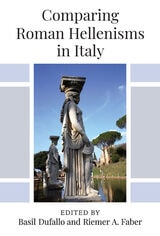
Comparing Roman Hellenisms in Italy
Edited by Basil Dufallo and Riemer A. Faber
University of Michigan Press, 2023
The story of Roman Hellenism—defined as the imitation or adoption of something Greek by those subject to or operating under Roman power—begins not with Roman incursions into the Greek mainland, but in Italy, where our most plentiful and spectacular surviving evidence is concentrated. Think of the architecture of the Roman capital, the Campanian towns of Pompeii and Herculaneum buried by Vesuvius, and the Hellenic culture of the Etruscans. Perhaps “everybody knows” that Rome adapted Greek culture in a steadily more “sophisticated” way as its prosperity and might increased. This volume, however, argues that the assumption of smooth continuity, let alone steady “improvement,” in any aspect of Roman Hellenism can blind us to important aspects of what Roman Hellenism really is and how it functions in a given context.
As the first book to focus on the comparison of Roman Hellenisms per se, Comparing Roman Hellenisms in Italy shows that such comparison is especially valuable in revealing how any singular instance of the phenomenon is situated and specific, and has its own life, trajectory, circumstances, and afterlife. Roman Hellenism is always a work in progress, is often strategic, often falls prey to being forgotten, decontextualized, or reread in later periods, and thus is in important senses contingent. Further, what we may broadly identify as a Roman Hellenism need not imply Rome as the only center of influence. Roman Hellenism is often decentralized, and depends strongly on local agents, aesthetics, and materials. With this in mind, the essays concentrate geographically on Italy to lend both focus and breadth to our topic, as well as to emphasize the complex interrelation of Hellenism at Rome with Rome’s surroundings. Because Hellenism, whether as practiced by Romans or Rome’s subjects, is in fact widely diffused across far-flung geographical regions, the final part of the collection gestures to this broader context.
Hellenism in Late Antiquity
G.W. Bowersock
University of Michigan Press, 1996
Hellenistic Aesthetic
Barbara Hughes Fowler
University of Wisconsin Press, 1989
“Fowler’s . . . own insights are apparent throughout, and they seem to distill the personal appreciation and understanding of a scholar who has devoted much of her career to both contemplating and enjoying Hellenistic poetry. . . . [This book] would make an excellent background text for courses in later Greek and Roman art, and it can be read with profit by anyone interested in exploring the character of Hellenistic culture.”—J. J. Pollitt, American Journal of Archaeology
“Outstanding is the range of examples discussed both in poetry and art. Theocritus, Callimachus, Appolonius, the epigrammatists, and others—that is, the major figures of the time—are considered at length and in several different contexts. Passages are quoted in the original Greek, translated, and analyzed. Fowler’s sensitivity to poetic forms, evident in her other published writings, is again evident here. In addition, however, the philosophical context is not overlooked. . . . Also highly commendable are the liberal references to works of art. Sculpture in the round and in relief, portraits, terracotta figurines, original paintings (grave stelai) and Campanian murals, mosaics, gold and silver vessels, and jewelry are introduced at various points. Every work of art discussed is illustrated in astonishingly clear photographs, which are interspersed in the body of the text.”—Christine Mitchell Havelock
“The Hellenistic Aesthetic provides classicists with their first thorough discussion of the aesthetic unity found in Hellenistic art and literature. . . . Fowler examines parallels both in subject matter and in artistic approach among a diverse group of literary genres and artistic forms. In twelve chapters, The Hellenistic Aesthetic surveys Alexandrian epigrams, pastorals, epics, sculptural groups, mosaics, paintings, and jewelry to supply a convincing, and frequently unexpected, picture of a unified aesthetic vision.”—Jeffrey Buller, Classical Outlook