Results by title
8 books match the query 'Hemingway'

Faulkner and Hemingway
Biography of a Literary RivalryJoseph Fruscione
The Ohio State University Press, 2012
Fitzgerald, Hemingway, and the Twenties
Ronald Berman
University of Alabama Press, 2002
A noted scholar offers fresh ways of looking at two legendary American authors.
Both F. Scott Fitzgerald and Ernest Hemingway came into their own in the 1920s and did some of their best writing during that decade. In a series of interrelated essays, Ronald Berman considers an array of novels and short stories by both authors within the context of the decade's popular culture, philosophy, and intellectual history. As Berman shows, the thought of Fitzgerald and Hemingway went considerably past the limits of such labels as the Jazz Age or the Lost Generation.
Both Fitzgerald and Hemingway were avid readers, alive to the intellectual currents of their day, especially the contradictions and clashes of ideas and ideologies. Both writers, for example, were very much concerned with the problem of untenable belief—and also with the need to believe. In this light, Berman offers fresh readings of such works as Fitzgerald's The Great Gatsby, "Bernice Bobs Her Hair," and "The Diamond as Big as the Ritz" and Hemingway's "The Killers," A Farewell to Arms, and The Sun Also Rises. Berman invokes the thinking of a wide range of writers in his considerations of these texts, including William James, Alfred North Whitehead, Walter Lippman, and Edmund Wilson.
Berman's essays are driven and connected by a focused line of inquiry into Fitzgerald's and Hemingway's concerns with dogma both religious and secular, with new and old ideas of selfhood,and, particularly in the case of Hemingway, with the way we understand, explain, and transmit experience.
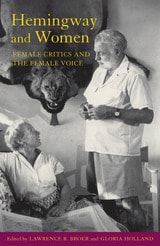
Hemingway and Women
Female Critics and the Female VoiceLawrence R. Broer
University of Alabama Press, 2003
Ernest Hemingway has often been criticized as a misogynist because of his portrayal of women. But some of the most exciting Hemingway scholarship of recent years has come from women scholars who challenge traditional views of Hemingway and women. The essays in this collection range from discussions of Hemingway’s famous heroines Brett Ashley and Catherine Barkley to examinations of the central role of gender in his short stories and in the novel The Garden of Eden. Other essays address the real women in Hemingway’s life—those who cared for him, competed with him, and, ultimately, helped to shape his art. While Hemingway was certainly influenced by traditional perceptions of women, these essays show that he was also aware of the struggle of the emerging new woman of his time. Making this gender struggle a primary concern of his fiction, these critics argue, Hemingway created women with strength, depth, and a complexity that readers are only beginning to appreciate.
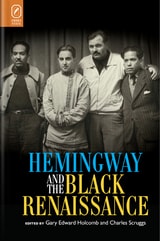
Hemingway and the Black Renaissance
Edited by Gary Edward Holcomb and Charles Scruggs
The Ohio State University Press, 2012
Hemingway and the Black Renaissance, edited by Gary Edward Holcomb and Charles Scruggs, explores a conspicuously overlooked topic: Hemingway’s wide-ranging influence on writers from the Harlem Renaissance to the present day. An observable who’s who of black writers—Ralph Ellison, James Baldwin, Langston Hughes, Claude McKay, Wallace Thurman, Chester Himes, Alex la Guma, Derek Walcott, Gayl Jones, and more—cite Hemingway as a vital influence. This inspiration extends from style, Hemingway’s minimalist art, to themes of isolation and loneliness, the dilemma of the expatriate, and the terrifying experience of living in a time of war. The relationship, nevertheless, was not unilateral, as in the case of Jean Toomer’s 1923 hybrid, short-story cycle Cane, which influenced Hemingway’s collage-like 1925 In Our Time.
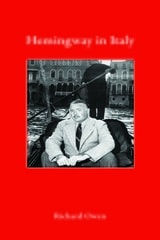
Hemingway in Italy
Richard Owen
Haus Publishing, 2017
In evocative prose, complemented by a rich selection of historical images, Richard Owen takes us on a tour through Hemingway’s Italy. He describes how Hemingway first visited the country of the Latins during World War I, an experience that set the scene for A Farewell to Arms. Then after World War II, it was in Italy that he found inspiration for Across the River and into the Trees. Again and again, the Italian landscape—from the Venetian lagoon to the Dolomites and beyond—deeply affected one of the greatest writers of the twentieth century. Hemingway in Italy demonstrates that Italy stands alongside Spain as a key influence on Hemingway’s work—and why the Italians themselves hold Hemingway and his writing close to their hearts.
Hemingway on Love
By Robert W. Lewis, Jr.
University of Texas Press, 1965
Love was a central theme of Ernest Hemingway’s major works. And although his passages on sexual love and on romantic love may be widely remembered and frequently quoted, says Robert W. Lewis in this scholarly and detailed consideration, Hemingway’s later work revealed his ultimate belief that brotherly love was the supreme love of mankind. Eros, Hemingway concluded, was a neutral value, neither good nor bad in itself, but yet capable of complementing agape in giving man pleasure.
By examining the forms and essences of the various kinds of love, Hemingway worked out an explanation and tentative solution to the troubles of the human condition. The tradition of romantic love that had prevailed in Western literature had challenged sexual love and brotherly love and had been confused with them since the Middle Ages. Hemingway’s early work was destructive of romantic love, says Lewis; the work of his middle career was crucial in his exploration for the supreme love and the means to whatever peace and happiness man may achieve. By the time he wrote The Old Man and the Sea, his ethic was formulated and he could write conclusively of the trial and lesson of love in Western civilization in a way that reflected his discovery that true love must be a reciprocal blend of eros and agape between man and woman, man and man, and man and his world.

Hemingway
The Writer’s Art of Self-DefenseJackson J. Benson
University of Minnesota Press, 1970
Hemingway was first published in 1970. Minnesota Archive Editions uses digital technology to make long-unavailable books once again accessible, and are published unaltered from the original University of Minnesota Press editions.
In a close critical analysis of five of Ernest Hemingway's novels and a number of his most important short stories, Professor Benson provides a fascinating new view of his work. The novels discussed are The Sun Also Rises, A Farewell to Arms, For Whom the Bell Tolls, Across the River and into the Trees,and the Old Man and the Sea.
Hemingway's art of self-defense, which Professor Benson refers to in his subtitle, was, as he demonstrates in his perceptive criticism, the writer's use of style and technique to attack the sentimentalities which were Hemingway's own weakness. Emotion was central to the task which Hemingway defined for himself, Professor Benson explains, and a critical appraisal of his work must, therefore, focus particularly on the ways in which he dealt with and expressed emotion.
Translating Modernism
Fitzgerald and HemingwayRonald Berman
University of Alabama Press, 2009