Results by title
3 books match the query 'Henderson, George Wylie'
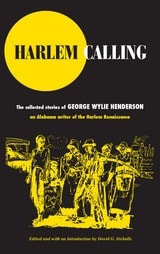
Harlem Calling
The Collected Stories of George Wylie HendersonGeorge Wylie Henderson
University of Michigan Press, 2005
"A very interesting collection . . . both for the way that Henderson's work links the literature of the Harlem Renaissance with the black protest literature of Richard Wright and others, and for Henderson's subject matter and the places that he chose to publish."
--Nellie McKay, University of Wisconsin-Madison
"There is really no other black fiction quite like this that I know of, from the 1920s through the 1930s . . . That Henderson was publishing stories in a newspaper and magazine for the mass market after the period when 'the vogue of the Negro' had allegedly ended is significant in itself. The stories are interesting in relation to both the Negro renaissance and the turn to proletarian fiction."
--George Hutchinson, Indiana University
Harlem Calling collects carefully crafted short stories about life in Alabama, Memphis, and New York City that dramatize the profound ambivalence many blacks felt about their participation in the Great Migration. George Wylie Henderson's tales of the rural South are sometimes nostalgic but also present the hard work and violence of everyday life there, and his stories set in Harlem present the glamour of urban life, while they also are concerned with poverty and social mores.
Henderson enjoyed a widespread popular audience for his periodical fiction in the 1930s and '40s and was a regular contributor to the New York Daily News and Redbook magazine, where the seventeen stories in Harlem Calling were originally published. Until the publication of Harlem Calling, Henderson had been chiefly known for his critically acclaimed 1935 novel about an Alabama farmhand, Ollie Miss, and the 1946 sequel narrating her son's migration to Harlem, Jule. Contemporary critics have favorably compared Henderson's writing to that of Zora Neale Hurston and Langston Hughes, as it captures the life of the black migrant with a style that embraces simplicity and honesty.
Collected here by literary scholar and editor David G. Nicholls, and contextualized with an informative and insightful introduction, Harlem Calling provides a unique perspective on the Harlem Renaissance and on the African American literary tradition.
George Wylie Henderson (1904-65) was born in Alabama, worked in the printing trade, and began writing fiction shortly after graduating from the Tuskegee Institute. He migrated to Harlem with his wife in the late 1920s and published his first story in the New York Daily News in 1932. He also published two novels, Ollie Miss (1935) and Jule (1946). David G. Nicholls is the Director of Book Publications for the Modern Language Association and holds a Ph.D. in English from the University of Chicago. He is author of Conjuring the Folk: Forms of Modernity in African America.
Jule
George Wylie Henderson
University of Alabama Press, 1989
From the fields of Alabama to the streets of Harlem, a young man's journey mirrors a generation's search for opportunity and identity.
Jule by George Wylie Henderson is a powerful coming-of-age novel that traces the journey of a young African American man from the rural communities of Alabama to the bustling streets of Harlem during a transformative period in American history. Raised by his devoted mother, Ollie Miss, who encourages him to strive for a better future, Jule grows up amid the traditions, hardships, and close-knit relationships of Depression-era Southern life. As he matures, friendships, first love, and the realities of racial inequality shape his understanding of himself and the world around him.
When circumstances compel him to leave Alabama, Jule embarks on a journey to Harlem, the cultural capital of Black America and a center of artistic, intellectual, and economic opportunity. There he encounters a vibrant urban society that challenges and expands his ambitions while exposing him to new possibilities and struggles. Drawing on autobiographical elements from Henderson's own experiences, the novel offers a rare and insightful portrayal of the connections between the rural South and the Harlem Renaissance.
Jule is both a compelling personal story and an important work of African American literary history. The novel provides valuable insight into migration, identity, family, and aspiration, illuminating the experiences of a generation seeking opportunity while carrying the enduring influence of its Southern roots.
Ollie Miss
George Wylie Henderson
University of Alabama Press, 2007
A forgotten classic of African American life, identity, and resilience in rural Alabama.
Ollie Miss by George Wylie Henderson is a landmark work of African American fiction that offers a vivid portrayal of rural Black life in Alabama during the early twentieth century. Set in the backwoods communities of Macon County, Alabama, the novel follows the journey of Ollie Miss, a young woman determined to find purpose, independence, and personal fulfillment in a world shaped by poverty, isolation, and limited opportunities. Through her struggles and aspirations, Henderson creates a compelling portrait of individual resilience and self-discovery.
More than a personal story, Ollie Miss serves as an important social document, preserving the customs, relationships, and daily realities of a Black Southern community before the transformative changes brought about by the Civil Rights Movement. Henderson's richly detailed narrative captures the rhythms of rural life, the bonds of community, and the challenges faced by African Americans in the segregated South. At the same time, the novel explores universal themes of loneliness, belonging, love, and the search for dignity.
Originally published in 1935 during the era of the Harlem Renaissance, Ollie Miss stands today as a rediscovered classic that broadens our understanding of African American literary history. Both a moving coming-of-age story and an invaluable cultural record, the novel remains essential reading for anyone interested in Southern literature, Black history, women's experiences, and the rich diversity of American fiction.