Results by title
4 books match the query 'Henry David Thoreau'
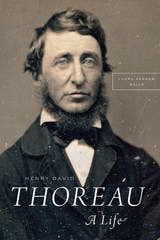
Henry David Thoreau
A LifeLaura Dassow Walls
University of Chicago Press, 2017
But there was much more to Thoreau than his brief experiment in living at Walden Pond. A member of the vibrant intellectual circle centered on his neighbor Ralph Waldo Emerson, he was also an ardent naturalist, a manual laborer and inventor, a radical political activist, and more. Many books have taken up various aspects of Thoreau’s character and achievements, but, as Laura Dassow Walls writes, “Thoreau has never been captured between covers; he was too quixotic, mischievous, many-sided.” Two hundred years after his birth, and two generations after the last full-scale biography, Walls restores Henry David Thoreau to us in all his profound, inspiring complexity.
Walls traces the full arc of Thoreau’s life, from his early days in the intellectual hothouse of Concord, when the American experiment still felt fresh and precarious, and “America was a family affair, earned by one generation and about to pass to the next.” By the time he died in 1862, at only forty-four years of age, Thoreau had witnessed the transformation of his world from a community of farmers and artisans into a bustling, interconnected commercial nation. What did that portend for the contemplative individual and abundant, wild nature that Thoreau celebrated?
Drawing on Thoreau’s copious writings, published and unpublished, Walls presents a Thoreau vigorously alive in all his quirks and contradictions: the young man shattered by the sudden death of his brother; the ambitious Harvard College student; the ecstatic visionary who closed Walden with an account of the regenerative power of the Cosmos. We meet the man whose belief in human freedom and the value of labor made him an uncompromising abolitionist; the solitary walker who found society in nature, but also found his own nature in the society of which he was a deeply interwoven part. And, running through it all, Thoreau the passionate naturalist, who, long before the age of environmentalism, saw tragedy for future generations in the human heedlessness around him.
“The Thoreau I sought was not in any book, so I wrote this one,” says Walls. The result is a Thoreau unlike any seen since he walked the streets of Concord, a Thoreau for our time and all time.

Life of Henry David Thoreau
Henry S. SaltEdited by George Hendrick, Willene Hendrick, and Fritz Oehlschlaeger
University of Illinois Press, 1993
In 1890 Salt published the initial version of Thoreau's Life. With the help of American friends, he revised the book and published it anew six years later. The present volume is the third version of the biography, completed in 1908 but never published in Salt's lifetime.
Combining a concise narrative of Thoreau's life with a perceptive treatment of his ideas and writings, it stands as a penetrating study of Thoreau, stressing his distinctive individuality. Through an astute analysis of the text and a concise biography, the editors illustrate Salt's growth as a scholar and his changing views on Thoreau and Thoreau's philosophy.
Seeing New Worlds
Henry David Thoreau and Nineteenth-Century Natural ScienceLaura Dassow Walls
University of Wisconsin Press, 1995
Thoreau was a poet, a naturalist, a major American writer. Was he also a scientist? He was, Laura Dassow Walls suggests. Her book, the first to consider Thoreau as a serious and committed scientist, will change the way we understand his accomplishment and the place of science in American culture.
Walls reveals that the scientific texts of Thoreau’s day deeply influenced his best work, from Walden to the Journal to the late natural history essays. Here we see how, just when literature and science were splitting into the “two cultures” we know now, Thoreau attempted to heal the growing rift. Walls shows how his commitment to Alexander von Humboldt’s scientific approach resulted in not only his “marriage” of poetry and science but also his distinctively patterned nature studies. In the first critical study of his “The Dispersion of Seeds” since its publication in 1993, she exposes evidence that Thoreau was using Darwinian modes of reasoning years before the appearance of Origin of Species.
This book offers a powerful argument against the critical tradition that opposes a dry, mechanistic science to a warm, “organic” Romanticism. Instead, Thoreau’s experience reveals the complex interaction between Romanticism and the dynamic, law-seeking science of its day. Drawing on recent work in the theory and philosophy of science as well as literary history and theory, Seeing New Worlds bridges today’s “two cultures” in hopes of stimulating a fuller consideration of representations of nature.
The Gospel According to This Moment
The Spiritual Message of Henry David ThoreauBarry M. Andrews
University of Massachusetts Press, 2024
Henry David Thoreau is best known as a writer, naturalist, and social critic, but he was also a schoolteacher, surveyor, and pencil-maker. In The Gospel According to This Moment, Unitarian minister Barry M. Andrews reveals how an idiosyncratic and unconventional religious faith was central to Thoreau’s many-faceted life—a dimension that has been largely unexamined.
Through close readings of his writings and a focus on his Unitarian upbringing, Harvard education, mentoring by Ralph Waldo Emerson, and immersion in ancient Eastern and Western philosophies, Andrews explores the nature of Thoreau’s spiritual message, what he called the “Gospel according to this moment,” which enables a flourishing and deliberate life. Today, Thoreau is widely recognized as an advocate for simple living, environmental preservation, and civil disobedience. As Andrews uncovers, Thoreau is also a spiritual guide who can teach us an alternative way of being religious in the world.