Results by title
2 books match the query 'Heraclitus'
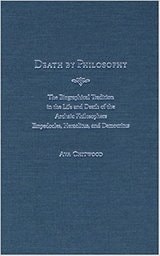
Death by Philosophy
The Biographical Tradition in the Life and Death of the Archaic Philosophers Empedocles, Heraclitus, and DemocritusAva Chitwood
University of Michigan Press, 2004
How does one die by philosophy? In Diogenes Laertius, philosophers jump into volcanoes, bury themselves in dung, get eaten by dogs, hang themselves, drown, and vanish into thin air -- sometimes all in a single lifetime. But what happens when we look beyond the fantastic and absurd to examine the particular ways that the philosophers' lives and deaths are recounted?
Ava Chitwood's reexamination of Diogenes Laertius's philosophical biographies opens a new window on the intellectual culture and context in which the work of philosophers like Empedocles, Heraclitus, and Democritus was read, received, and transmitted. Chitwood's analysis also suggests a methodology for understanding the interplay between biography and philosophy and for evaluating biographical sources.
While Chitwood's approach combines the disciplines of classical philology and philosophy, Death by Philosophy is not intended solely for the specialist. This investigation offers the modern reader a fascinating, fresh, and entertaining view of the ancient literary and philosophical world.
Ava Chitwood is Assistant Professor of Classics, at the University of South Florida.
[more]
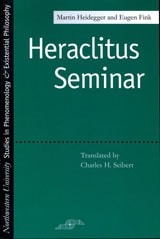
Heraclitus Seminar
Martin Heidegger
Northwestern University Press, 1993
In 1966–1967 Martin Heidegger and Eugen Fink conducted an extraordinary seminar on the fragments of Heraclitus. Heraclitus Seminar records those conversations, documenting the imaginative and experimental character of the multiplicity of interpretations offered and providing an invaluable portrait of Heidegger involved in active discussion and explication.
Heidegger's remarks in this seminar illuminate his interpretations not only of pre-Socratic philosophy, but also of figures such as Hegel and Holderllin. At the same time, Heidegger clarifies many late developments in his own understanding of truth, Being, and understanding. Heidegger and Fink, both deeply rooted in the Freiburg phenomenological tradition, offer two competing approaches to the phenomenological reading of the ancient text-a kind of reading that, as Fink says, is "not so much concerned with the philological problematic . . . as with advancing into the matter itself, that is, toward the matter that must have stood before Heraclitus's spiritual view."
Heidegger's remarks in this seminar illuminate his interpretations not only of pre-Socratic philosophy, but also of figures such as Hegel and Holderllin. At the same time, Heidegger clarifies many late developments in his own understanding of truth, Being, and understanding. Heidegger and Fink, both deeply rooted in the Freiburg phenomenological tradition, offer two competing approaches to the phenomenological reading of the ancient text-a kind of reading that, as Fink says, is "not so much concerned with the philological problematic . . . as with advancing into the matter itself, that is, toward the matter that must have stood before Heraclitus's spiritual view."
[more]