Results by title
34 books match the query 'Heritage'
As Legend Has It
History, Heritage, and the Construction of Swedish American IdentityJennifer Eastman Attebery
University of Wisconsin Press, 2023
The legends Swedish Americans tell about their past are both similar to and distinct from those of others who migrated westward; they participated in settler colonialism while maintaining a sense of their specific, Swedish ethnicity. Unlike racial minority groups, Swedish Americans could claim membership in a majority white community without abandoning their cultural heritage. Their legends and local histories reflect that positioning. Attebery reveals how Swedish American legends are embedded within local history writing, how ostension and rhetoric operate in historical legends, and how vernacular local history writing works in tandem with historical legends to create a common message about a communal past. This impeccably researched study points to ways in which legends about the past possess qualities unique to their subgenre yet can also operate similarly to contemporary legends in their social impact.

Behind the Big House
Reconciling Slavery, Race, and Heritage in the U.S. SouthJodi Skipper
University of Iowa Press, 2022
When residents and tourists visit sites of slavery, whose stories are told? All too often the lives of slaveowners are centered, obscuring the lives of enslaved people. Behind the Big House gives readers a candid, behind-the-scenes look at what it really takes to interpret the difficult history of slavery in the U.S. South. The book explores Jodi Skipper’s eight-year collaboration with the Behind the Big House program, a community-based model used at local historic sites to address slavery in the collective narrative of U.S. history and culture.
In laying out her experiences through an autoethnographic approach, Skipper seeks to help other activist scholars of color negotiate the nuances of place, the academic public sphere, and its ambiguous systems of reward, recognition, and evaluation.
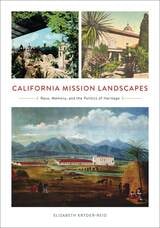
California Mission Landscapes
Race, Memory, and the Politics of HeritageElizabeth Kryder-Reid
University of Minnesota Press, 2016
“Nothing defines California and our nation’s heritage as significantly or emotionally,” says the California Mission Foundation, “as do the twenty-one missions that were founded along the coast from San Diego to Sonoma.” Indeed, the missions collectively represent the state’s most iconic tourist destinations and are touchstones for interpreting its history. Elementary school students today still make model missions evoking the romanticized versions of the 1930s. Does it occur to them or to the tourists that the missions have a dark history?
California Mission Landscapes is an unprecedented and fascinating history of California mission landscapes from colonial outposts to their reinvention as heritage sites through the late nineteenth and twentieth centuries. Illuminating the deeply political nature of this transformation, Elizabeth Kryder-Reid argues that the designed landscapes have long recast the missions from sites of colonial oppression to aestheticized and nostalgia-drenched monasteries. She investigates how such landscapes have been appropriated in social and political power struggles, particularly in the perpetuation of social inequalities across boundaries of gender, race, class, ethnicity, and religion. California Mission Landscapes demonstrates how the gardens planted in mission courtyards over the past 150 years are not merely anachronistic but have become potent ideological spaces. The transformation of these sites of conquest into physical and metaphoric gardens has reinforced the marginalization of indigenous agency and diminished the contemporary consequences of colonialism. And yet, importantly, this book also points to the potential to create very different visitor experiences than these landscapes currently do.
Despite the wealth of scholarship on California history, until now no book has explored the mission landscapes as an avenue into understanding the politics of the past, tracing the continuum between the Spanish colonial period, emerging American nationalism, and the contemporary heritage industry.
Cities Contested
Urban Politics, Heritage, and Social Movements in Italy and West Germany in the 1970sEdited by Martin Baumeister, Bruno Bonomo, and Dieter Schott
Campus Verlag, 2017
Conflict, Heritage and World-Making in the Chaco
War at the End of the Worlds?Esther Breithoff
University College London, 2020
Framing the study as an exploration of modern, industrialized warfare as a sort of “hyper object”, Breithoff shows how the material culture and heritage of modern conflict fuse together objects, people, and landscapes, connecting them physically and conceptually across vast, almost unimaginable distances and time periods. This book makes a major contribution to key debates in anthropology, archaeology, critical heritage, and material culture studies on the significance of conflict in understanding the Anthropocene, and the roles played by its persistent heritages in assembling worlds.
Conserving Culture
A NEW DISCOURSE ON HERITAGEEdited by Mary Hufford
University of Illinois Press, 1994
heritage protection in the United States and how it has been implemented in
specific cases. Contributors challenge the division of heritage into nature,
the built environment, and culture. They describe cultural conservation as an
integrated process for resource planning and recommend supplanting the current
prescriptive approach with one that is more responsive to grass-roots cultural
concerns.
Critical Perspectives on Cultural Memory and Heritage
Construction, Transformation and DestructionEdited by Veysel Apaydin
University College London, 2020
Cultural Genocide and the Protection of Cultural Heritage
Edward C. Luck
J. Paul Getty Trust, The, 2020

Cultural Landscapes
Balancing Nature and Heritage in Preservation PracticeRichard Longstreth
University of Minnesota Press, 2008
Preservation has traditionally focused on saving prominent buildings of historical or architectural significance. Preserving cultural landscapes-the combined fabric of the natural and man-made environments-is a relatively new and often misunderstood idea among preservationists, but it is of increasing importance. The essays collected in this volume-case studies that include the Little Tokyo neighborhood in Los Angeles, the Cross Bronx Expressway, and a rural island in Puget Sound-underscore how this approach can be fruitfully applied. Together, they make clear that a cultural landscape perspective can be an essential underpinning for all historic preservation projects.
Contributors: Susan Calafate Boyle, National Park Service; Susan Buggey, U of Montreal; Michael Caratzas, Landmarks Preservation Commission (NYC); Courtney P. Fint, West Virginia Historic Preservation Office; Heidi Hohmann, Iowa State U; Hillary Jenks, USC; Randall Mason, U Penn; Robert Z. Melnick, U of Oregon; Nora Mitchell, National Park Service; Julie Riesenweber, U of Kentucky; Nancy Rottle, U of Washington; Bonnie Stepenoff, Southeast Missouri State U.
Richard Longstreth is professor of American civilization and director of the graduate program in historic preservation at George Washington University.
Gulf To Rockies
The Heritage of the Fort Worth and Denver–Colorado and Southern Railways, 1861–1898By Richard C. Overton
University of Texas Press, 1953
Gulf to Rockies is a chapter in the business and economic history of the American West and the story of two of the most colorful railroad builders of the nineteenth century.
Throughout the 1860s the mineral treasures of Colorado were virtually inaccessible for lack of railroads. Even after a hectic decade of building in the 1870s, the state faced a new sort of isolation: every railroad crossing her borders was controlled by the Union Pacific or the Santa Fe. As a result, the Rocky Mountain region could not hope to compete with the Midwest for the business of the Atlantic seaboard.
To remedy this situation, John Evans, former governor of Colorado, organized in 1881 a railroad to run southward from Denver as the first link in a cheap rail-water route via the Gulf of Mexico to the East. Meanwhile ambitious Fort Worth citizens had incorporated the Fort Worth and Denver City in 1873. Not a rail was laid on either road, however, until General Grenville M. Dodge, famed builder of the Union Pacific and the Texas Pacific, took up the Texas project and joined forces with Evans to create the Gulf-to-Rockies route.
It took seven years for these men and their associates to mobilize funds and complete the Fort Worth–Denver line, and another decade to establish the system’s independence and solve its financial problems in the face of drought, depression, and intense competition.
Gulf to Rockies was written under special agreements with Northwestern University and the Chicago, Burlington & Quincy Railroad, whereby the university relieved Mr. Overton of a part of his duties in order that he might have time for research and writing and the railroad undertook to bear the cost of the research. The Burlington also permitted him free access to all company records and granted him unrestricted freedom to publish his findings.

Heritage and Change
Southern Paiute and Chemehuevi Nuwuvi Basketry, 1870 to 2026Catherine S. Fowler
Museum of New Mexico Press, 2026
This publication, years in the making, includes chapters by Catherine S. Fowler, Judith W. Finger, John J. Kania, and Larry Dalrymple that explore the cultural history of the Nuwuvi people, the work of known weavers, and the characteristics and development of Nuwuvi basketry from the 1870s to 2022. It focuses particularly on the fine-coiled work produced during the American Arts and Crafts Movement period of the 1890s to 1930s. Working separately and together, the authors analyzed over 1,200 baskets in museum collections across the United States, from the Smithsonian Institution in Washington, D.C., to the Lost City Museum in Henderson, Nevada. They researched the baskets’ collectors—from John Wesley Powell to Helen J. Stewart and Isabel T. Kelly—and conducted interviews with contemporary weavers. In order to give the reader as broad a visual understanding of Nuwuvi coiled baskets as possible, images of baskets from the collection of Judith and Andrew Finger are included. The book is lavishly illustrated with archival and contemporary photographs.
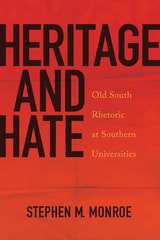
Heritage and Hate
Old South Rhetoric at Southern UniversitiesStephen M. Monroe
University of Alabama Press, 2021
How southern universities continue to wrestle with the words and symbols that embody and perpetuate Old South traditions
The US South is a rhetorical landscape that pulsates with division, a place where words and symbols rooted in a deeply problematic past litter the ground and contaminate the soil. Stephen M. Monroe’s provocative study focuses on predominantly white southern universities where Old South rhetoric still reverberates, where rebel flags cast a shadow over attempts at racial harmony, school cheers to reinforce racial barriers, and student yearbooks to create and protect an oppressive culture of exclusion. Across the region, in college towns like Oxford, Mississippi; Athens, Georgia; and Tuscaloosa, Alabama—communities remain locked in a difficult, recursive, and inherently rhetorical struggle that wrestles with this troubling legacy.
Words, images, and symbols are not merely passive artifacts of southern history, Monroe argues, but formative agents that influence human behavior and shape historical events. Drawing on research from many disciplines, including rhetoric, southern studies, history, sociology, and African American studies, Monroe develops the concept of confederate rhetoric: the collection of Old South words and symbols that have been and remain central to the identity conflicts of the South. He charts examples of such rhetoric at work in southern universities from Reconstruction to the present day.
Tracing the long life and legacy of Old South words and symbols at southern universities, this book provides close and nuanced analysis of the rhetorical conflicts that have resulted at places like the University of Mississippi and the University of Missouri. Some conflicts erupted during the civil rights movement, when the first African American students sought admission to all-white southern universities and colleges, and others are brewing now, as African Americans (and their progressive white peers) begin to cement genuine agency and voice in these communities. Tensions have been, and remain, high.
Ultimately, Monroe offers hope and optimism, contending that if words and symbols can be used to damage and divide, then words and symbols can also be used to heal and unify. Racist rhetoric can be replaced by antiracist rhetoric. The old South can become new. While resisting naïve or facile arguments, Heritage and Hate ultimately finds the promise of progress within the tremendous power of language.
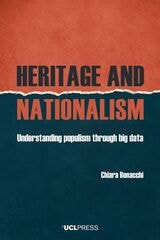
Heritage and Nationalism
Understanding Populism through Big DataChiara Bonacchi
University College London, 2021
How was the Roman Empire invoked in Brexit Britain and in the United States during Donald Trump’s presidency, and to what purpose? And why is it critical to answer these kinds of questions? Heritage and Nationalism explores how people’s perceptions and experiences of the ancient past shape political identities in the digital age. It examines the multiple ways in which politicians, parties, and private citizens mobilize aspects of the Iron Age, Roman, and Medieval past of Britain and Europe to include or exclude others based on culture, religion, class, race, and ethnicity.
The book uses quantitative and qualitative methods to investigate how premodern periods are leveraged to support or oppose populist-nationalist arguments as part of social media discussions concerning Brexit, the Italian Election of 2018, and the US-Mexican border debate in the United States. Analyzing millions of tweets and Facebook posts, comments, and replies, this book is the first to use big data to answer questions about public engagement with the past and identity politics. The findings and conclusions revise and reframe the meaning of populist nationalism today and help to build a shared basis for the democratic engagement of citizens in public life in the future. The book offers a fascinating and unmissable read for anyone interested in how the past and its contemporary legacy, or heritage, influence our political thinking and feeling in a time of hyper-connectivity.
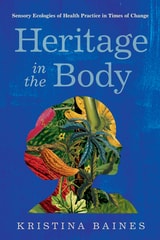
Heritage in the Body
Sensory Ecologies of Health Practice in Times of ChangeKristina Baines
University of Arizona Press, 2024
Employing an embodied ecological heritage (EEH) framework, Baines explores the links between health and heritage as a fluid series of ecological practices. Health and wellness are holistically defined and approached from a phenomenological perspective. Baines focuses on how sensory experiences change the body through practice and provides insights into community-driven alternatives as a means to maintain and support happy, healthy lives.
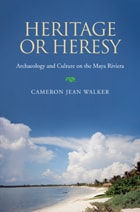
Heritage or Heresy
Archaeology and Culture on the Maya RivieraCameron Jean Walker
University of Alabama Press, 2008
How can we effectively interpret and present one culture to another without stereotypes or over-simplifications? What is the best way to present an authoritative version of a national heritage without also endangering ancient sites or being insensitive to the local customs, beliefs, and religious practices of the indigenous peoples?
This volume addresses the ongoing thrust in archaeology to take the next step after preserving the past: interpreting that past for the future. That future audience includes both local citizens and tourists who may have little background in archaeology, anthropology, or the history of the culture featured. Walker presents the key components of the anthropological study of tourism as a global phenomenon, with particular emphasis on the more prominent arguments for how and why tourism is a universal and meaningful human activity. The highly controversial topic of authenticity is examined, with special attention given to how "authentic" has been defined and how it relates to the ways in which archaeological sites, artifacts, and cultural traditions are presented--or not presented--to the visiting public. The ephemeral promise of “authenticity” drives the heritage tourism industry, which is a key consideration for the long term economy of the Maya Riviera and elsewhere. Through analysis of seven archaeological sites on the Yucatan peninsula that are open to heritage touring, Walker reveals the planned growth of the Maya Riviera since the early 1970s and examines the impact of international tourism on both ancient structures and the contemporary Maya people and culture.
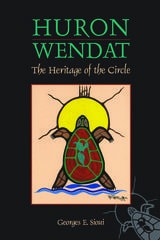
Huron Wendat
The Heritage of the CircleGeorges E. Sioui
Michigan State University Press, 1999
Wendat, or Wyandot, was the name that the five confederated nations of Wendake gave to Huronia, the Ontario territory described by the French in the 1600s. In this book, Georges Sioui, himself a Wendat, tells the history of his people by describing their social ideas and philosophy and their relevance to contemporary life. Sioui argues that for human beings there is only one way of looking at life on earth, and that is as a sacred circle of relationships among all beings. Sioui reviews the Wendats' Creation mythology and explains their origins, migrations, theology, ethics, philosophy, oral literature, and sociology, and their role in Amerindian geopolitics. He then examines archaeology and its role in bridging the gap created by negative perceptions. Finally, he describes Wendat society from an Amerindian viewpoint, concentrating on the period from 1615 to 1650 and drawing on traditional ethnographic documentation.
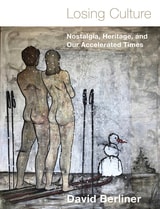
Losing Culture
Nostalgia, Heritage, and Our Accelerated TimesDavid Berliner
Rutgers University Press, 2020
Such sentiments get echoed around the world, from aging Trump supporters in West Virginia to young villagers in West Africa. But what is triggering this sense of cultural loss, and to what ends does this rhetoric get deployed?
To answer these questions, anthropologist David Berliner travels around the world, from Guinea-Conakry, where globalization affects the traditional patriarchal structure of cultural transmission, to Laos, where foreign UNESCO experts have become self-appointed saviors of the nation’s cultural heritage. He also embarks on a voyage of critical self-exploration, reflecting on how anthropologists handle their own sense of cultural alienation while becoming deeply embedded in other cultures. This leads into a larger examination of how and why we experience exonostalgia, a longing for vanished cultural heydays we never directly experienced.
Losing Culture provides a nuanced analysis of these phenomena, addressing why intergenerational cultural transmission is vital to humans, yet also considering how efforts to preserve disappearing cultures are sometimes misguided or even reactionary. Blending anthropological theory with vivid case studies, this book teaches us how to appreciate the multitudes of different ways we might understand loss, memory, transmission, and heritage.
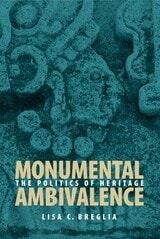
Monumental Ambivalence
The Politics of HeritageBy Lisa C. Breglia
University of Texas Press, 2006
From ancient Maya cities in Mexico and Central America to the Taj Mahal in India, cultural heritage sites around the world are being drawn into the wave of privatization that has already swept through such economic sectors as telecommunications, transportation, and utilities. As nation-states decide they can no longer afford to maintain cultural properties—or find it economically advantageous not to do so in the globalizing economy—private actors are stepping in to excavate, conserve, interpret, and represent archaeological and historical sites. But what are the ramifications when a multinational corporation, or even an indigenous village, owns a piece of national patrimony which holds cultural and perhaps sacred meaning for all the country's people, as well as for visitors from the rest of the world?
In this ambitious book, Lisa Breglia investigates "heritage" as an arena in which a variety of private and public actors compete for the right to benefit, economically and otherwise, from controlling cultural patrimony. She presents ethnographic case studies of two archaeological sites in the Yucatán Peninsula—Chichén Itzá and Chunchucmil and their surrounding modern communities—to demonstrate how indigenous landholders, foreign archaeologists, and the Mexican state use heritage properties to position themselves as legitimate "heirs" and beneficiaries of Mexican national patrimony. Breglia's research masterfully describes the "monumental ambivalence" that results when local residents, excavation laborers, site managers, and state agencies all enact their claims to cultural patrimony. Her findings make it clear that informal and partial privatizations—which go on quietly and continually—are as real a threat to a nation's heritage as the prospect of fast-food restaurants and shopping centers in the ruins of a sacred site.
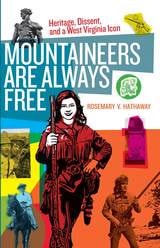
Mountaineers Are Always Free
Heritage, Dissent, and a West Virginia IconRosemary V. Hathaway
West Virginia University Press, 2020
The West Virginia University Mountaineer is not just a mascot: it is a symbol of West Virginia history and identity embraced throughout the state. In this deeply informed but accessible study, folklorist Rosemary Hathaway explores the figure’s early history as a backwoods trickster, its deployment in emerging mass media, and finally its long and sometimes conflicted career—beginning officially in 1937—as the symbol of West Virginia University.
Alternately a rabble-rouser and a romantic embodiment of the state’s history, the Mountaineer has been subject to ongoing reinterpretation while consistently conveying the value of independence. Hathaway’s account draws on multiple sources, including archival research, personal history, and interviews with former students who have portrayed the mascot, to explore the complex forces and tensions animating the Mountaineer figure. Often serving as a focus for white, masculinist, and Appalachian identities in particular, the Mountaineer that emerges from this study is something distinct from the hillbilly. Frontiersman and rebel both, the Mountaineer figure traditionally and energetically resists attempts (even those by the university) to tame or contain it.
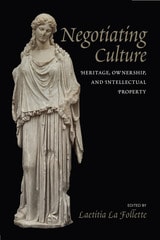
Negotiating Culture
Heritage, Ownership, and Intellectual PropertyLaetitia La Follette
University of Massachusetts Press, 2013
This provocative collection of essays—a series of case studies in cultural ownership by scholars from a range of fields—explores issues of cultural heritage and intellectual property in a variety of contexts, from contests over tangible artifacts as well as more abstract forms of culture such as language and oral traditions to current studies of DNA and genes that combine nature and culture, and even new, nonproprietary models for the sharing of digital technologies. Each chapter sets the debate in its historical and disciplinary context and suggests how the approaches to these issues are changing or should change.
One of the most innovative aspects of the volume is the way each author recognizes the social dimensions of group ownership and demonstrates the need for negotiation and new models. The collection as a whole thus challenges the reader to reevaluate traditional ways of thinking about cultural ownership and to examine the broader social contexts within which negotiation over the ownership of culture is taking place.
In addition to Laetitia La Follette, contributors include David Bollier, Stephen Clingman, Susan DiGiacomo, Oriol Pi-Sunyer, Margaret Speas, Banu Subramaniam, Joe Watkins, and H. Martin Wobst.
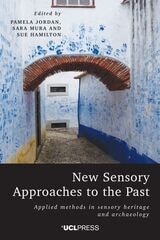
New Sensory Approaches to the Past
Applied Methods in Sensory Heritage and ArchaeologyEdited by Pamela Jordan, Sara Mura, and Sue Hamilton
University College London, 2025
In recent years, archaeologists and other researchers dealing with heritage sites have increasingly emphasized the fact that people in the past interacted with their natural and built environment through all of their senses. In turn, they have come to acknowledge the limits of research methods that rely solely on visual analysis. Presenting studies of historical environments from multiple fields, from archaeology to acoustics, through the lens of the senses, New Sensory Approaches to the Past showcases the latest developments in sensory research through real-world scenarios of human-environment connections. Interdisciplinary examples of diverse sensory in-situ studies will enable readers to replicate and enhance their own investigations. Further, the volume pushes beyond historically Western frameworks of sensory perception towards a more global understanding of the senses.

Pluralising Pasts
Heritage, Identity and Place in Multicultural SocietiesBrian Graham, G. J. Ashworth, and J. E. Tunbridge
Pluto Press, 2007

Prairie Spirit
Perspectives on the Heritage of the United Church of Canada in the WestDennis L. Butcher
University of Manitoba Press, 1985

Quebec and the Heritage of Franco-America
Edited by Iwan Morgan and Philip D. Davies
University of London Press, 2010
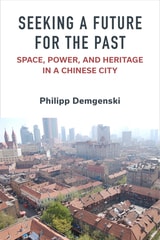
Seeking a Future for the Past
Space, Power, and Heritage in a Chinese CityPhilipp Demgenski
University of Michigan Press, 2024
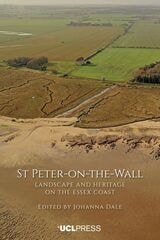
St Peter-On-The-Wall
Landscape and Heritage on the Essex CoastEdited by Johanna Dale
University College London, 2023
The Chapel of St Peter-on-the-Wall, built on the ruins of a Roman fort, dates from the mid-seventh century and is one of the oldest largely intact churches in England. It stands in splendid isolation on the shoreline at the mouth of the Blackwater Estuary in Essex, where the land meets and interpenetrates with the sea and the sky. This book brings together contributors from across the arts, humanities, and social sciences to uncover the premodern contexts and modern resonances of this medieval building and its landscape setting. In analyzing the significance of the chapel and surrounding landscape over more than a thousand years, this collection additionally contributes to wider debates about the relationship between space and place, and particularly the interfaces between both medieval and modern cultures and also heritage and the natural environment.
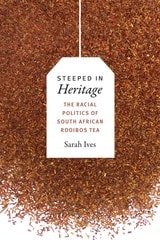
Steeped in Heritage
The Racial Politics of South African Rooibos TeaSarah Ives
Duke University Press, 2017

The Big Jones Cookbook
Recipes for Savoring the Heritage of Regional Southern CookingPaul Fehribach
University of Chicago Press, 2015
You expect to hear about restaurant kitchens in Charleston, New Orleans, or Memphis perfecting plates of the finest southern cuisine—from hearty red beans and rice to stewed okra to crispy fried chicken. But who would guess that one of the most innovative chefs cooking heirloom regional southern food is based not in the heart of biscuit country, but in the grain-fed Midwest—in Chicago, no less? Since 2008, chef Paul Fehribach has been introducing Chicagoans to the delectable pleasures of Lowcountry cuisine, while his restaurant Big Jones has become a home away from home for the city’s southern diaspora. From its inception, Big Jones has focused on cooking with local and sustainably grown heirloom crops and heritage livestock, reinvigorating southern cooking through meticulous technique and the unique perspective of its Midwest location. And with The Big Jones Cookbook, Fehribach brings the rich stories and traditions of regional southern food to kitchens everywhere.
Fehribach interweaves personal experience, historical knowledge, and culinary creativity, all while offering tried-and-true takes on everything from Reezy-Peezy to Gumbo Ya-Ya, Chicken and Dumplings, and Crispy Catfish. Fehribach’s dishes reflect his careful attention to historical and culinary detail, and many recipes are accompanied by insights about their origins. In addition to the regional chapters, the cookbook features sections on breads, from sweet potato biscuits to spoonbread; pantry put-ups like bread and butter pickles and chow-chow; cocktails, such as the sazerac; desserts, including Sea Island benne cake; as well as an extensive section on snout-to-tail cooking, including homemade Andouille and pickled pigs’ feet.
Proof that you need not possess a thick southern drawl to appreciate the comfort of creamy grits and the skill of perfectly fried green tomatoes, The Big Jones Cookbook will be something to savor regardless of where you set your table.
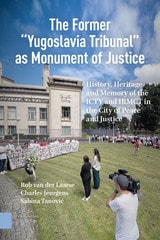
The Former “Yugoslavia Tribunal” as Monument of Justice
History, Heritage and Memory of the ICTY and IRMCT in the City of Peace and JusticeRob van der Laarse
Amsterdam University Press, 2025

The Heritage
A Daughter's Memoir Of Louis BromfieldEllen Bromfield Geld
Ohio University Press, 1999
This lively, outspoken, and affectionate memoir preserves all things Louis Bromfield fought for or against in a life marked by surging vitality and gusto. He came from an Ohio family whose roots were in the land before the land was lost. He had his father's love of the land, and from his willful mother a hunger to know the world. From the New York City of theaters, concerts, parties, and novels, and a life in France that his success allowed, he finally returned to Ohio and established a new order for his family and friends, and for his followers, a new orbit into which they were drawn.
Ellen Bromfield Geld wrote a memoir of the man who was Louis Bromfield, father and friend, tyrant and “Boss,” alive always to whatever was worth responding to in people and in places, yet complex and lonely as a writer must essentially be to work at his craft. Now revived in paperback thirty-five years after its first publication, The Heritage remains a moving tribute and the recreation of a remarkable human being.
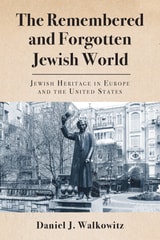
The Remembered and Forgotten Jewish World
Jewish Heritage in Europe and the United StatesDaniel J. Walkowitz
Rutgers University Press, 2018
The Remembered and Forgotten Jewish World investigates the politics of heritage tourism and collective memory. In an account that is part travelogue, part social history, and part family saga, acclaimed historian Daniel J. Walkowitz visits key Jewish museums and heritage sites from Berlin to Belgrade, from Krakow to Kiev, and from Warsaw to New York, to discover which stories of the Jewish experience are told and which are silenced. As he travels to thirteen different locations, participates in tours, displays, and public programs, and gleans insight from local historians, he juxtaposes the historical record with the stories presented in heritage tourism. What he finds raises provocative questions about the heritage tourism industry and its role in determining how we perceive Jewish history and identity. This book offers a unique perspective on the importance of collective memory and the dangers of collective forgetting.

The Royal Observatory, Greenwich, 1881–1939
Astronomy, Astronomers and Heritage in a Changing WorldLee T. Macdonald
University College London, 2026
The first detailed history of the Royal Observatory at Greenwich covering the period after the retirement of George Airy, seventh Astronomer Royal, in 1881.
This book charts an under-researched period in the long history of the Royal Observatory at Greenwich. It covers both the scientific and social-political history of the Royal Observatory, focusing on its significance within the history of astronomy and UK history more generally. Using a wealth of archival material—much of which was previously unpublished—Lee T. Macdonald's narrative brings the day-to-day operations of the Observatory to life and reveals how its mission in positional astronomy, combined with its cutting-edge research in photographic mapping and the study of solar eclipses, continues to expand the frontiers of astronomical research.
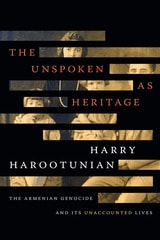
The Unspoken as Heritage
The Armenian Genocide and Its Unaccounted LivesHarry Harootunian
Duke University Press, 2019
Urban Space as Heritage in Late Colonial Cuba
Classicism and Dissonance on the Plaza de Armas of Havana, 1754-1828By Paul Niell
University of Texas Press, 2015
According to national legend, Havana, Cuba, was founded under the shade of a ceiba tree whose branches sheltered the island’s first Catholic mass and meeting of the town council (cabildo) in 1519. The founding site was first memorialized in 1754 by the erection of a baroque monument in Havana’s central Plaza de Armas, which was reconfigured in 1828 by the addition of a neoclassical work, El Templete. Viewing the transformation of the Plaza de Armas from the new perspective of heritage studies, this book investigates how late colonial Cuban society narrated Havana’s founding to valorize Spanish imperial power and used the monuments to underpin a local sense of place and cultural authenticity, civic achievement, and social order.
Paul Niell analyzes how Cubans produced heritage at the site of the symbolic ceiba tree by endowing the collective urban space of the plaza with a cultural authority that used the past to validate various place identities in the present. Niell’s close examination of the extant forms of the 1754 and 1828 civic monuments, which include academic history paintings, neoclassical architecture, and idealized sculpture in tandem with period documents and printed texts, reveals a “dissonance of heritage”—in other words, a lack of agreement as to the works’ significance and use. He considers the implications of this dissonance with respect to a wide array of interests in late colonial Havana, showing how heritage as a dominant cultural discourse was used to manage and even disinherit certain sectors of the colonial population.