Results by title
6 books match the query 'Herzfeld, Michael'
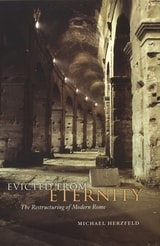
Evicted from Eternity
The Restructuring of Modern RomeMichael Herzfeld
University of Chicago Press, 2009
Modern Rome is a city rife with contradictions. Once the seat of ancient glory, it is now often the object of national contempt. It plays a significant part on the world stage, but the concerns of its residents are often deeply parochial. And while they live in the seat of a world religion, Romans can be vehemently anticlerical. These tensions between the past and the present, the global and the local, make Rome fertile ground to study urban social life, the construction of the past, the role of religion in daily life, and how a capital city relates to the rest of the nation.
Michael Herzfeld focuses on Rome’s historic Monti district and the wrenching dislocation caused by rapid economical, political, and social change. Evicted from Eternity tells the story of the gentrification of Monti—once the architecturally stunning home of a community of artisans and shopkeepers now displaced by an invasion of rapacious real estate speculators, corrupt officials, dithering politicians, deceptive clerics, and shady thugs. As Herzfeld picks apart the messy story of Monti’s transformation, he ranges widely over many aspects of life there and in the rest of the city, richly depicting the uniquely local landscape of globalization in Rome.

Portrait of a Greek Imagination
An Ethnographic Biography of Andreas NenedakisMichael Herzfeld
University of Chicago Press, 1997
Herzfeld explores how personal vision intersects with national cultures by examining the Greek author's novels and recollections as historical accounts. Bringing together the methods of the novelist and the anthropologist in their common concern with both social and lived experience, Herzfeld shows how different perspectives shape the historical record. Nenedakis has endured persecution, exile, imprisonment, and torture under Greece's military dictatorship, and his novels—excerpted here in English for the first time—offer an individual version of historical events. As one of his characters ask, "For was not his life, and are not the lives of all of us, a novel?"
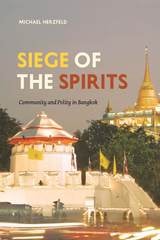
Siege of the Spirits
Community and Polity in BangkokMichael Herzfeld
University of Chicago Press, 2016
Herzfeld argues that even though the residents of Pom Mahakan have lost every legal battle the city government has dragged them into, they have won every public relations contest, highlighting their struggle as one against bureaucrats who do not respect the age-old values of Thai/Siamese social and cultural order. Such values include compassion for the poor and an understanding of urban space as deeply embedded in social and ritual relations. In a gripping account of their standoff, Herzfeld—who simultaneously argues for the importance of activism in scholarship—traces the agile political tactics and styles of the community’s leadership, using their struggle to illuminate the larger difficulties, tensions, and unresolved debates that continue to roil Thai society to this day.
Subversive Archaism
Troubling Traditionalists and the Politics of National HeritageMichael Herzfeld
Duke University Press, 2021
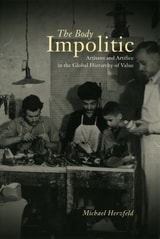
The Body Impolitic
Artisans and Artifice in the Global Hierarchy of ValueMichael Herzfeld
University of Chicago Press, 2003
Michael Herzfeld takes us inside a rich variety of small-town Cretan artisans' workshops to show how apprentices are systematically thwarted into learning by stealth and guile. This harsh training reinforces a stereotype of artisans as rude and uncultured. Moreover, the same stereotypes that marginalize artisans locally also operate to marginalize Cretans within the Greek nation and Greece itself within the international community. What Herzfeld identifies as "the global hierarchy of value" thus frames the nation's ancient monuments and traditional handicrafts as evidence of incurable "backwardness."
Herzfeld's sensitive observations offer an intimately grounded way of understanding the effects of globalization and of one of its most visible offshoots, the heritage industry, on the lives of ordinary people in many parts of the world today.
The Social Production of Indifference
Michael Herzfeld
University of Chicago Press, 1993
"Herzfeld's book is extremely ambitious and will be of interest to any anthropologist concerned with the study of bureaucracy, organizational and institutional control, symbols and their power, and social conflict. . . . Thoughtful and challenging."—Helen B. Schwartzman, American Ethnologist