Results by title
7 books match the query 'Hesford, Wendy S.'
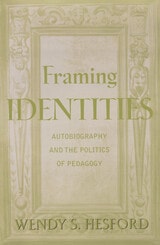
Framing Identities
Autobiography and the Politics of PedagogyWendy S. Hesford
University of Minnesota Press, 1999
A trenchant examination of the political dynamics of autobiography in education.
How do historically marginalized groups expose the partiality and presumptions of educational institutions through autobiographical acts? How are the stories we tell used to justify resistance to change or institutional complacency? These are the questions Wendy S. Hesford asks as she considers the uses of autobiography in educational settings. This book demonstrates how autobiographical acts-oral, written, performative, and visual-play out in vexed and contradictory ways and how in the academy they can become sites of cultural struggle over multicultural education, sexual harassment, institutional racism, hate speech, student activism, and commemorative practices.
Within the context of Oberlin, a small liberal arts college in Ohio, and beginning with a speak-out organized by Asian American students in 1995, this book looks at the uses of autobiographical practices in empowering groups traditionally marginalized in academic settings. Investigating the process of self-representation and the social, spatial, and discursive frames within which academic bodies and identities are constituted, Framing Identities explores the use of autobiographical acts in terms of power, influence, risks involved, and effectiveness. Hesford does not endorse autobiography as an unequivocal source of empowerment, however. Instead, she illustrates how autobiographical practices in the academy can mobilize competing and often irreconcilable interests. Hesford argues that by integrating self-reflection into cultural, rhetorical, and material analyses-and encouraging students to do the same-teachers not only will largely justify attention to the personal in the classroom, they will help their communities move beyond a naive identity politics. Framing Identities provides a model for teacher-researchers across the disciplines (education, English, composition, cultural studies, women’s studies, to name a few) to investigate the contradictory uses and consequences of autobiography at their own institutions, and to carve out new pedagogical spaces from which they and their students can emerge as social, political, and intellectual subjects.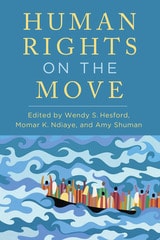
Human Rights on the Move
Edited by Wendy S. Hesford, Momar K. Ndiaye, and Amy Shuman
The Ohio State University Press, 2024
Contributing artists, activists, and scholars expose the fundamental paradox of human rights (namely that nation-states are violators and guarantors of rights) while also showing how people facing violence and persecution move with the hope of more livable and equitable futures. The assembled scholarly essays, interviews, and creative pieces demonstrate the importance of a more relational and contextual understanding of human rights—one that can destabilize current definitions and open space for new formulations.
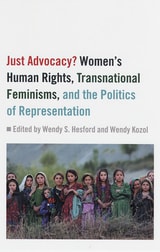
Just Advocacy?
Women's Human Rights, Transnational Feminism, and the Politics of RepresentationHesford, Wendy S
Rutgers University Press, 2005
In humanitarian and political debates about the topic, women and children are frequently considered first. Since the 1990s, human rights have become the most legitimate and legitimizing juridical and cultural claim made on a woman's behalf. But what are the consequences of equating women's rights with human rights? As the eleven essays in this volume show, the impact is often contradictory.
Bringing together some of the most respected scholars in the field, including Inderpal Grewal, Leela Fernandes, Leigh Gilmore, Susan Koshy, Patrice McDermott, and Sidonie Smith, Just Advocacy? sheds light on the often overlooked ways that women and children are further subjugated when political or humanitarian groups represent them solely as victims and portray the individuals that are helping them as paternal saviors.
Drawn from a variety of disciplinary perspectives in the humanities, arts, and social sciences, Just Advocacy? promises to advance a more nuanced and politically responsible understanding of human rights for both scholars and activists.
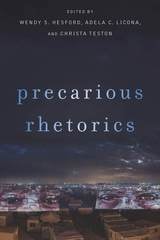
Precarious Rhetorics
Edited by Wendy S. Hesford, Adela C. Licona, and Christa Teston
The Ohio State University Press, 2018
This collection features cross-disciplinary contributions from leading scholars, including the editors of the volume as well as James J. Brown Jr., Gale Coskan-Johnson, Ronald Greene, Lavinia Hirsu, Arabella Lyon, Louis Maraj, Sara McKinnon, Alexandra Schultheis Moore, Kimberlee Pérez, Margaret Price, Amy Shuman, Kristin Swenson, Becca Tarsa, and Belinda Walzer. Chapters emphasize a materialist-rhetorical approach while also drawing on feminist studies, women of color feminisms, affect studies, critical disability studies, critical race and ethnic studies, medical humanities, sexuality studies, queer migration studies, and human rights and humanitarian studies. While theoretically rich, this volume intentionally features chapters that explore precarious rhetorics as they operate in practice—whether in borderlands, politics, public policy, or the quotidian spaces of human activity, such as school, work, social media, and medicine.
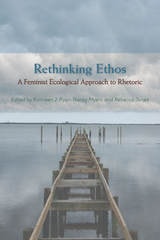
Rethinking Ethos
A Feminist Ecological Approach to RhetoricEdited by Kathleen J. Ryan, Nancy Myers, and Rebecca Jones
Southern Illinois University Press, 2016
Editors Kathleen J. Ryan, Nancy Myers, and Rebecca Jones identify three rhetorical maneuvers that characterize ethos in the feminist ecological imaginary: ethe as interruption/interrupting, ethe as advocacy/advocating, and ethe as relation/relating. Each section of the book explores one of these rhetorical maneuvers. An afterword gathers contributors’ thoughts on the collection’s potential impact and influence, possibilities for future scholarship, and the future of feminist rhetorical studies.
With its rich mix of historical examples and contemporary case studies, Rethinking Ethos offers a range of new perspectives, including queer theory, transnational approaches, radical feminism, Chicana feminism, and indigenous points of view, from which to consider a feminist approach to ethos.
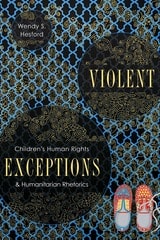
Violent Exceptions
Children's Human Rights and Humanitarian RhetoricsWendy S. Hesford
The Ohio State University Press, 2021

Violent Exceptions
Children's Human Rights and Humanitarian RhetoricsWendy S. Hesford
The Ohio State University Press, 2021