Results by title
2 books match the query 'Heterology'
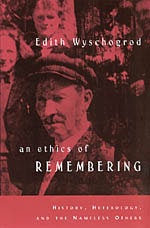
An Ethics of Remembering
History, Heterology, and the Nameless OthersEdith Wyschogrod
University of Chicago Press, 1998
What are the ethical responsibilities of the historian in an age of mass murder and hyperreality? Can one be postmodern and still write history? For whom should history be written?
Edith Wyschogrod animates such questions through the passionate figure of the "heterological historian." Realizing the philosophical impossibility of ever recovering "what really happened," this historian nevertheless acknowledges a moral imperative to speak for those who have been rendered voiceless, to give countenance to those who have become faceless, and hope to the desolate. Wyschogrod also weighs the impact of modern archival methods, such as photographs, film, and the Internet, which bring with them new constraints on the writing of history and which mandate a new vision of community. Drawing on the works of continental philosophers, historiographers, cognitive scientists, and filmmakers, Wyschogrod creates a powerful new framework for the understanding of history and the ethical duties of the historian.
Edith Wyschogrod animates such questions through the passionate figure of the "heterological historian." Realizing the philosophical impossibility of ever recovering "what really happened," this historian nevertheless acknowledges a moral imperative to speak for those who have been rendered voiceless, to give countenance to those who have become faceless, and hope to the desolate. Wyschogrod also weighs the impact of modern archival methods, such as photographs, film, and the Internet, which bring with them new constraints on the writing of history and which mandate a new vision of community. Drawing on the works of continental philosophers, historiographers, cognitive scientists, and filmmakers, Wyschogrod creates a powerful new framework for the understanding of history and the ethical duties of the historian.
[more]

Heterology and the Postmodern
Bataille, Baudrillard, and LyotardJulian Pefanis
Duke University Press, 1991
In Heterology and the Postmodern, Julian Pefanis presents a new view of the history of poststructuralism (heterology) and the origins of postmodernism by analyzing three important French theorists, Georges Bataille, Jean Baudrillard, and Jean-François Lyotard.
Beginning with the introduction of Hegel in French postmodernist thought—largely but not exclusively through the thought of Georges Bataille—Pefanis argues that the core problematics of postmodern aesthetics—history, exchange, representation, and writing—are related to Bataille’s reconceptualization of the Hegelian framework. Pefanis explores how Bataille was influenced by Hegel, Marcel Mauss, Freud, and Nietzsche, and traces the effects of this influence on the analyses and critiques of later postmodernists, most notably Lyotard and Baudrillard. Finally, employing these postmodernists along with Freud and Jacques Lacan, Pefanis discusses discourse on postmodernism and its relation to Freud’s concept of the death drive.
This intellectual history makes valuable contributions to the debates over what the “postmodern” may mean for intellectual and political activity.
[more]